
An NCLEX pass rate is the share of a specified group of test takers who passed during the reporting period. It can help applicants examine one outcome of a prelicensure program, but it does not describe everyone who originally enrolled. Students who did not reach graduation or did not take the examination may be outside the reported denominator.
NCSBN's pass-rate resources distinguish candidate groups such as first-time test takers and repeaters, domestically and internationally educated candidates, and examination year. Those distinctions should be preserved whenever a program's result is compared with another result.
Compare the same measure
First confirm whether the number concerns NCLEX-RN or NCLEX-PN. Then check whether it includes first attempts only, repeat attempts, or a different defined group. Record the calendar or reporting year and the number tested.
A combined pass rate and a first-time pass rate answer different questions. A national figure for one candidate group is not automatically the right benchmark for another. Likewise, a multi-campus school should explain whether its published result applies to the campus or track being considered.
An illustrative calculation
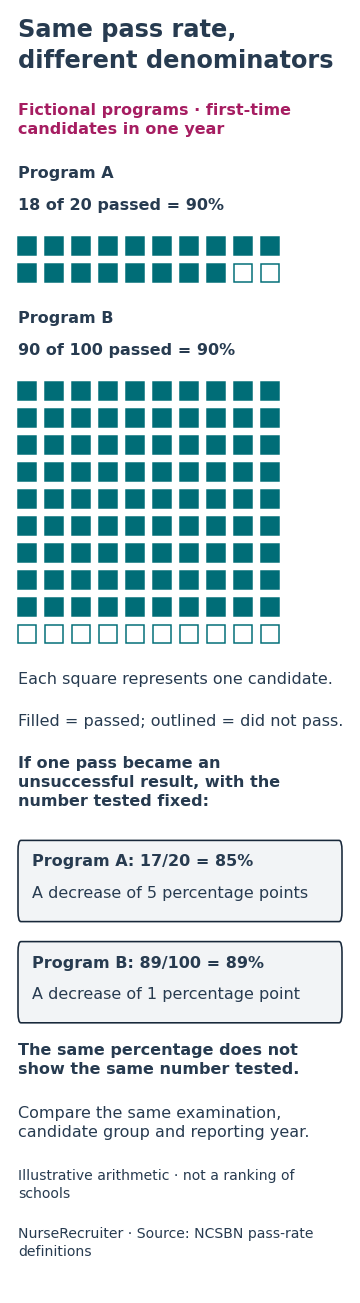
These fictional counts show why a pass rate needs its denominator. One changed result moves the smaller group by five percentage points and the larger group by one point; it does not establish which school is better.
Suppose a fictional program reports that 18 of 20 first-time candidates passed during one year. Its first-time rate is 90%. Another program reports 90 of 100, also 90%. If one passing result became an unsuccessful result in each program, with the number tested unchanged, the rates would fall to 85% and 89%—drops of five and one percentage points.
The example shows why counts matter. It does not establish that either program is better or worse. Several comparable years can provide more context than a single percentage.
Keep graduation and examination outcomes separate
Ask how many students entered the nursing sequence and how many graduated, in addition to asking about NCLEX results. A very high examination pass rate among a small graduating group does not by itself show a high likelihood of completing the program.
For illustration, if a school advertises a perfect pass rate, request the number of candidates and period covered before drawing a conclusion. Do not assume that a result for one small graduating class describes every student admitted over several years.
Check the regulator and accreditor
ACEN's Standard 5 addresses examination pass rates separately from program completion. Under Criterion 5.3, either the latest annual rate or the three-year mean must satisfy at least one of three alternatives: 80% or higher among first-time candidates; 80% or higher among first-time candidates and repeaters together; or a rate at least equal to the relevant national or territorial average for that program type.
Those are ACEN accreditation criteria, not a universal state-board rule or a ranking of schools. The applicable nursing regulator and accreditor have different responsibilities and may use different criteria.
Check the official program status directly rather than inferring approval or accreditation from a percentage. When data sources disagree, inspect their dates and definitions. NCSBN notes that live dashboards and static publications can differ because of data reconciliation.
Pass rates are useful evidence when the population, period, and denominator travel with the number. They should be considered alongside curriculum, clinical learning arrangements, student support, and completion outcomes, rather than used as a solitary ranking.
Related
Nursing Program Graduation Rates · NCLEX Test Plans.
Sources
- NCSBN: NCLEX Pass Rates (accessed 2026-11-11).
- ACEN: Standard 5, Outcomes (accessed 2026-11-11).