
A post-master's nursing certificate provides additional preparation for someone who already holds a relevant graduate degree. The title may also appear as a post-graduate certificate. Applicants need to identify exactly what role or area the program prepares them for; the certificate name alone does not establish eligibility for a particular professional credential.
An academic certificate, national certification, and authorization to practice are distinct. Completing a program can be part of a certification pathway, but the certifying organization and nursing regulator make their own decisions under their current requirements.
Begin with the intended role
Write down the desired role and population focus, then identify the associated certification requirements and the jurisdiction where practice is intended. Ask the school to explain how its certificate curriculum meets those requirements for a person with the applicant's prior preparation.
As a specific example, ANCC's Family Nurse Practitioner eligibility page recognizes an appropriate FNP master's degree, post-graduate certificate, or DNP route. This does not mean that any graduate nursing certificate qualifies someone for the FNP examination. The program and applicant must meet the credential's stated requirements.
Request an individual gap analysis
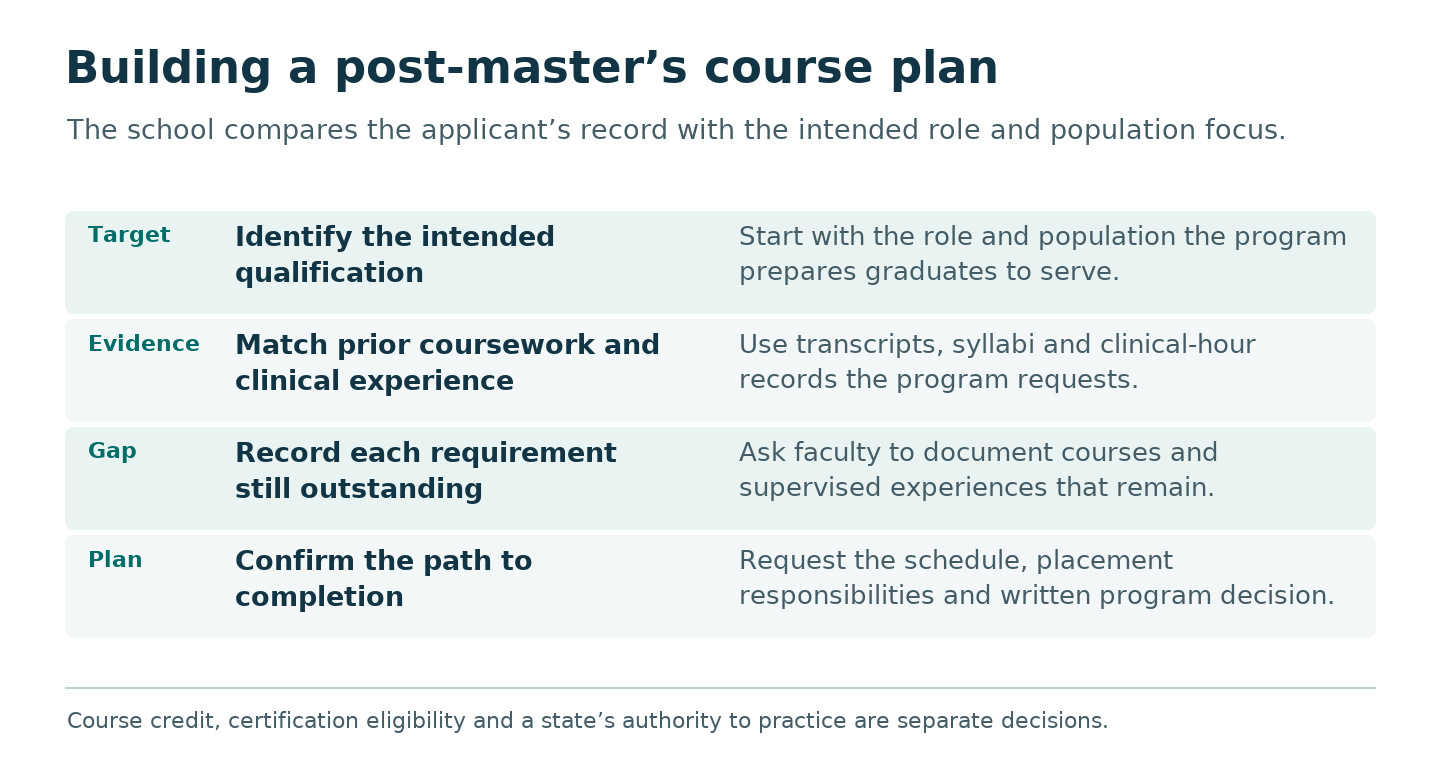
ANCC's certification FAQs advise post-graduate certificate applicants to ask faculty to compare prior coursework and clinical hours with what the new program requires. That review should identify what can be accepted and what additional preparation is needed.
For illustration, a fictional nurse with a graduate degree in nursing education applies to an APRN certificate program. The school should evaluate the actual transcript and relevant course materials rather than assume the previous degree contains all of the advanced practice content. Another applicant with different prior preparation may receive a different plan.
The example illustrates individualized evaluation; it is not an eligibility decision or a prediction of how many courses will be waived.
Check accreditation at the correct level
ANCC's faculty guidance states that, beginning January 1, 2026, post-graduate certificate applicants need the appropriate PGC APRN program accreditation, active at graduation. Accreditation of a parallel master's or DNP program is not accepted as a substitute for that certificate-program accreditation.
This is an ANCC eligibility rule and should be identified as such. Applicants pursuing another credential should check that issuer's current rules. Ask for the exact program listing and verify it with the accreditor, rather than relying only on a university-wide accreditation statement.
Review the practical plan
Obtain the required courses, clinical experiences, expected schedule, placement responsibilities, and total costs in writing. Ask what happens if a proposed placement is unavailable. Keep documentation of any accepted prior coursework and clinical hours so that the final record matches the approved plan.
Before graduation and certification application, recheck the issuer's documentation and timing requirements. A school's admission decision does not guarantee certification, and certification alone should not be treated as permission to practice a new role in every jurisdiction.
Related
Transfer Credits in Nursing Education · Clinical Placement Agreements.
Sources
- ANCC: Family Nurse Practitioner Certification Eligibility (accessed 2026-09-17).
- ANCC: Certification FAQs, Post-Graduate Certificates (accessed 2026-09-17).
- ANCC: Information for APRN Faculty (accessed 2026-09-17).
- NCSBN: APRN Consensus Model (accessed 2026-09-17).