
A clinical placement agreement records a school's arrangement with a clinical organization for student learning. Depending on the organizations involved, it may be called an affiliation agreement or another similar name. Its purpose is to make the approved relationship and responsibilities explicit before the placement proceeds.
A willing preceptor is an important part of many placements, but personal agreement alone may not complete the institutional process. The school and site need to confirm what approvals, documents, and onboarding steps apply to the specific program and student.
Separate the layers of approval
A practical way to review readiness is to distinguish the institutional agreement, approval of the particular placement, approval of the preceptor where required, and completion of student onboarding. These are suggested categories for organizing questions; the organizations may use different terminology.
Texas Health Resources provides a concrete example. Its published process requires an affiliation agreement for applicable experiences at its wholly owned entities, asks the preceptor to check that the specified program is covered, and requires leadership approval and student onboarding. These are that system's requirements, not a statement of national law.
Questions to resolve before the start date
Ask the school's placement coordinator and the site's designated contact to confirm the following:
- Does an active agreement cover this school, program, site, and proposed experience?
- Who approves the learner's activities and supervision arrangements?
- What onboarding must be completed, and who confirms completion?
- Who should be contacted about an absence, safety concern, or placement interruption?
- How will performance be evaluated and communicated to faculty?
Use the organizations' approved process for legal terms, insurance questions, privacy obligations, and any required clearances. This article is a guide to identifying issues; it does not interpret an individual contract or prescribe universal terms.
An illustrative delay
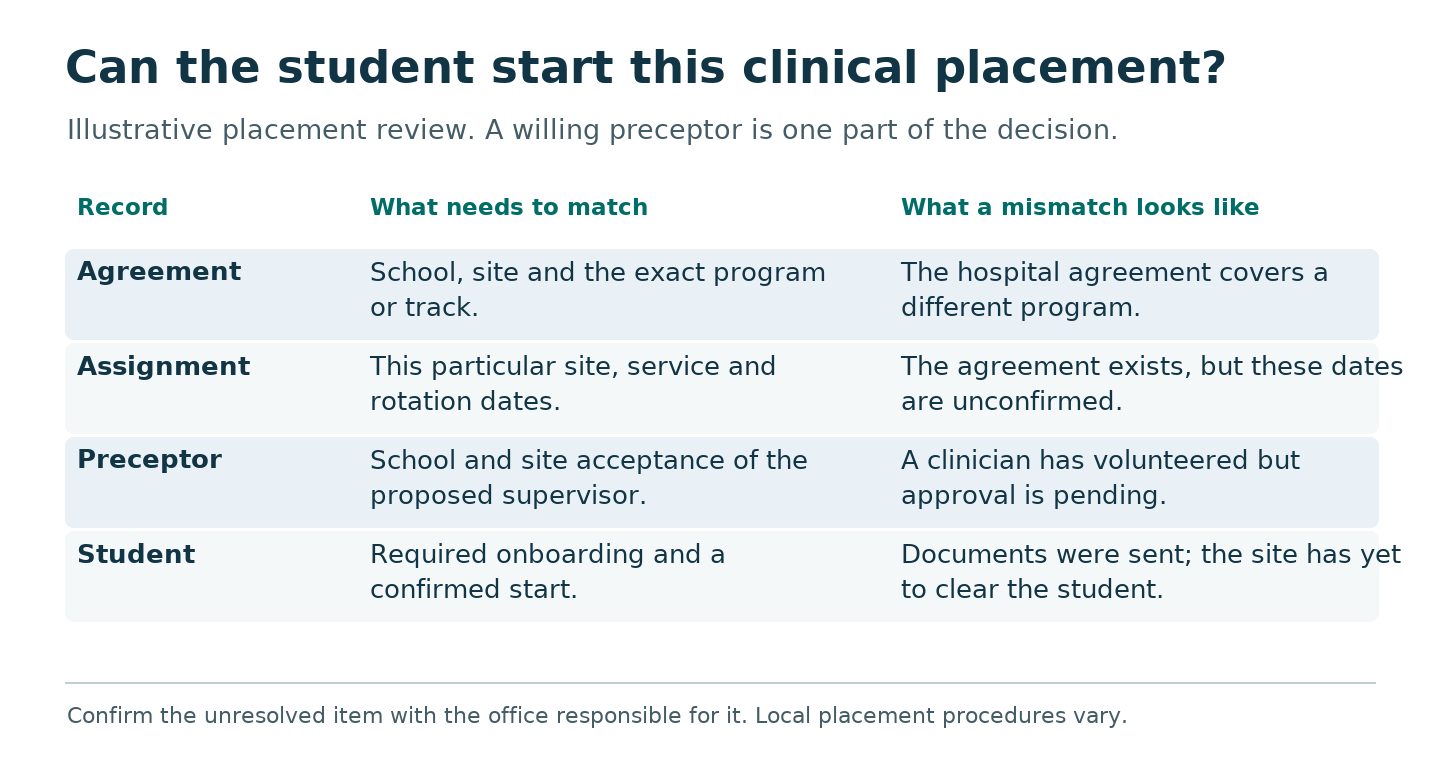
A fictional student finds a practitioner who agrees to supervise a placement. The school later learns that the site's agreement covers a different program but not the student's program. The preceptor's willingness does not resolve that mismatch. The responsible offices need to determine whether an amendment or another arrangement is possible before the experience begins.
The lesson is to check the exact program and site early. A statement that a hospital “partners with the university” may not answer whether this particular placement is authorized.
Keep a clear readiness record
A useful record lists each required step, the responsible office, its status, and the confirmation date. Distinguish submitted paperwork from approved paperwork. Ask who provides the final instruction that the student may begin; do not infer permission merely because no one has objected.
If the arrangement changes, return to the designated coordinator. A different site, preceptor, or activity may need review under the applicable process. Confirm how interrupted hours or experiences will be handled by the program.
For applicants comparing schools, ask how the school establishes and maintains placements and what support is available when a placement falls through. The existing clinical placements overview addresses the broader educational context.
Related
Nursing Preceptorship · Post-Master’s Nursing Certificates.
Sources
- Texas Health Resources: Academic Partnerships (accessed 2026-09-17).