
A nursing license record can contain several labels at once: active, single-state, probation, an expiration date and a link to a board order. Those labels answer different questions. To decide what work is authorized, read them together and use the issuing board's definitions.
There is no substitute for the applicable jurisdiction's terminology. The examples below use the California Board of Registered Nursing's published explanations to show how easily similar-looking terms can be misread.
Administrative status and practice authority
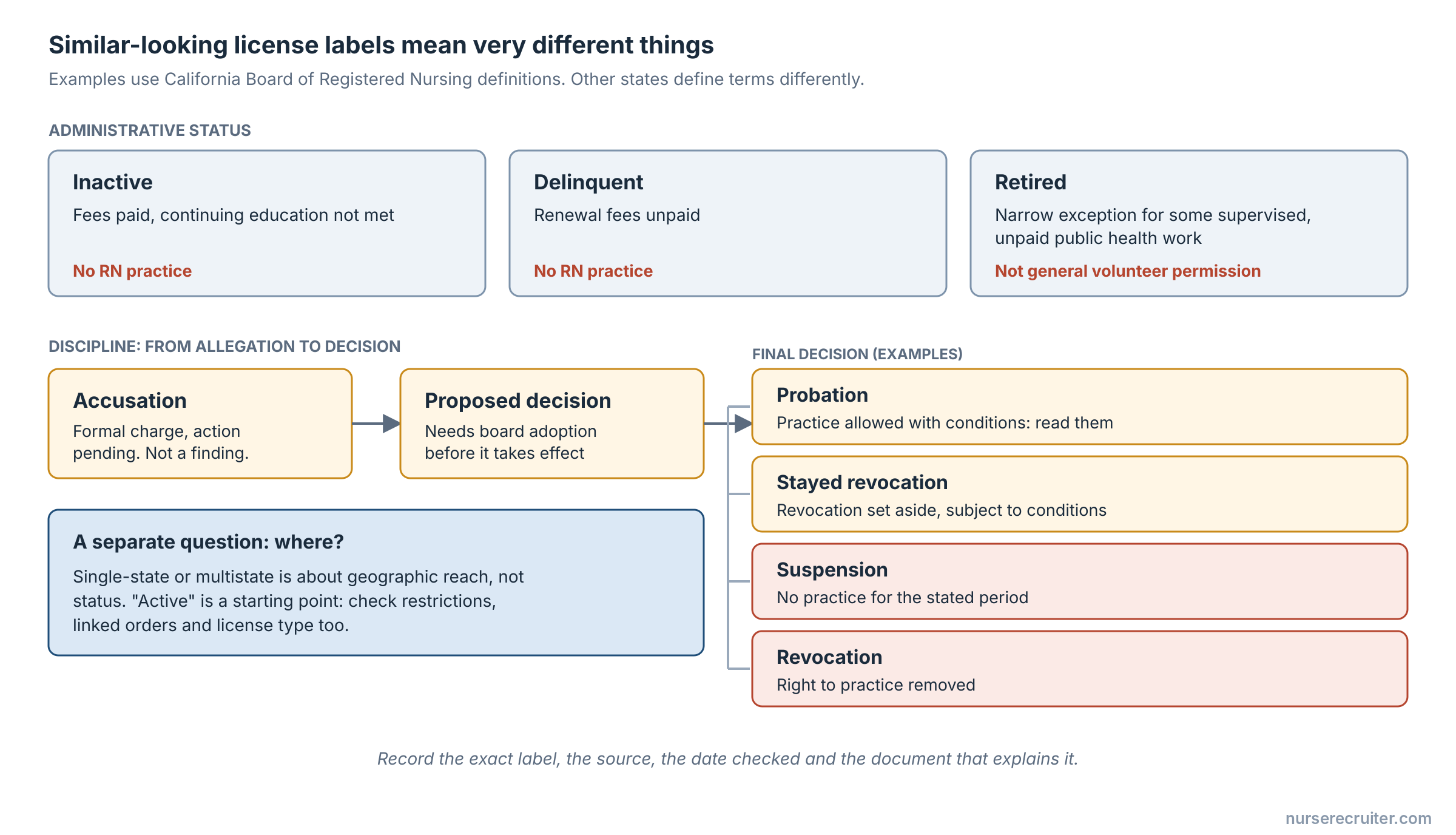
Active is a starting point for checking authorization, not a reason to ignore other information on the record. Look for restrictions, linked decisions and the license type as well.
Inactive and delinquent have distinct meanings in California. The board describes an inactive license as one for which renewal fees have been paid but the continuing education requirement has not been met. A delinquent license has unpaid renewal fees. Neither permits California RN practice.
An inactive license does not, by itself, establish that a nurse was disciplined. California also explains that a lapse does not negatively affect the nurse's record if the nurse is not practicing. Avoid turning an administrative label into a judgment about the person's conduct.
Retired also needs its own rules. California allows certain supervised, unpaid nursing services in specified public health programs under its retired-license provisions. That narrow exception should not be generalized into permission to take any volunteer nursing role.
Allegations, decisions and restrictions
An accusation, in California's terminology, is a formal charge with disciplinary action pending. It is not the same document as a final finding.
A proposed decision still requires board adoption before it can take effect. Look for the final action and its effective date before describing the legal result.
Probation can allow practice subject to restrictions. Read the actual conditions rather than assuming either unrestricted practice or a complete ban.
A stayed revocation means the revocation has been set aside subject to conditions. California distinguishes that from an effective revocation, which removes the right to practice. Suspension directs the nurse not to practice for the specified or indefinite period.
These distinctions matter to both patient protection and fair treatment of applicants. A summary that drops the word “stayed,” or calls an allegation a finding, can change the meaning of the record.
Geographic reach is another question
A single-state license and a multistate license describe different geographical authority under the Nurse Licensure Compact. That distinction is separate from administrative status or restrictions.
For a job outside the issuing state, confirm the applicable authority rather than treating “active” as a complete answer. For advanced practice, verify the additional credential needed for the proposed role.
Write a useful verification note
Record the exact label, source, date checked and document that resolves its meaning. A useful note says, for example, that a specified board order imposes a particular assignment restriction. It does not merely say “license has issues.”
When the labels and documents do not agree, ask the board to clarify the current status. The process for making and documenting that check is covered in primary-source verification.
Sources
- California BRN: Disciplinary Actions and Reinstatements (accessed 2026-09-17).
- California BRN: Licensee Frequently Asked Questions (accessed 2026-09-17).
- Nurse Licensure Compact: Definitions and FAQs (accessed 2026-09-17).