
A single-state nursing license authorizes practice in its issuing jurisdiction. A multistate license issued under the Nurse Licensure Compact also supports RN or LPN/VN practice privileges in other participating jurisdictions. The distinction affects where a nurse can work; it does not describe two different levels of nursing education.
A license issued by a compact state is not automatically multistate. Start with the nurse's actual license record, then consider the location of the work and any change in legal residence.
First, identify what you already hold
Use the issuing board's verification service or Nursys QuickConfirm to check the license type and status. Do not rely on an old card, a colleague's experience or the fact that your state appears on a compact map.
A nurse may hold a single-state license because of residence or eligibility circumstances. For a multistate license, the home state must be the nurse's primary state of residence, and the nurse must meet the compact's uniform requirements. The board handles applications to convert or upgrade an eligible single-state license.
A useful question for the board is: “My record shows single-state status. Which application and supporting documents are required for a multistate license in my circumstances?” That is more precise than asking to “activate the compact.”
Then, match the next job to the record
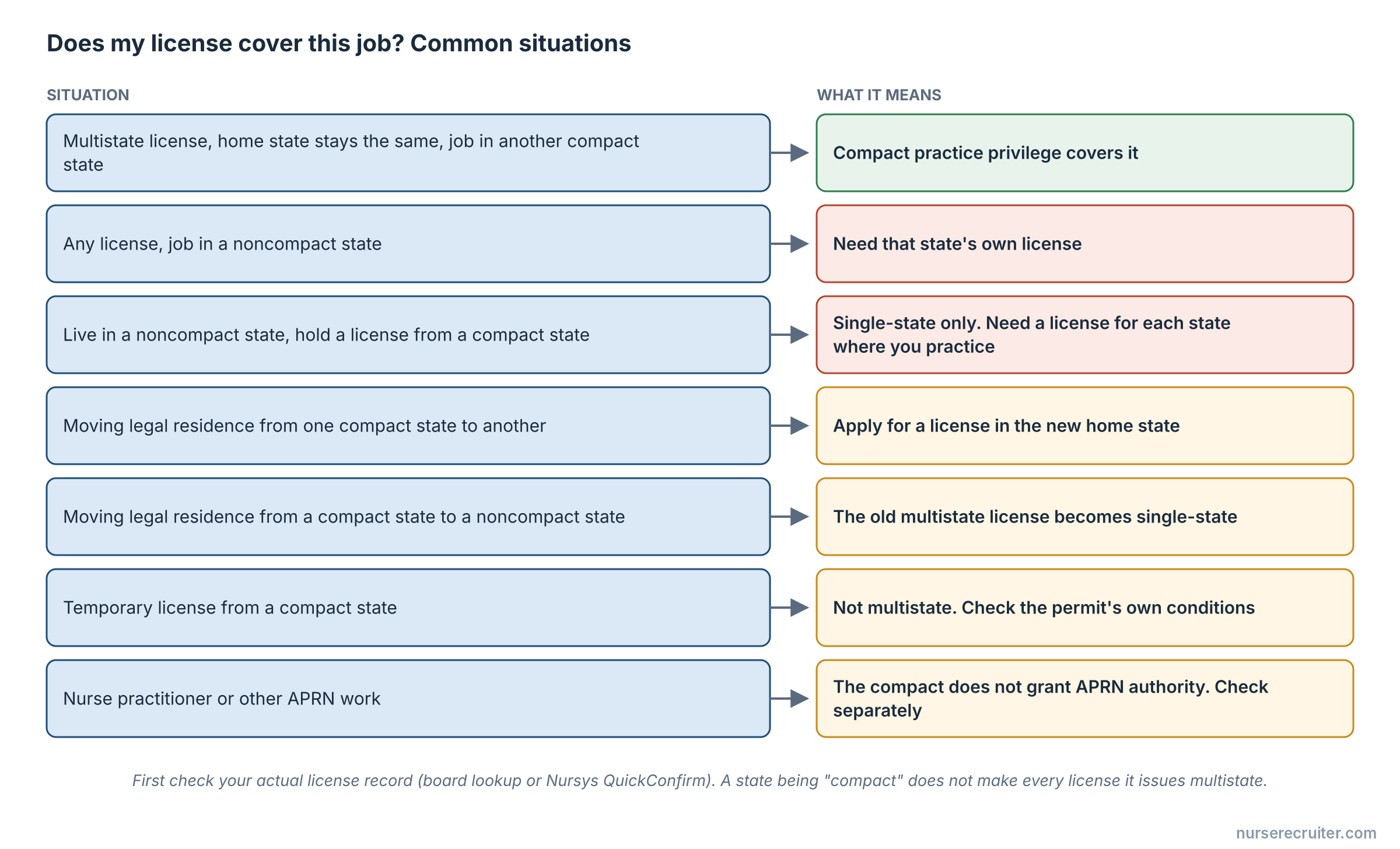
If you hold a qualifying multistate license and keep your home-state residence, check whether it covers the proposed practice jurisdiction. If it does, the relevant authorization is the compact practice privilege.
If you live in a noncompact state, obtaining a license from a compact state does not by itself create multistate eligibility. You may need a single-state license for each destination where you intend to practice.
If you are moving your legal residence, use the correct moving scenario. Moving into a compact state may make multistate licensure possible after the requirements are met. Moving from a compact state to a noncompact state changes the former multistate license to a single-state license. A compact-to-compact move requires an application in the new home state; the existing license does not simply change its issuer.
The endorsement overview explains the application route, while the compact's moving guidance provides the details for each scenario.
Keep temporary and advanced practice credentials separate
A temporary license issued by a compact state does not carry multistate status. Verify the permit with the issuing board and read its own conditions.
The RN/LPN Nurse Licensure Compact also does not grant nurse practitioner or other APRN authority. An APRN's underlying RN license and authorization for advanced practice must be checked separately.
Record the decision before committing to a start date
Write down the current license, the destination, whether residence is changing and the authority that covers the work. If an application remains outstanding, identify exactly what must be issued or confirmed before practice begins.
Avoid planning around a general promise that a state is “compact.” The useful answer is whether this nurse's current authorization covers this role, in this location, on the intended date.
Sources
- Nurse Licensure Compact: FAQs (accessed 2026-09-17).
- NLC: Applying for Licensure (accessed 2026-09-17).
- NLC: Moving Scenarios (accessed 2026-09-17).
- NLC: What Nurse Employers Need to Know (accessed 2026-09-17).