
Assignment and delegation answer different questions
Assignment organizes work that already belongs within a team member’s authorized role. Delegation authorizes a specific nursing activity through a deliberate process. The NCSBN–ANA national guidelines distinguish the two and emphasize that applicable nursing law determines what is permitted. A job title or a staffing shortage alone does not settle the question.
The guidelines also separate delegation from a handoff between licensed clinicians. Transferring a patient’s care to another nurse involves a different communication process. See supervision of delegated tasks for what follows an appropriate delegation decision.
Start with the patient and the task
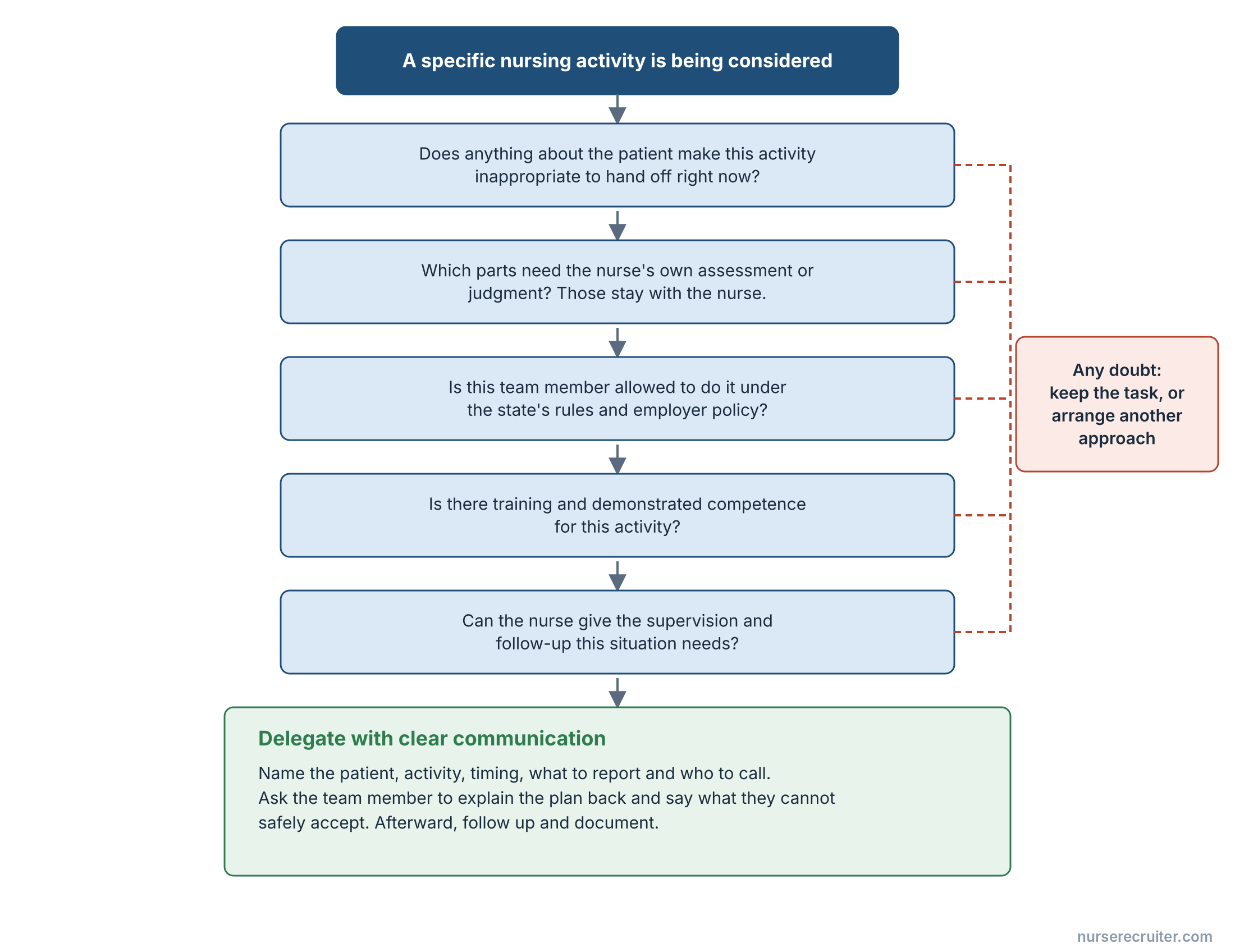
Before deciding, write down the exact activity being considered. “Help with this patient” leaves too much unspecified. A useful review asks:
- What information about the patient could change whether this activity is appropriate?
- Which parts require the nurse’s assessment or judgment?
- What can this particular team member perform under the applicable rules?
- What training and demonstrated competence support the decision?
- Can the nurse provide the supervision and follow-up this situation needs?
The national guidelines do not permit delegation of nursing judgment. They connect the decision to patient needs, competence and available supervision. Use them alongside the governing nurse practice act and employer policy, rather than treating them as a nationwide list of authorized procedures.
Verify the setting-specific rules
Texas illustrates why context matters. Its board describes separate delegation chapters for acute settings or conditions and for independent living environments involving stable, predictable conditions. An answer found for one category should not be carried into another without checking applicability. Other jurisdictions may organize their rules differently.
A useful local reference should identify the governing rule, the permitted personnel, exclusions, required preparation and supervisory arrangements. Keep the reference date visible. When a policy and a regulator’s rule appear inconsistent, seek clarification before using the policy as permission.
Make the communication usable
Consider this fictional orientation exercise: an experienced assistant is asked to complete an unfamiliar activity because the unit is busy. Instead of assuming experience covers that activity, the nurse checks the role, preparation and patient situation, then either establishes an appropriate plan or arranges another approach.
For an authorized task, the conversation should name the patient, activity, timing, information to report and the person available for questions. Ask the team member to explain the plan back and identify anything they cannot safely accept. Avoid turning this exchange into a test of willingness to help; the purpose is to discover mismatches before work begins.
Afterward, review whether the activity was completed and whether the patient’s needs changed. Record the relevant care and decisions using the organization’s documentation process. Delegation is useful when it produces clear responsibilities, not merely a shorter task list for one person.
Accountability when a delegated task goes wrong
Suppose the agreed activity was completed, but a change the nurse asked the team member to report never reached the nurse. Reconstruct what each person knew and when. Did the employer provide a policy, competent personnel and a usable way to reach the nurse? Did the delegating nurse assess this patient, communicate the reporting conditions and arrange supervision? Did the person accepting the task understand the limits, perform it as agreed and escalate a concern? The answers identify different responsibilities. They do not settle legal liability by themselves.
Keep the observed facts, times, notifications and follow-up clear. If an earlier record is incomplete, follow the local process for late entries and corrections. If older text was carried into the current note, check it against the actual encounter before relying on it. See copy-forward in nursing documentation.
An employer review, a nursing board proceeding and a civil claim may consider the same event for different reasons. The board addresses professional conduct and licensure under its jurisdiction. A civil claim concerns legal responsibility for alleged harm. The rules, findings and available outcomes can differ. For questions about defense or representation in either setting, review the actual professional liability policy and seek qualified advice for the jurisdiction.
Sources
- NCSBN–ANA National Guidelines for Nursing Delegation (accessed 2026-09-17).
- Texas Board of Nursing: Delegation FAQ (accessed 2026-09-17).
- NCSBN — Discipline and the board complaint process (accessed 2026-11-11).