
Preserve an honest chronology
A correction fixes inaccurate information. A late entry records information after the event. An addendum supplies additional information. These labels should help a reader understand what changed and when; the organization’s record system determines the available functions and required workflow.
CMS’s Medicare review guidance recognizes amendments, corrections and delayed entries. It recommends identifying the author and date and clearly and permanently marking the change. This is Medicare documentation-review guidance, not a complete account of every nursing documentation rule.
Identify the problem before editing
First determine what needs correction. Was a value entered incorrectly, was an event omitted, or was documentation placed in the wrong chart? The last situation deserves prompt use of the organization’s record-correction and privacy processes because it may affect more than one person’s information.
Review the relevant record and your own knowledge of the event. Do not reconstruct precise times or observations from guesswork. If you cannot establish a detail, seek the appropriate documentation guidance rather than make the entry appear more certain than the evidence allows.
An error that could affect ongoing care also needs communication. Editing the record alone is an incomplete response if a clinician is already acting on the wrong information. Identify who needs to know and how the correction will become visible in the care process.
Use the approved correction function
British Columbia’s nursing regulator offers a clear example of a preservation standard: correct errors promptly while leaving the original information visible or retrievable. Its late-entry standard distinguishes the date and time of the entry from the date and time of the event. These are British Columbia requirements; US nurses must check their own governing rules and system instructions.
Useful questions for a local workflow include:
- Does the electronic record have a correction or addendum function?
- Will the original entry remain retrievable?
- How is the author identified?
- Where are the event time and entry time recorded?
- Who assists when the chart is locked or the entry belongs to someone else?
Avoid sharing credentials or asking another person to sign as though they made your observations. Escalate technical obstacles through the designated support route.
A fictional late-entry example
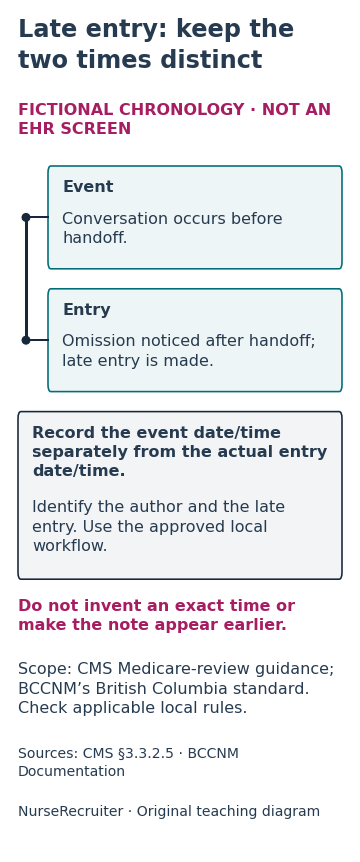
The event and its documentation are different moments. CMS’s cited guidance concerns Medicare reviews; the BCCNM standard is specific to British Columbia. Follow applicable rules and the approved record workflow.
Suppose a nurse realizes after handoff that a conversation was not documented. The appropriate task is to enter the remembered, relevant information through the approved late-entry process, with an honest event chronology. It is not to make the record look as though the note was written before handoff.
Use the example to check local expectations for uncertain timing, attribution of another person’s statements and notification of the receiving team. The aim is a useful and truthful record, not a defensive narrative written with hindsight. For repeated omissions or mistaken carryover, review copy-forward practices and the workflow that produced the problem.
If a late entry concerns a delegated task, distinguish what you observed from what a colleague reported. Record who supplied the information and when the team received it. A late note cannot substitute for a necessary handoff.
Sources
- CMS: Amendments, Corrections and Delayed Entries (accessed 2026-09-17).
- BCCNM: Nurses—Documentation (accessed 2026-09-17).