
Reused text needs a fresh review
Copy-forward brings earlier documentation into a later entry. It can make prior information easier to find, but the resulting note must still tell the reader what is true for the current encounter. A copied statement should never become a new observation simply because it appears under a new date.
NIST’s 2017 study of copy-and-paste use in electronic health records identified three important problems: excessive information, unclear attribution and failure to review or edit reused material. These findings concern information design and human use of records; they do not establish that every copied entry is wrong.
Separate history from current findings
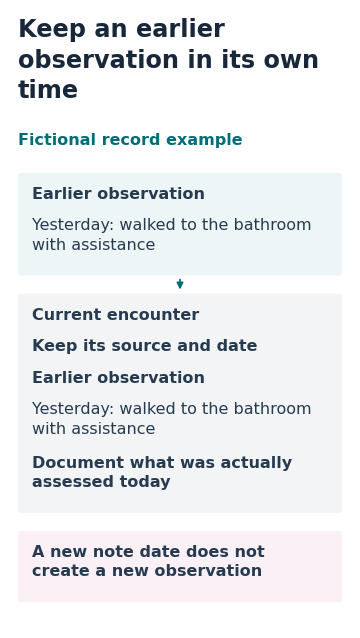
Reused information needs its original context. This example supplies no finding about today’s mobility.
Before signing, ask what each carried-forward sentence represents. Is it a past finding, a current observation, a patient report or a plan that has not yet happened? Keep those categories visible.
For example, in a fictional training case, yesterday’s note says the patient walked to the bathroom with assistance. Copying that sentence into today’s assessment could imply a new observation. A more useful exercise is to identify the source and date of the historical information, then document today’s actual assessment separately using the approved record structure.
Do not update a date merely to make old text appear current. Where information cannot be verified, determine whether it belongs in the note and how its uncertainty should be represented.
A focused pre-signature check
Review reused text for:
- Correct patient and encounter.
- Statements about equipment, support people or care arrangements that may have changed.
- Findings that the current author did not assess.
- Plans described as completed actions.
- Contradictions between narrative and structured fields.
- Repeated material that hides the new problem or response.
This is an editorial review aid, not a required clinical checklist. Follow employer policy on whether particular fields may be copied and how source attribution must appear. If the interface makes provenance difficult to see, ask the informatics team how to inspect it.
Correct errors and improve the system
British Columbia’s nursing documentation standard illustrates the wider accountability issue: nurses are responsible for their documentation, must not record care before it occurs and must correct errors while preserving retrievable original information. Those are jurisdiction-specific standards, not a statement of US law.
If inaccurate text has already propagated, use the approved correction process. Consider which current decisions could be affected and who needs notification. Silently fixing only the latest note may leave earlier misleading information in circulation.
For a recurring problem, bring a de-identified description to the documentation or informatics team. Ask whether templates need clearer dates, whether copying can be limited to appropriate sections and whether training uses realistic examples. The aim is to preserve useful continuity while making genuinely new findings easy for the next reader to recognize.
When a colleague performs a delegated activity, copying an earlier entry can obscure both the time and the source of the new information. Document the current observation or attributed report using the approved workflow. See nursing assignment and delegation.
Sources
- NIST: Examining Copy and Paste in Electronic Health Records (accessed 2026-09-17).
- BCCNM: Nurses—Documentation (accessed 2026-09-17).