
An accountable care organization, or ACO, brings healthcare providers together to coordinate care and take responsibility for defined aspects of cost and quality. This article focuses on Medicare ACOs; the details of other payer arrangements require their own review.
Medicare explains that an ACO can include doctors, hospitals and other providers participating in Original Medicare. An ACO is not a Medicare Advantage plan. Patients retain their Original Medicare coverage and freedom to use Medicare providers outside the ACO.
Separate the organization from the insurance
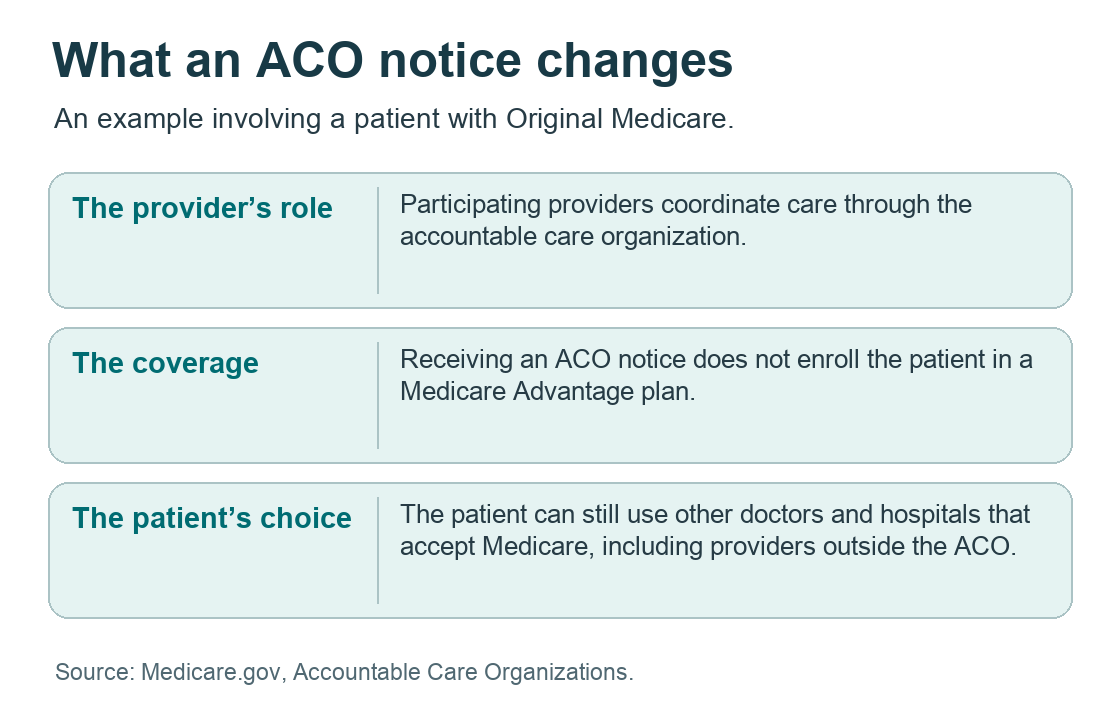
An ACO participation notice concerns the provider’s arrangement. Patients can use the contact on the notice to ask about their own care.
A patient may receive an ACO notice without choosing a new health plan. When discussing the notice, identify what it says about the provider's participation and where the patient can ask questions.
Avoid language suggesting that the patient must stay within an ACO network. Also avoid promising a particular extra benefit: Medicare describes possible additional services, but tells patients to check what their provider offers and whether they qualify.
For example, a fictional patient asks whether an ACO letter means they must cancel an appointment with an outside specialist. A useful response explains the Original Medicare choice principle and connects the patient with the ACO contact for questions about the specific notice.
Understand shared savings in context
The Medicare Shared Savings Program is one ACO program. Participating organizations accept accountability for the quality, cost and experience of care for an assigned fee-for-service population. CMS may pay a share of savings when the organization meets the relevant quality and financial requirements.
This is an organizational payment arrangement. It does not mean an individual nurse receives a bonus for avoiding a particular service, or that a single patient's necessary care should be judged against an improvised spending target.
When evaluating an ACO-related position, ask which program the organization participates in and what the nursing team is actually expected to accomplish.
Trace the coordination work
A nursing role may be described in broad terms such as outreach, care management or transitions. Ask for the specific workflow: who identifies patients for contact, who verifies needs, how clinical concerns are escalated and how the team knows a referral was completed.
Clarify the relationship between the ACO and the patient's usual practice. A patient should be able to understand who is calling and how that person connects with the existing care team.
Agree on how duplicate calls, unanswered messages and conflicting plans are resolved. Use the organization's approved privacy and communication processes when information crosses settings.
Examine performance without losing the patient
When reviewing a team dashboard, distinguish work completed from outcomes achieved. A count of outreach calls is not a count of people reached, and a referral sent is not proof of an appointment.
Ask how patient preferences and experience inform improvement decisions alongside financial measures. Keep the patient's stated goal visible in the care plan and the next contact.
For the handoff itself, look at what a care plan needs to communicate across organizations.
Related pages cover measuring care coordination, closed-loop referrals and healthcare payment models.
Sources
- Accountable Care Organizations (accessed 2026-09-17) — Medicare.gov.
- About the Medicare Shared Savings Program (accessed 2026-09-17) — CMS, updated March 10, 2026.