
A healthcare payment model describes how an insurer or other payer pays an organization or professional for care. To understand a model, identify what the payment covers, when it is calculated and who accepts responsibility for the costs.
The following examples describe common arrangements using Medicare sources. They are a starting point for understanding a workplace discussion, rather than a guide to a particular patient's bill.
Compare the unit of payment
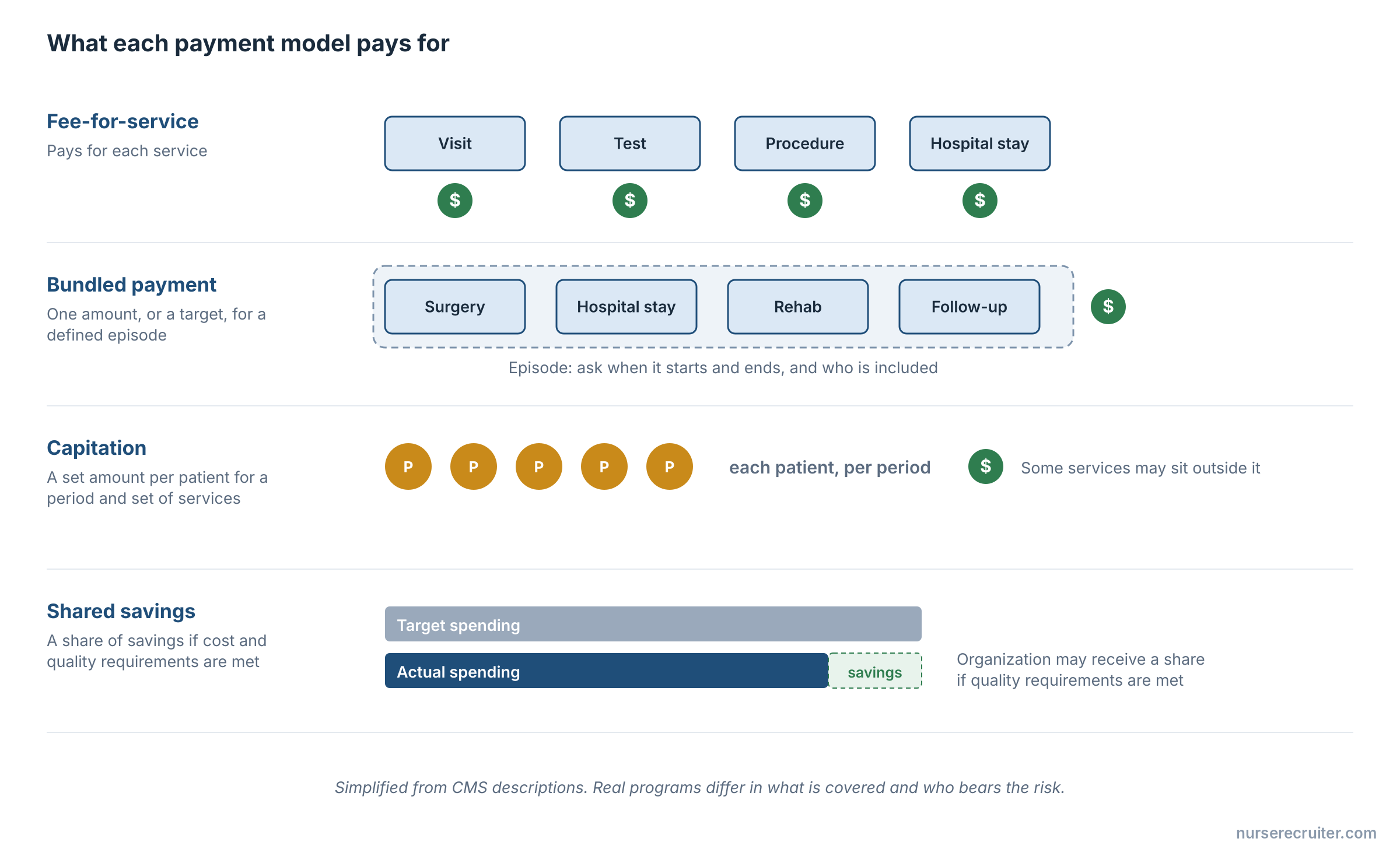
Fee-for-service pays for individual services. CMS contrasts this approach with payment that groups eligible services into an episode. A service might be a visit, test, procedure or hospital stay.
Bundled payment groups eligible services and supplies within a defined episode. The episode may include multiple providers. Some arrangements pay a designated provider in advance; others retain individual payments and later compare their total with a target amount. The latter approach can produce an additional payment or an obligation to repay money.
Capitation provides a set amount per patient for a specified period and set of services. The payment may be adjusted for characteristics associated with expected costs. It does not necessarily cover every possible service.
Shared savings can reward an organization for meeting specified cost and quality requirements. In Medicare's Shared Savings Program, accountable care organizations may receive a share of savings when they satisfy the program's requirements.
These descriptions answer different questions. An episode identifies a span of care, while a per-patient payment identifies a population and time period. Ask which arrangement actually applies before interpreting the label.
Identify the boundaries
For a bundled arrangement, ask when the episode starts and ends, which services belong to it and which organizations participate. Do not assume every bundle has the same duration.
For a capitated arrangement, ask which patients are included, which services remain outside the payment and who handles those services. For shared savings, identify the spending comparison, quality requirements and party accountable for the result.
Keep a written distinction between the organization's financial arrangement and the patient's individual coverage, authorization and cost-sharing questions. Refer the latter questions to the appropriate benefits or financial specialist.
Connect the model to nursing work
Use payment discussions to clarify practical responsibilities. Who coordinates a transition? Who receives a pending result? Who contacts a patient when the planned service cannot be arranged?
Ask how the organization funds these functions and how staff report unmet needs. A financial target is not a complete care plan. Bring clinical concerns through the appropriate clinical and supervisory processes.
For example, in a fictional episode-management discussion, a nurse might discover that everyone assumed another team would arrange the follow-up visit. The useful next step is to establish responsibility and confirmation, rather than merely recording that the episode has a spending target.
Read the actual agreement
When a leader refers to “value,” “risk” or “a bundle,” request the applicable program name and year. Ask for an explanation of the local workflow in ordinary language.
For a concrete payment example, see how a hospital readmission measure is defined.
Related pages cover accountable care organizations, case management and value-based purchasing.
Sources
- Bundled Payments (accessed 2026-09-17) — CMS.
- Capitation and Pre-payment (accessed 2026-09-17) — CMS.
- About the Shared Savings Program (accessed 2026-09-17) — CMS.