
The certification arm of the American Association of Critical-Care Nurses awards the PCCN in progressive care. Its direct-care pathway focuses on acutely ill adults in progressive care. Eligibility depends on patient needs and qualifying practice rather than the unit name.
Which settings count
The credential explicitly covers nurses working in intermediate care, direct observation, step-down, telemetry, transitional care, and emergency departments.
That list is worth reading before choosing between this and the critical care credential, because progressive care units are named inconsistently across hospitals and the certification follows the patients rather than the sign on the door. See progressive care nursing.
Eligibility
Two routes, mirroring the critical care credential:
Two-year option. 1,750 hours in direct care of acutely ill adult patients during the previous two years, with 875 of those in the most recent year.
Five-year option. 2,000 hours over five years, with at least 144 in the most recent year.
AACN accepts eligible hours in US or Canadian facilities, or facilities it determines provide comparable progressive care. The direct-care pathway requires an eligible, unencumbered RN or APRN license and qualifying direct care or bedside supervision.
The knowledge professional pathway serves eligible nurses who influence progressive care practice. AACN awards PCCN through this pathway and its direct-care pathway. The former PCCN-K designation changed to PCCN in November 2023.
PCCN or CCRN
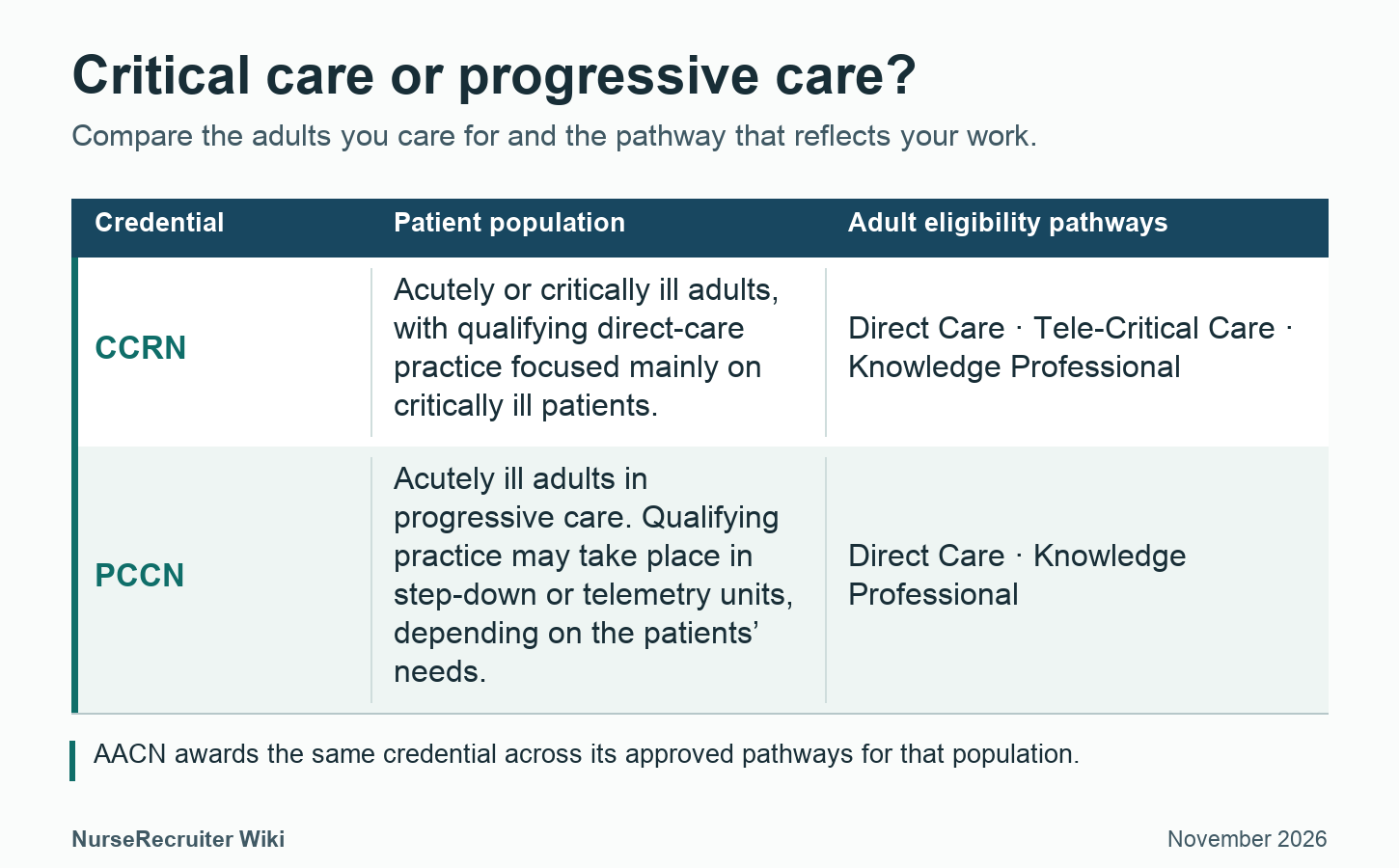
The eligibility language draws the line. The critical care credential covers direct care of acutely or critically ill patients; the progressive care credential covers acutely ill adult patients. That is the official statement of the distinction the two examinations are built on.
Practically: nurses in intensive care take the critical care credential; nurses in step-down, telemetry, and intermediate care take this one. Nurses who move between both, which is common, generally certify for where they spend most of their hours.
See CCRN certification and critical care nursing.
What it is worth
The same three effects as any specialty certification: hiring preference, a differential at many employers, and the unit's certified-nurse proportion, which is reported as a structural quality measure and matters to Magnet-recognized organizations. See Magnet recognition.
It carries additional weight in progressive care specifically, because the specialty is chronically under-recognized as a distinct practice and the credential is the clearest available evidence that it is one. Telemetry also has the highest time to fill of any nursing specialty at 87 days, which gives certified candidates unusual leverage.
Related
Sources
- PCCN (Adult) Certification — AACN Certification Corporation, on eligibility hours and the settings the credential covers. Accessed September 9, 2026.
- National Health Care Retention and RN Staffing Report — NSI Nursing Solutions, 2026 edition, for time to fill by specialty. Accessed September 9, 2026.
- AACN: adult CCRN direct care (accessed November 11, 2026)
- AACN: changes to CCRN and PCCN credential names (accessed November 11, 2026)