
The certification arm of the American Association of Critical-Care Nurses awards the CCRN in critical care nursing. It is one of the most widely held specialty certifications in the country and is offered in adult, pediatric, and neonatal versions.
Eligibility
For the direct-care pathway, AACN offers two practice-hour options:
Two-year option. 1,750 hours in direct care of acutely or critically ill patients during the previous two years, with 875 of those hours in the most recent year before applying.
Five-year option. 2,000 hours over five years, with at least 144 hours in the most recent year.
A current unrestricted registered nurse licence is required. Qualifying hours must be in direct care of the relevant patient population, in settings including intensive care units, cardiac care units, trauma units, and critical care transport or flight.
The structure is deliberate: both routes require recent hours, so the credential reflects current practice rather than a career that has since moved elsewhere.
The related credentials
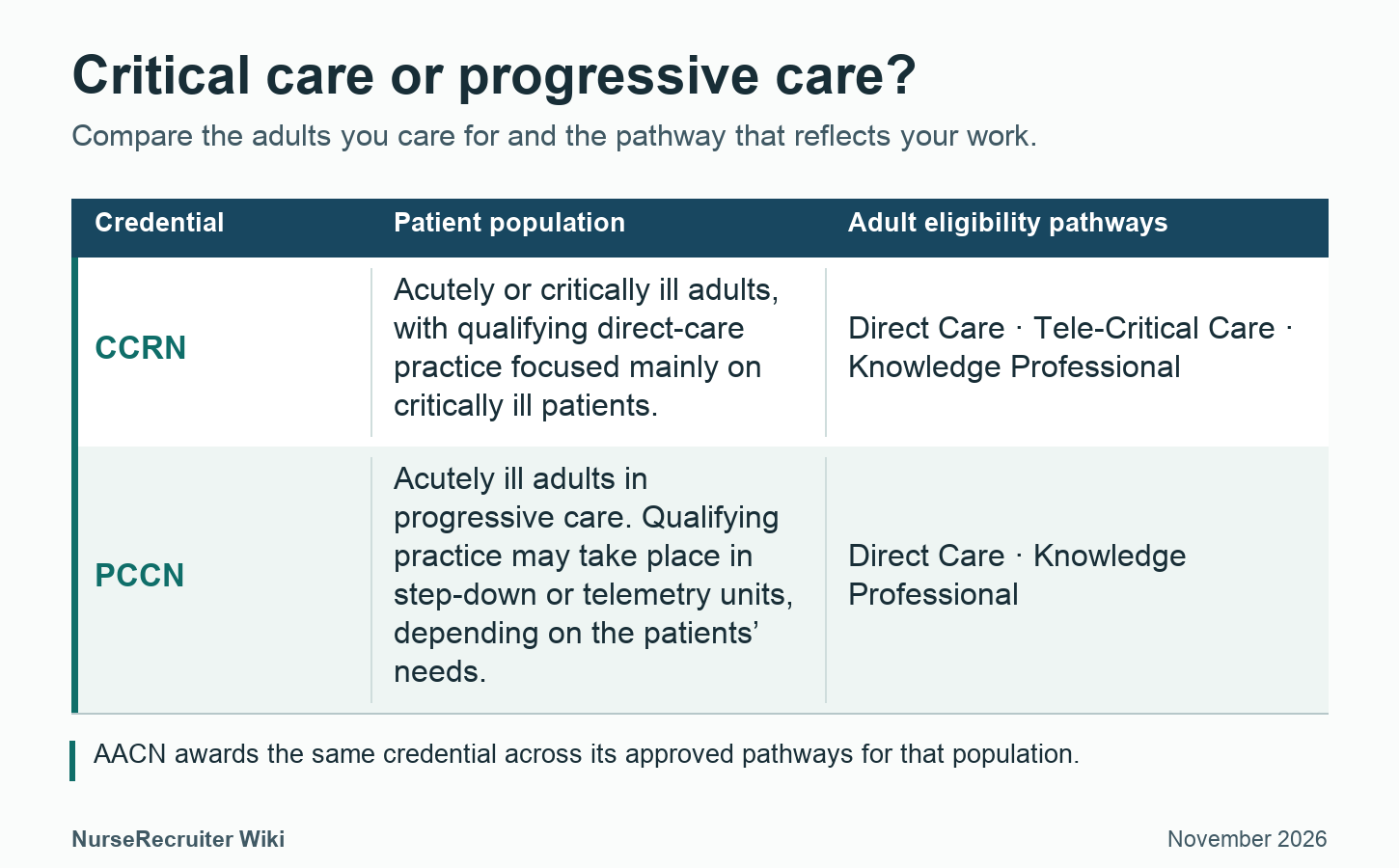
AACN awards CCRN through three adult pathways: direct care, tele-critical care and knowledge professional. The knowledge professional pathway covers eligible nurses who influence care, including some educators, managers and clinical nurse specialists. The former CCRN-K and CCRN-E designations changed to CCRN in November 2023.
CMC and CSC are adult cardiac medicine and cardiac surgery subspecialty credentials. They attach to a qualifying current clinical nursing specialty certification, which can include CCRN.
PCCN is the equivalent for acutely ill patients in progressive care, step-down, telemetry, and intermediate care. See PCCN certification.
What it is worth
Certification is voluntary and does not widen scope of practice. Three things it does affect:
Hiring. Many intensive care units list it as preferred, and it is close to expected for experienced applicants.
Pay, sometimes. Many employers pay a certification differential or cover the examination fee. Worth asking before paying personally.
The unit's numbers. The proportion of certified nurses is reported as a structural quality measure and is part of what Magnet recognition assesses. See Magnet recognition.
For nurse anesthesia applicants it is a common but not universal expectation, and it signals seriousness alongside the critical care experience the programmes require. See certified registered nurse anesthetists.
Who should take it
Any critical care nurse with the hours. The main reason to wait is that both eligibility routes require recent hours, so a nurse about to leave the bedside should either sit it while eligible or plan on the variant for non-bedside roles.
Related
Sources
- CCRN (Adult) Certification — AACN Certification Corporation, on eligibility hours, the two options, and qualifying settings. Accessed September 9, 2026.
- Get Certified — AACN Certification Corporation, on the full credential range including the cardiac subspecialties. Accessed September 9, 2026.
- AACN: adult PCCN direct care (accessed November 11, 2026)
- AACN: changes to CCRN and PCCN credential names (accessed November 11, 2026)
- AACN: CMC and CSC eligibility (accessed November 11, 2026)