
Patient identity matching links a person to the correct health record and keeps information from different people from being combined. Nurses encounter this work when selecting a chart, verifying a wristband, receiving an outside record, or noticing that the displayed history does not fit the patient.
Electronic matching and bedside identification are related safeguards. A matching system may locate a likely record, but staff still need to follow the approved process for verifying the patient involved in care.
Understand the two main record problems
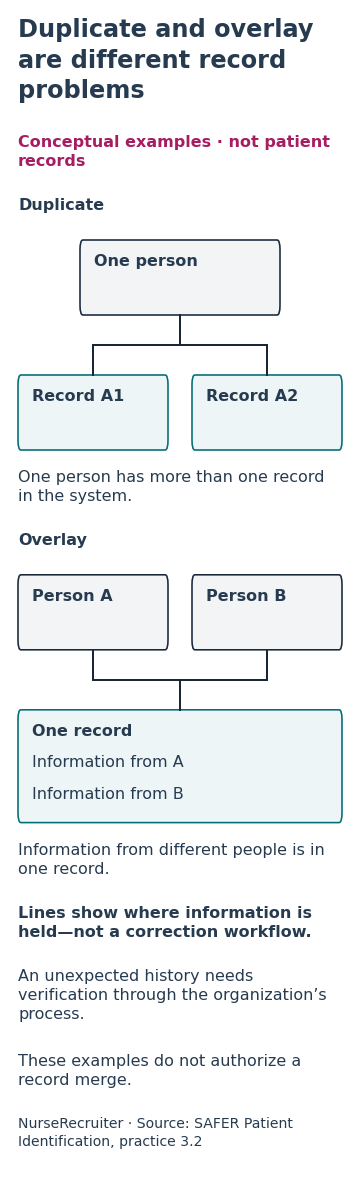
A duplicate can split one person’s information across records; an overlay can place another person’s information in the displayed record. These are conceptual examples, with no real identifiers. Resolve a suspected problem through the organization’s identity-verification and correction process.
A duplicate record occurs when one person has more than one record within a system. An overlay or commingled record contains information from different people. The SAFER patient-identification guide addresses both problems, along with patient mix-ups.
The consequences differ. A duplicate can separate information that belongs together. An overlay can make another person's information appear to belong to the patient. Either can affect what clinicians see and how they interpret it.
Names alone are insufficient identifiers. The SAFER guide recommends clear identifiers across the EHR interface and multiple identifying attributes in patient lists. Similar names, changed contact details, and other variations need a consistent registration and verification process.
What a nurse can do when something does not fit
A history that seems inconsistent is a reason to verify, not a reason to independently decide that the entire record belongs to someone else. Use the organization's patient-identification and escalation procedures. Protect urgent care while the identity concern is investigated.
Describe the discrepancy precisely through the approved channel: which record or encounter was involved, what information raised concern, and where it appeared. Avoid copying unnecessary identifiable data into informal messages. Authorized registration or health-information staff should handle record correction or merging according to policy.
Illustrative matching concern
In an illustrative admission, a nurse notices two records with the same name and similar demographic details. One contains the expected recent encounter, while the other contains an unfamiliar treatment history. The nurse does not select a record solely because it has more information.
The team verifies identifying information and asks the authorized identity-management staff to investigate. The example does not establish whether the records are duplicates, an overlay, or two different people. That uncertainty is exactly why a formal resolution process is necessary.
Design systems that make errors easier to detect
The SAFER guide discusses interface design, patient photographs, barcode use, and procedures for unidentified patients. Each organization needs to assess which methods fit its setting and how they will be maintained. A photograph or barcode is an additional aid, not a substitute for a reliable process.
Local monitoring can track suspected duplicates, corrected overlays, wrong-patient near misses, and the circumstances in which errors occur. Define those categories before comparing rates. Include downtime and transfers in testing, because identity information must remain connected to the patient as workflows change.
For a period when the normal matching systems are unavailable, see EHR downtime planning.
Related
Barcode Medication Administration Systems
Sources
-
SAFER: Patient Identification (accessed 2026-09-17).
-
SAFER: Contingency Planning (accessed 2026-09-17).