
EHR downtime planning prepares a nursing team to continue safe care when part or all of the electronic record is unavailable. Downtime can be planned for maintenance or occur unexpectedly. A slow or partly functioning system can also prevent reliable work, even when a login screen remains available.
The SAFER contingency-planning guide treats preparation, the downtime period, and recovery as connected parts of the problem. Restoring access is only one step; the team also needs to know what happened while the system was unavailable.
Prepare for the work that must continue
A unit plan should identify how staff will access essential patient information, record care, communicate orders and results, identify patients, and manage handoffs. It should name who activates the plan and how staff receive updates.
SAFER recommends paper forms for key functions, staff training and testing, and a communication strategy that does not depend on the same infrastructure as the EHR. A plan stored only inside the unavailable system is not a usable bedside reference.
Nurses should know where approved supplies and instructions are kept and which processes differ from ordinary operations. Downtime training needs to include recently hired staff and staff who work outside routine daytime hours.
Protect patient identity and sequence
Patient identification remains necessary throughout the interruption. Temporary identifiers, replacement labels, and later record reconciliation require an approved process. Staff should not improvise record merges or choose a similar-looking patient because the expected record cannot be found.
The timing of orders, administrations, observations, and communications also matters. Use the approved documentation method to preserve what occurred and when. An entry made during recovery should not obscure the original event time or create the appearance that a completed action still needs to occur.
Illustrative recovery problem
In an illustrative downtime exercise, a medication is administered and recorded on the approved paper record. When the EHR returns, the electronic task still appears due. The team walks through its reconciliation procedure before treating that electronic status as a new instruction to administer the medication.
The example is a training scenario, not medication guidance. It highlights why clinical and technical recovery need coordination and why the absence of an electronic entry cannot establish that care did not occur.
Reconnect deliberately
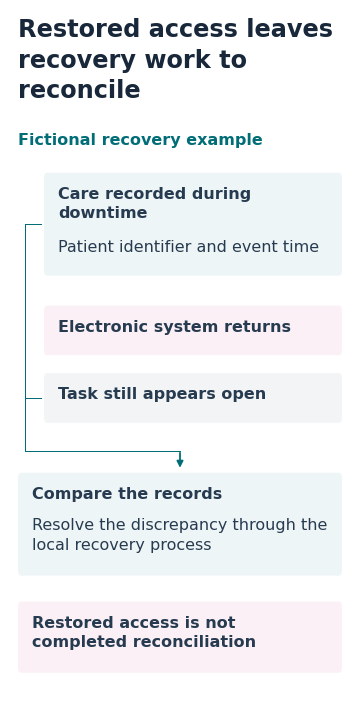
The example is about information continuity. It does not instruct staff to repeat care or change an electronic task without verification.
SAFER recommends policies for stopping and restarting data exchange across interfaces in an orderly way. Nurses need clear instructions about when to resume routine electronic work and how outstanding paper records, results, and requests will be reconciled.
After an exercise or actual event, review what failed: inaccessible forms, unclear roles, missing contact information, or conflicting recovery instructions. Assign corrective actions and retest the affected process.
A downtime drill is most useful when it follows a realistic patient journey through the interruption and back into the EHR.
Related
Cybersecurity for Nursing Teams
Sources
-
SAFER: Contingency Planning (accessed 2026-09-17).
-
SAFER: Patient Identification (accessed 2026-09-17).