
Vermont has about 645,000 residents, the second smallest population of any state. Registered nurses average $96,650 a year, 19th among the fifty states and the District of Columbia.
Licensure
The Vermont Board of Nursing licenses registered nurses, licensed practical nurses and advanced practice registered nurses through the Office of Professional Regulation in the Secretary of State's office. It sits on Main Street in Montpelier, telephone (802) 828-2396. Rules and applications are at sos.vermont.gov/nursing.
Vermont implemented the Nurse Licensure Compact in 2022. An eligible RN or LPN/VN whose primary state of residence is Vermont may obtain a multistate license. That license permits practice in other jurisdictions where the compact privilege is in effect, New Hampshire included. New York, along Vermont's western border, is not a member, and Massachusetts has enacted the compact without implementing it, so both require a license by endorsement.
Nurse practitioner practice
Vermont is a full practice state. Nurse practitioners evaluate patients, order and interpret tests, and prescribe under the nursing board's authority after finishing a transition to practice period. See nurse practitioner practice authority.
Nursing education
The University of Vermont runs the state's main nursing program in Burlington, alongside its medical center. Norwich University in Northfield and Vermont State University carry further programs, the latter across several campuses, and the community college system supplies practical nurse graduates.
Pay and workforce
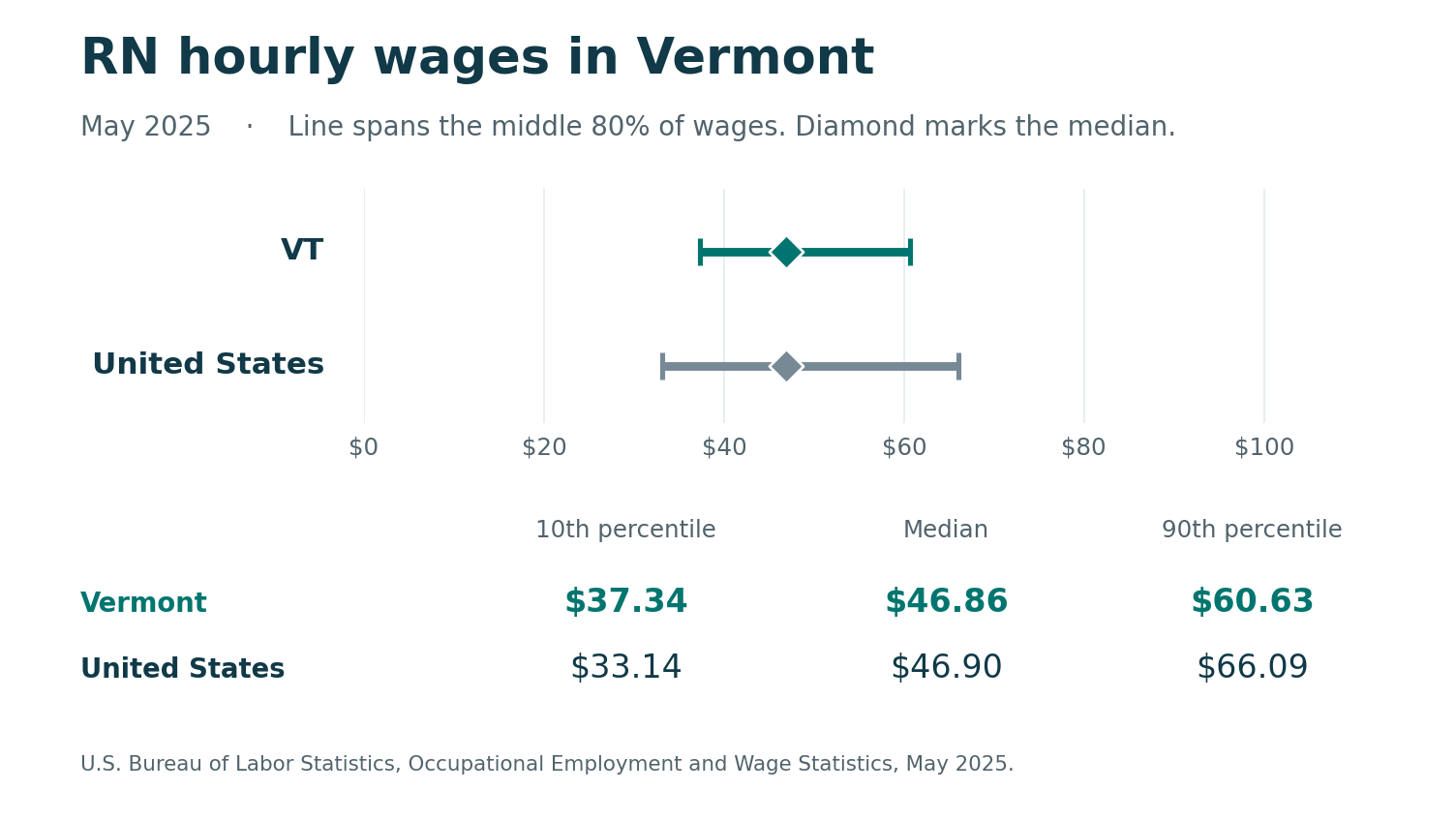
The University of Vermont Medical Center in Burlington is the state's only academic medical center and by a wide margin its largest hospital employer. It also draws patients from northern New York, which is one of the places the missing compact link is felt.
The rest of Vermont runs on a dozen or so small community hospitals and critical access hospitals, several with fewer than thirty beds. Vermont has one of the oldest populations in the country, which puts weight on home health, hospice and long term care. Winter conditions and mountain roads make transfer times a real factor in emergency care, and the ski areas produce a seasonal trauma load out of all proportion to the resident population. See rural and frontier nursing.
Travel and flexible work
Vermont relies on agency nursing more heavily than any other state, and two independent datasets say so.
In federal reporting, contract staff were 25.1 percent of nursing home nurse hours in Vermont in mid-2025, the highest share in the country and more than three times the national figure of about 7.5 percent. Alabama, at the other end, was 1.0 percent.
On this site's own listings, Vermont ranks fifth of the fifty states and the District of Columbia for travel assignments advertised per employed registered nurse, across the full archive from 2009 to 2026. With 7,240 registered nurses in the state, small absolute numbers of vacancies translate into a large share of the workforce. See where the assignments are.
Of the Vermont registered nurses with a profile here, 42 percent say they will consider travel assignments and 44 percent per diem shifts, both a little above the national picture. A visiting nurse with an active multistate license may work in Vermont under the compact privilege. Residence in a member state alone does not confer that privilege. See travel nursing and per diem nursing.
Related
- Nurse Licensure Compact
- Critical access hospitals
- Rural and frontier nursing
- Where the assignments are
- Nurse practitioner practice authority
- Nursing by state
Sources
- U.S. Census Bureau, state population estimates for July 1, 2025. Accessed September 8, 2026.
- U.S. Bureau of Labor Statistics, Occupational Employment and Wage Statistics, registered nurses (29-1141), May 2025. Accessed September 8, 2026.
- Vermont Board of Nursing, contact details and licensing information. Accessed September 8, 2026.
- Nurse Licensure Compact, member states and implementation dates. Accessed September 8, 2026.
- American Association of Nurse Practitioners, State Practice Environment. Accessed September 8, 2026.
- Nursing home staffing data. Long Term Care Community Coalition, for contract staffing by state. Accessed September 9, 2026.
- NurseRecruiter job listings, 2009 to September 2026, and nurse profiles, for travel postings per employed nurse and stated willingness. Method and limits are set out in where the assignments are.
- Nurse Licensure Compact: eligibility and multistate privileges (accessed 2026-11-11).
- O*NET OnLine, registered nurse wage percentiles for Vermont, BLS May 2025 data (accessed 2026-11-11).