
Susie King Taylor spent four years and three months nursing a Union regiment. She was never paid for any of it, and she is the only Black woman who published a memoir of her Civil War service.
Learning to read illegally
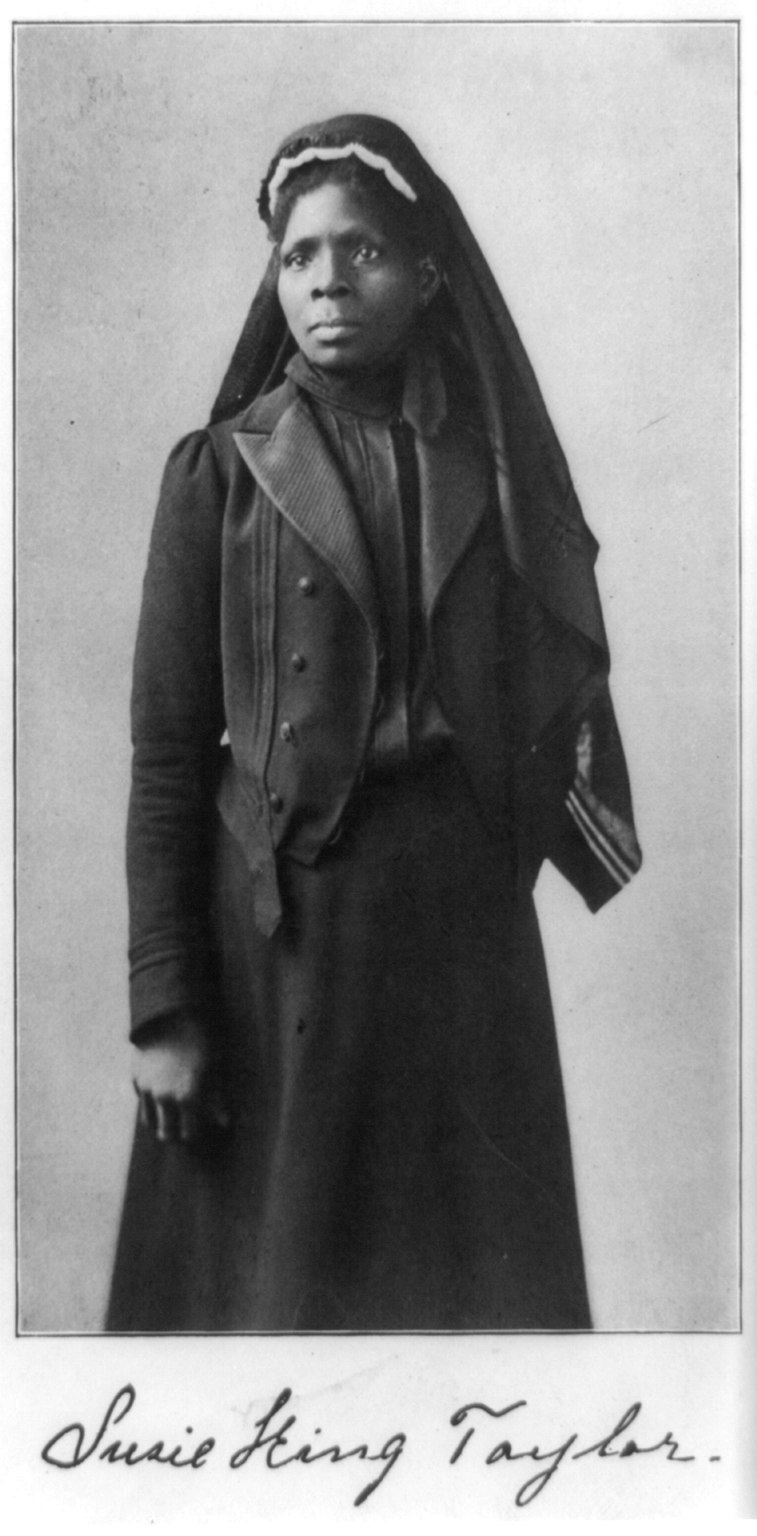
She was born Susan Baker on August 6, 1848 on a plantation in Liberty County, Georgia, into slavery. At about seven her grandmother took her to Savannah, where she was taught to read and write by two free Black women — Mrs Woodhouse and Mathilda Beasley — who ran secret schools. Georgia law made teaching an enslaved person to read a crime, so the children carried their books wrapped in paper and went in one at a time so the neighbours would not count them.
Being literate is the reason her account exists, and it is also what made her useful to the Army.
St Simons Island
After Fort Pulaski fell in April 1862 she fled with her uncle's family to Union-held territory, reaching St Simons Island off the Georgia coast.
She was fourteen. Union officers, discovering she could read, asked her to teach, and she opened the first free school for Black children on the island — about forty children by day and adults in the evening.
Four years with the 33rd
When the men of the island were organized into what became the 33rd United States Colored Troops, Taylor went with the regiment. She was enrolled as a laundress, which was the only category the Army had for her, and did almost no laundry.
She nursed the sick and wounded. She cleaned and loaded muskets, and taught herself to shoot one. She packed haversacks and cartridge boxes. She taught the soldiers to read in camp, in the evenings, so that a regiment of formerly enslaved men came out of the war literate.
She was fifteen when it started. She married Edward King, a sergeant in the regiment, during the war; he died in a dock accident in September 1866, before their son was born.
At Camp Shaw in Beaufort, South Carolina, she worked in the hospital alongside Clara Barton, who was there in 1863.
For four years and three months of nursing, teaching and camp work she received no pay of any kind. The Army had no pay category for what she was doing, and after the war it had no pension for it either. She applied and was refused.
Reminiscences
Taylor settled in Boston, worked in domestic service, and in 1886 helped organize Corps 67 of the Woman's Relief Corps, the Union veterans' auxiliary, serving as its president from 1893.
In 1902 she published Reminiscences of My Life in Camp with the 33rd United States Colored Troops, paying for the printing herself. It is the only published memoir of the Civil War by a Black woman, and one of very few first-hand accounts of Black army nursing from any source.
It is not a nostalgic book. She wrote it in part after travelling south in 1898 to nurse her dying son and finding she could not get him a berth on a train, and it ends by asking what the war had actually bought:
There are still many people in the North who are opposed to the negro, and if we do not have justice done us here, where can we look for it?
Taylor died in Boston on October 6, 1912, at 64.
Related
Sources
- Reminiscences of My Life in Camp with the 33rd United States Colored Troops, Susie King Taylor, 1902. Documenting the American South, University of North Carolina. Accessed September 9, 2026.
- Susie King Taylor, for the chronology of her service and later life. Accessed September 9, 2026.
- Susie King Taylor. National Park Service. Accessed September 9, 2026.