
Clarissa Harlowe Barton, always called Clara, was born on December 25, 1821 in North Oxford, Massachusetts. She is best known for founding the American Association of the Red Cross in 1881.
She is claimed by nursing, and she earned the claim at the bedside, but she had no nursing training of any kind and never sought any. What she had was an unusual talent for getting supplies to places the official system could not reach, and a refusal to wait for permission.
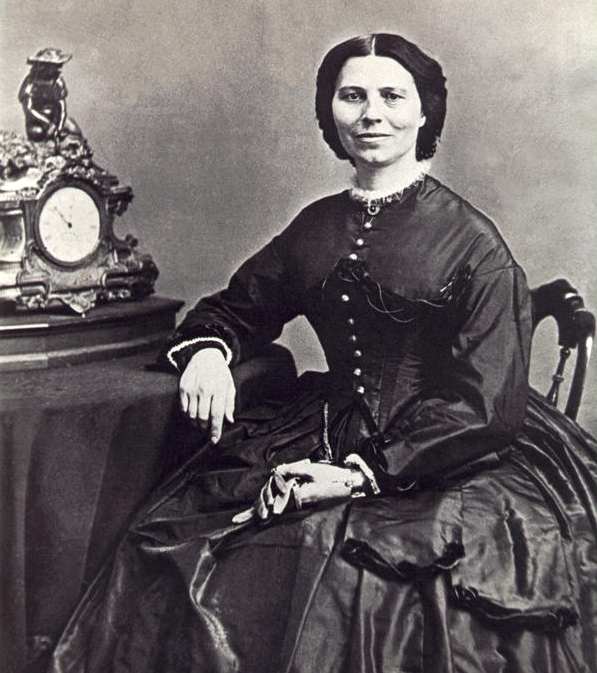 Clara Barton, around 1865. Photograph by Mathew Brady.
Teacher and clerk
Barton began teaching in May 1839 and spent several years in the schools of Oxford and North Oxford. In 1845 she founded a school for mill workers' children in West Millbury. She studied at the Clinton Liberal Institute in Oneida County, New York from 1850 to 1851, then returned to teaching and in 1852 founded the first free public school in Bordentown, New Jersey.
In 1854 she moved to Washington to work as a recording clerk at the U.S. Patent Office, one of the first women employed by the federal government — and, at first, at a man's wage. Her starting salary of $1,400 a year matched what the men in the office were paid. Objections to women holding federal clerkships caught up with her: she was demoted to copyist in 1855 and her position was eliminated in 1857. She got the job back after Lincoln's election in 1860.
The war
The Civil War began on April 12, 1861. Within about a week Barton was collecting supplies for wounded soldiers, working out of her own rooms and through a network of donors she assembled herself.
Getting the supplies to the wounded was the harder problem, and in August 1862 she obtained permission to take them directly to the field. On August 13, 1862 she reached the Battle of Cedar Mountain in Virginia and worked in field hospitals on both the Union and the Confederate side. She kept it up until 1864, following the armies to Antietam, Fredericksburg, Charleston and the siege of Petersburg, distributing supplies, cooking, dressing wounds and helping to set up field hospitals. Soldiers took to calling her the Angel of the Battlefield.
The missing men
Barton's most original work came after the fighting. Union records of the dead were chaotic, and tens of thousands of families had no idea what had happened to their sons.
In March 1865 Lincoln approved her establishment of the Office of Correspondence with Friends of the Missing Men of the United States Army. She ran it out of a Washington boarding house until 1867. It answered more than 63,000 letters and settled the fate of more than 22,000 men.
Nearly 13,000 of those were the Andersonville dead. That summer she went to the Georgia prison camp with Dorence Atwater, a former prisoner who had secretly copied the camp's death register while assigned to record it. Working from his list, they identified and marked the graves, and the site became a national cemetery.
Congress did not reimburse her $15,000 in expenses until March 1866.
The Red Cross
The International Committee of the Red Cross had been created in August 1864 at the first Geneva Convention, which the United States declined to join. Barton learned about it while recovering from exhaustion in Europe, saw it work during the Franco-Prussian War, and came home determined to bring it over.
She began campaigning in 1877. The American Association of the Red Cross was formed in May 1881 and she was elected its first president that June. Local chapters spread quickly. In March 1882 the United States signed the Treaty of Geneva and joined the international organization.
Barton's lasting contribution to the movement was an argument about scope. At the International Conference of the Red Cross in Geneva in August 1884 she pressed for an amendment allowing national societies to work in peacetime disasters — floods, fires, famine, epidemics — and not only in war. It passed, and it is why the Red Cross today is a disaster relief organization as much as a wartime one.
Last years
In 1905 she founded the National First Aid Association of America, which taught first aid, promoted emergency preparedness and assembled first aid kits.
She died on April 12, 1912 in Glen Echo, Maryland, at 90 — fifty-one years to the day after the war that made her began.
Related
- History of nursing
- Notable nurses
- Walt Whitman
- Nursing in Maryland
- Nursing in the District of Columbia
Sources
- Who Is Clara Barton. American Red Cross. Accessed September 9, 2026.
- Clara Barton Missing Soldiers Office Museum. National Park Service, for the letters answered and soldiers identified. Accessed September 9, 2026.
- Clara Barton National Historic Site. National Park Service, Glen Echo, Maryland. Accessed September 9, 2026.
- Clara Barton, Humanitarian, Corra Bacon-Foster. Columbia Historical Society, 1918. Accessed September 9, 2026.
- A Woman of Valor: Clara Barton and the Civil War, Stephen B. Oates. Free Press, 1994. Accessed September 9, 2026.
- Works by Clara Barton. Project Gutenberg. Accessed September 9, 2026.