
Sally Tompkins ran a twenty-two bed hospital in a borrowed house in Richmond and returned more of her patients alive than any other military hospital on either side of the Civil War. She was commissioned an officer in the Confederate Army so that nobody could take it off her.
Robertson Hospital
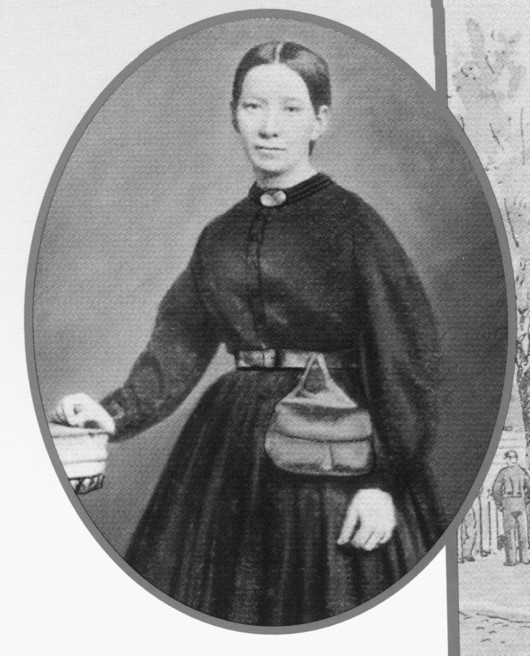
Tompkins was born on November 9, 1833 at Poplar Grove in Mathews County, Virginia, into a wealthy family, and was living in Richmond on her own means when the war began.
After the First Battle of Bull Run in July 1861 the wounded overwhelmed Richmond. Tompkins asked Judge John Robertson for the use of his house on Third Street and opened it as a hospital, paying for it herself.
The commission
In the autumn of 1861 the Confederate government ordered all private hospitals closed and their patients moved into military hospitals under army surgeons. Robertson Hospital was about to be shut.
President Jefferson Davis's solution was to commission Tompkins as a captain of cavalry in the Confederate States Army, on September 9, 1861, so that her hospital was legally a military one under a commissioned officer, and could stay open with her running it.
She is very probably the only woman commissioned in the Confederate Army. She accepted the commission and refused the pay:
I would not allow my name to be placed upon the payroll of the army.
The numbers
Robertson Hospital ran from August 1861 to June 13, 1865, and treated 1,334 patients. Seventy-three died.
That is a death rate of about five and a half per cent, the lowest of any military hospital in the war, in a period when a large military hospital could lose a quarter of its patients. Wounded men reportedly asked to be sent to Captain Sally's, and surgeons sent her the worst cases knowing it.
There was no drug in 1861 that accounts for it. What Robertson Hospital had was a small patient load, obsessive cleanliness, adequate food bought with Tompkins's own money, enough staff to give real attention, and one person in charge who stayed for four years. It is a nineteenth-century demonstration of what nurse staffing does to patient outcomes, and it was noticed at the time without being understood.
Afterwards
Tompkins spent most of her fortune on the hospital and lived modestly afterwards on charitable work. She never married, and turned down several proposals. In 1896 she hosted a reunion for her former patients.
In 1905 she moved into the Confederate Woman's Home in Richmond, which took her without charge, and she died there on July 25, 1916 at 82. She was buried with full military honours at Christ Church in Mathews County.
Related
- Mary Ann Bickerdyke
- Clara Barton
- Susie King Taylor
- Nurse staffing and patient outcomes
- Nursing in Virginia
Sources
- Sally Louisa Tompkins, for the chronology, the commission and the hospital's figures. Accessed September 9, 2026.
- Sally Louisa Tompkins. Encyclopedia Virginia, Virginia Humanities. Accessed September 9, 2026.
- Robertson Hospital. National Museum of Civil War Medicine. Accessed September 9, 2026.