
Mixed methods research deliberately integrates quantitative and qualitative approaches to answer a question. Numbers might describe the frequency or magnitude of a problem; interviews or observations might explain how people experience it. The defining feature is a planned connection between those forms of evidence, rather than simply placing a table and a few quotations in the same report.
The NIH Office of Behavioral and Social Sciences Research describes merging, connecting, and embedding data as different ways to achieve that integration. Its methodological guidance was published in 2011; that date is the guidance's publication date, not the date of data in a particular study.
Look for the reason to combine methods
A paper should explain what cannot be understood adequately through one approach alone. It may use interviews to develop a survey, follow a survey with interviews to explore unexpected findings, or embed an investigation of experience within a trial.
The two components need not have identical sample sizes or equal emphasis. They do need appropriate methods for their respective questions and a clear account of how their results inform each other.
An illustrative sequence
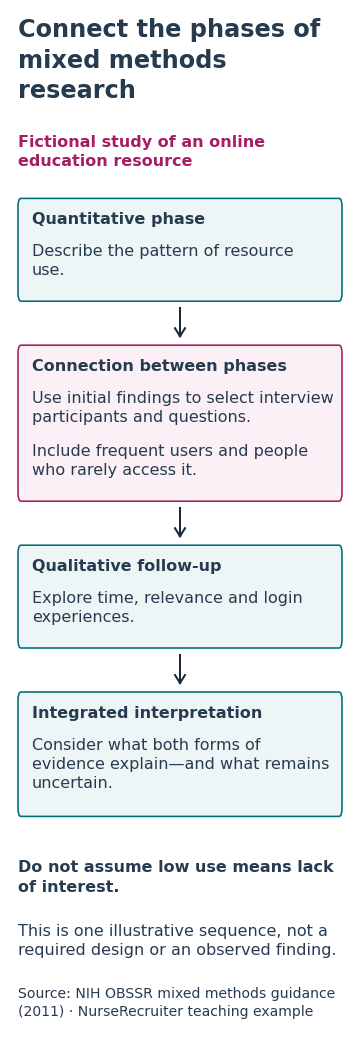
Integration is the planned connection between methods. In this fictional example, initial usage findings shape interviews, and the final interpretation draws on both phases without inventing a reason for nonuse.
Imagine a study finds low use of an online education resource. A follow-up interview phase could explore how nurses find time to access it, whether the material fits their work, and whether login problems interfere. Researchers could select interview participants deliberately to include both frequent users and people who rarely access it.
The integrated interpretation might distinguish lack of interest from barriers to access. This is an invented example, not evidence about a real resource. It illustrates why a usage count alone might not explain the observed pattern.
If the interviews include only enthusiastic users, the explanation for nonuse remains incomplete. The qualitative component cannot repair a quantitative measure that counts page openings as completed learning without acknowledging that limitation.
Find the point of integration
Look for an explicit connection: one phase shapes sampling in the next, a combined display compares findings, or the discussion develops an interpretation that uses both components. Ask what the reader learns from that connection that neither component supplies alone.
When findings disagree, a good report investigates the difference rather than hiding it. A survey might suggest satisfaction while interviews describe important frustrations. Different questions, populations, timing, or meanings could explain the apparent conflict. Agreement is not the only useful result.
Judge the combined conclusion
Check the quality of each component and the strength of the integration. Adding qualitative material does not convert a weak causal comparison into a randomized trial. Adding a survey does not make interview participants representative of an entire profession.
A useful journal-club summary names the quantitative question, qualitative question, sequence, participants, integration method, and remaining uncertainty. See qualitative nursing research for reading the interpretive component on its own terms.
Mixed methods within one project answer a different question from synthesizing findings across multiple studies.
Sources
- NIH OBSSR: The Nature and Design of Mixed Methods Research (accessed 2026-09-17).