
Medication reconciliation compares medication information across a change in care, identifies discrepancies and makes the intended plan clear. Collecting a list is an essential input; reconciliation also requires reviewing differences and resolving questions with the clinicians responsible for the plan.
AHRQ's MATCH toolkit describes reconciliation at admission, transfer and discharge. It emphasizes defined team responsibilities, verification with patients and other information sources, and clarification of discrepancies. An electronic list does not replace the conversation needed to establish what a person actually uses.
Establish what the list represents
Record when the information was obtained and where it came from. A prior discharge list, a pharmacy record and the patient's account may answer different questions. Do not silently treat them as interchangeable evidence of current use.
The FDA advises including prescription and nonprescription medicines, vitamins and supplements in a medication list. Useful details include the product name, strength, purpose and instructions for use, together with allergies and emergency contacts. The list should be updated when the regimen changes.
Within the team's approved process, ask about products that might not appear in a prescription record. Preserve uncertainty explicitly when the patient does not know a name or strength, and identify who will verify it.
Compare, clarify and document the decision
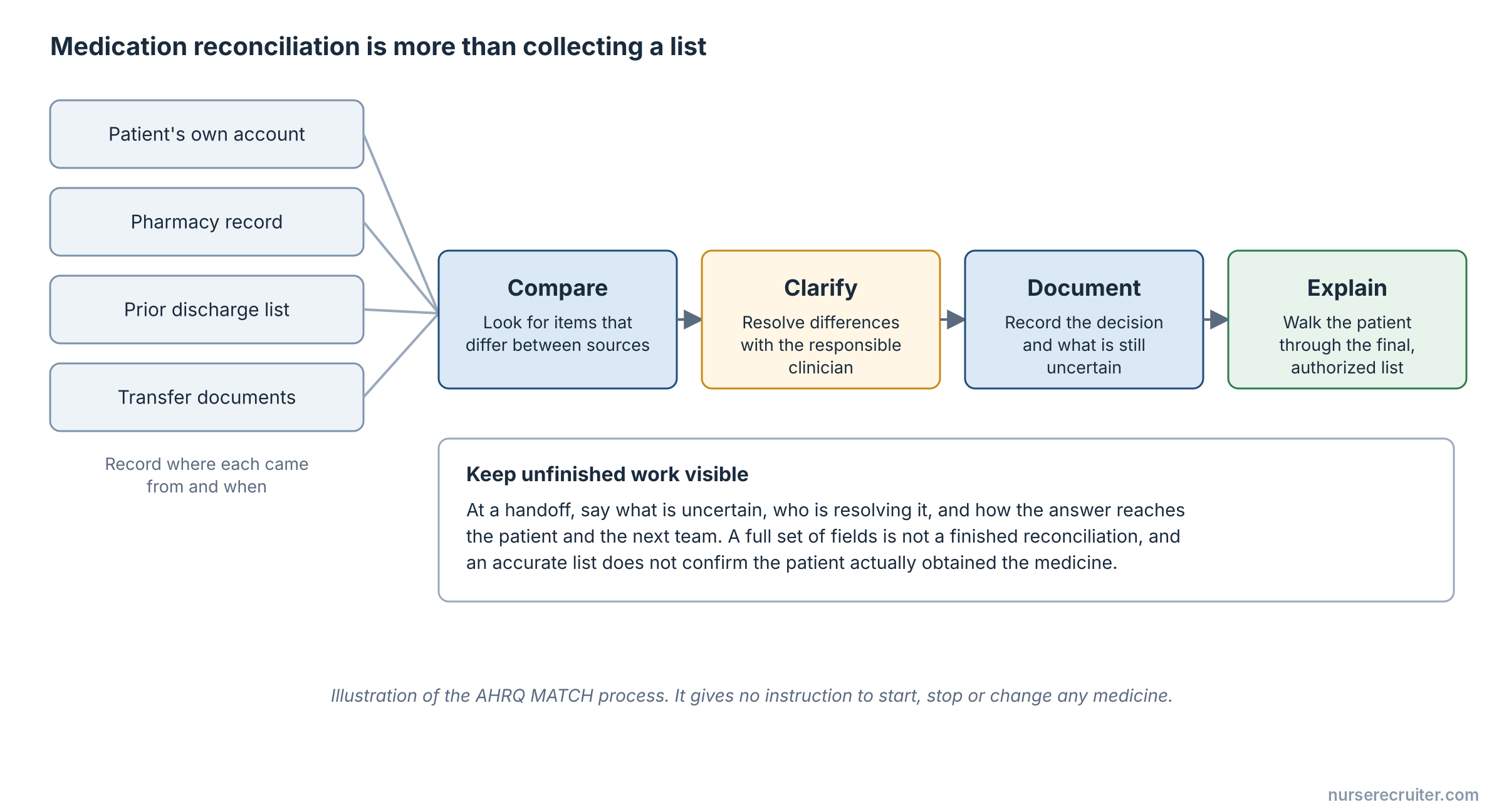
MATCH distinguishes the work of gathering information from ordering decisions and follow-through on discrepancies. Nursing and pharmacy workflows may include confirming information, discussing unexplained differences with the prescriber and documenting the resulting clarification. Roles should be defined for the setting rather than assumed from a generic checklist.
A discrepancy does not by itself establish that one list is wrong. The next step is to determine the intended plan through the authorized clinical process.
For example, in a fictional transfer, the patient's own list contains an item absent from the transfer documents. The nurse records the discrepancy, identifies the sources and obtains clarification through the receiving team's process. The example supplies no instruction to start, stop or resume that medicine.
Make changes understandable
Once the responsible clinician has clarified the plan, organize the explanation around what the patient is expected to use now and which earlier instructions have changed. Use the final, authorized instructions and an accessible format.
A suggested understanding check is to ask the patient to walk through the list with the materials they will use at home. If the explanation reveals a conflicting bottle label, missing supply or unanswered question, send that issue back through the appropriate clinical or pharmacy route.
Keep unfinished work visible
At a handoff, state what remains uncertain, who is resolving it and how the result will reach the patient and next team. Avoid marking reconciliation complete simply because every electronic field contains an entry.
A local quality review can examine whether discrepancies were resolved and communicated, rather than counting list completion alone. Keep medication access problems distinct from list accuracy: an accurate instruction is not confirmation that the patient obtained the product.
During nursing discharge planning, identify who will resolve a conflicting medication instruction. At follow-up after discharge, ask whether the patient obtained the medicine and can explain the agreed plan; teach-back checks the explanation without treating the patient’s answer as a test.
Sources
- MATCH Toolkit, Chapter 3: Designing the Medication Reconciliation Process (accessed 2026-09-17) — AHRQ.
- Create and Keep a Medication List for Your Health (accessed 2026-09-17) — FDA.