
A certification lapses when it expires without renewal. The first task is to establish the actual status and date with the certifying organization, then determine what must change while reactivation is pending.
Do not assume that an RN license, an application receipt or a scheduled examination keeps an expired specialty credential active. Treat certification, licensure and employer requirements as separate checks.
Respond to the lapse promptly
Confirm the expiration date and whether a renewal was submitted and accepted. Save the issuer's response if there is a processing discrepancy.
Correct documents that describe the expired certification as current. ANCC expressly prohibits using an expired ANCC credential or representing yourself as currently certified after it has lapsed.
Notify the appropriate employer or credentialing contact when the certification is relevant to your role. For APRN practice, ask the licensing board and other responsible authorities how a lapse affects the specific authorization or role. Do not infer permission to continue from another nurse's experience.
Find the correct reactivation route
ANCC's reactivation policy distinguishes the time elapsed and whether the examination remains available. Within its two-year reactivation window, applicants must meet the renewal requirements in effect when applying and submit the required application and fees.
After more than two years, an available examination must also be passed. If the examination is no longer available, ANCC does not permit reactivation after that period.
Confirm your precise deadline with ANCC if you are close to the boundary. Do not rely on an approximate month count or assume an old renewal-only credential can always be restored.
Use your issuer's current policy for other certifications; ANCC's timeline is not a universal nursing-certification rule.
Distinguish lapse from approved inactive status
Some organizations offer a formal inactive option before expiration. AACN offers this for CCRN, PCCN, CMC and CSC certificants who cannot meet renewal eligibility, allowing up to three years to meet the requirements.
AACN does not permit use of the respective credential while it is inactive. That arrangement therefore does not mean the person remains actively certified for a job requiring the credential.
An inactive option must be obtained under its rules. Simply allowing a credential to expire does not automatically enroll you in such a program.
Document the gap and the return
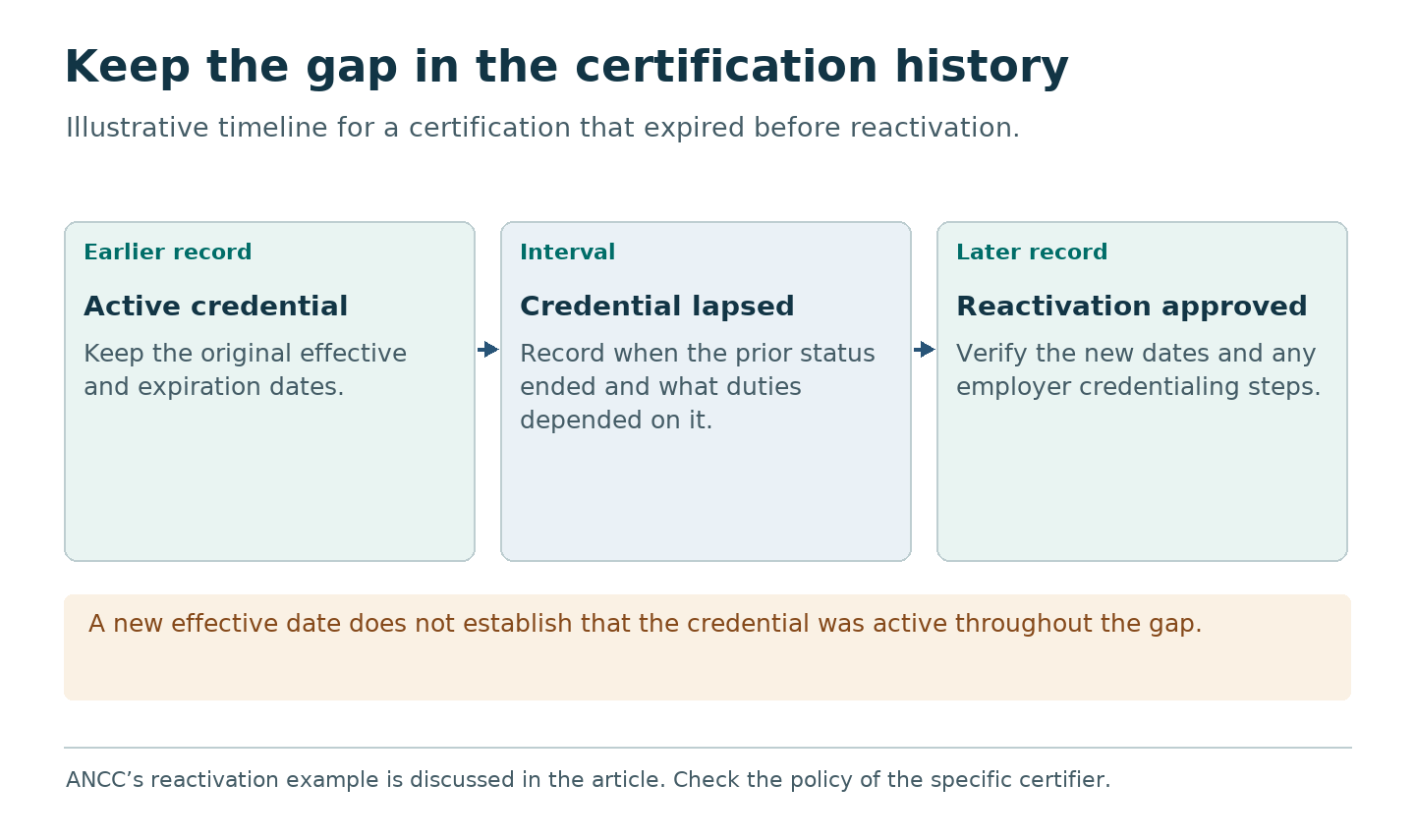
ANCC does not backdate a renewed certification to erase a lapse. Its guidance directs nurses to check with licensing boards, employers and reimbursement organizations about the consequences of a gap.
Keep the former expiration date, the reactivation decision and the new effective dates. Present that sequence accurately when an application asks about certification history.
Before returning to duties that depend on the credential, obtain the required confirmation and complete any employer credentialing steps. Then add reminders and a supporting-record check to your renewal planning so the next deadline has a clear owner and evidence file.
Sources
- ANCC: Reactivation of a Lapsed Certification (accessed 2026-09-17).
- AACN: Inactive Status (accessed 2026-09-17).
- ANCC: Certification Renewal Handbook (accessed 2026-09-17) — pages 17 and 19.