
Track each nursing certification against its own renewal period and requirements. A single education total or calendar reminder cannot show whether every specialty, date range and renewal condition has been satisfied.
Start with a credential matrix. Give each certification its own row and record the issuer, current status, expiration date, renewal options, qualifying activity period and outstanding requirements. Keep the source handbook alongside the plan so that an unexplained number can be checked.
Separate shared education from separate requirements
Some education can support more than one renewal, but acceptance must be established for each credential.
BCEN permits the same CE hours to be used for multiple BCEN certifications when the content is relevant to both specialties and falls within each credential's four-year recertification period. That does not establish acceptance by a different certifying organization.
For example, a course completed during the overlap between two qualifying periods may be considered for both if its content also fits both specialties. A course outside one period should not be moved into it simply because the other credential accepts it.
Save one original certificate and link it to each relevant renewal record. Do not alter the completion date or credit award to make the records line up.
Keep requirements in distinct columns
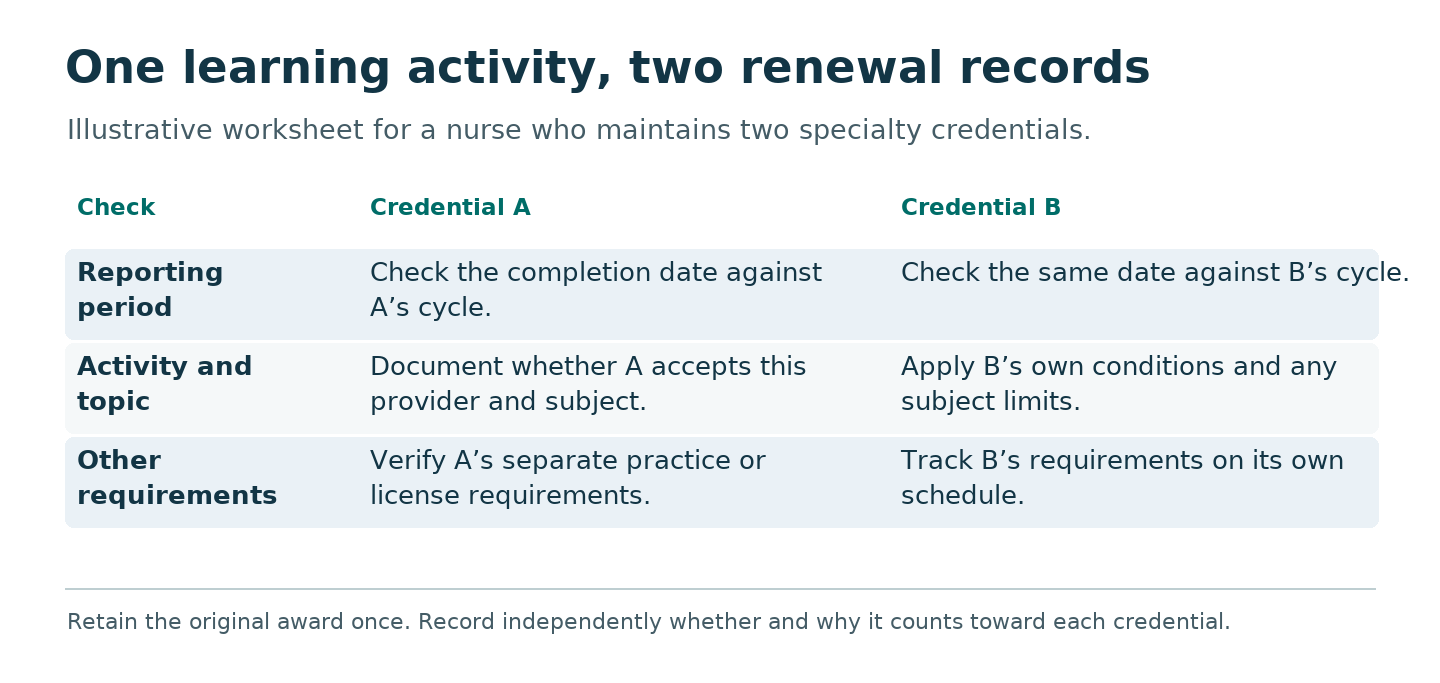
Track total CE, specialty content and required approval categories separately. One activity may satisfy several attributes without creating additional hours.
BCEN's 2027 CE guide, for example, requires at least 75 clinical hours and at least 75 hours from accredited sources within the 100-hour total. Those are overlapping classification requirements, not a 150-hour sum.
BCEN applies the increased accredited-source minimum to applications submitted on or after January 1, 2027; its current earlier minimum is 50. Record an announced rule's effective trigger, not just the year printed on the certificate.
Include requirements beyond education
Do not let the CE spreadsheet hide practice or license conditions. AACN's adult CCRN direct-care renewal uses a three-year cycle and includes qualifying practice requirements.
For each credential, identify what evidence is needed and who can confirm it. If work hours count, retain enough detail to distinguish relevant practice from hours that do not fit that pathway.
If an employer reimburses renewal costs, track its submission process separately from the certification deadline. Reimbursement approval and certification renewal are different decisions.
Review the plan when work changes
A move into management, education or another specialty may change which credentials are useful and which renewal pathways remain available. Reassess before the next deadline becomes urgent.
Compare the practical benefit of maintaining each credential with the time and eligible activity needed. If considering inactive or retired status, read the issuer's rules and credential-display restrictions.
After every renewal, verify the new status and dates, update the matrix and retain the supporting evidence. A useful system should show both what is complete and what still needs a decision.
Sources
- BCEN: How to Recertify (accessed 2026-09-17).
- BCEN: CE Requirements Guide Effective January 1, 2027 (accessed 2026-09-17).
- AACN: CCRN Adult Renewal (accessed 2026-09-17).