
A medical interpreter supports communication across languages during a healthcare encounter. The interpreter conveys what participants say; the clinician remains responsible for the clinical explanation and decisions within their role.
Interpretation and translation are different services. Interpreters work with spoken or signed communication, while translators work with written text. AHRQ recommends qualified healthcare interpreters and cautions against relying on staff whose language skills or interpreting preparation have not been established.
Prepare the encounter
Confirm the patient's communication needs and arrange the appropriate service through the organization's process. Establish whether the encounter requires an in-person interpreter or an effective remote connection. Test the equipment before relying on it for an important exchange.
HHS's interpreter guidance recommends briefing the interpreter on the encounter's purpose, allowing time for interpretation and minimizing distractions. It also recommends documenting the interpreter's name. Apply the organization's requirements for any additional documentation.
A brief preparation discussion might cover the participants, the purpose of the conversation and whether a demonstration or document will be used. Keep it focused on facilitating an accurate encounter rather than asking the interpreter to make a clinical judgment.
Speak with the patient
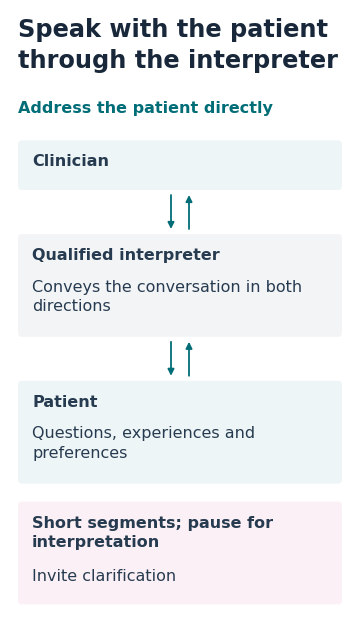
The interpreter supports the conversation; the clinician keeps responsibility for the clinical explanation and decisions within their role.
Address the patient directly, using first-person language. HHS recommends clear speech, everyday words and short segments that allow the interpreter to convey each message. Leave space for the patient's questions and clarification.
For example, ask “What concerns would you like us to discuss?” rather than telling the interpreter “Ask them what is wrong.” This is an original wording example. It keeps the patient in the conversation rather than making them the subject of a conversation between professionals.
Do not treat a pause, an unfamiliar phrase or a request for clarification as evidence that the interpreter should fill in missing clinical details. Restate the question or clarify the meaning as needed.
Check the communication, not just the connection
A connected telephone or video session is a means of communication, not proof that the patient has understood. Invite the patient to describe the agreed next step through the interpreter, and resolve discrepancies before closing the conversation.
If a remote session is interrupted, establish what information was missed. If written instructions will be supplied, confirm how an appropriate version will reach the patient. Do not assume that arranging spoken interpretation has also solved the written-materials need.
Keep responsibilities visible
A suggested handoff identifies the language or communication method, the service used, outstanding questions and any support still to be arranged. Avoid substituting “interpreter present” for a meaningful account of unresolved needs.
See language access in healthcare for the organizational system, and teach-back for checking an explanation. Neither replaces the organization's interpreter procedures.
Sources
- Address Language Differences: Tool 9 (accessed 2026-09-17) — AHRQ.
- Working Effectively with an Interpreter (accessed 2026-09-17) — HHS Think Cultural Health.