
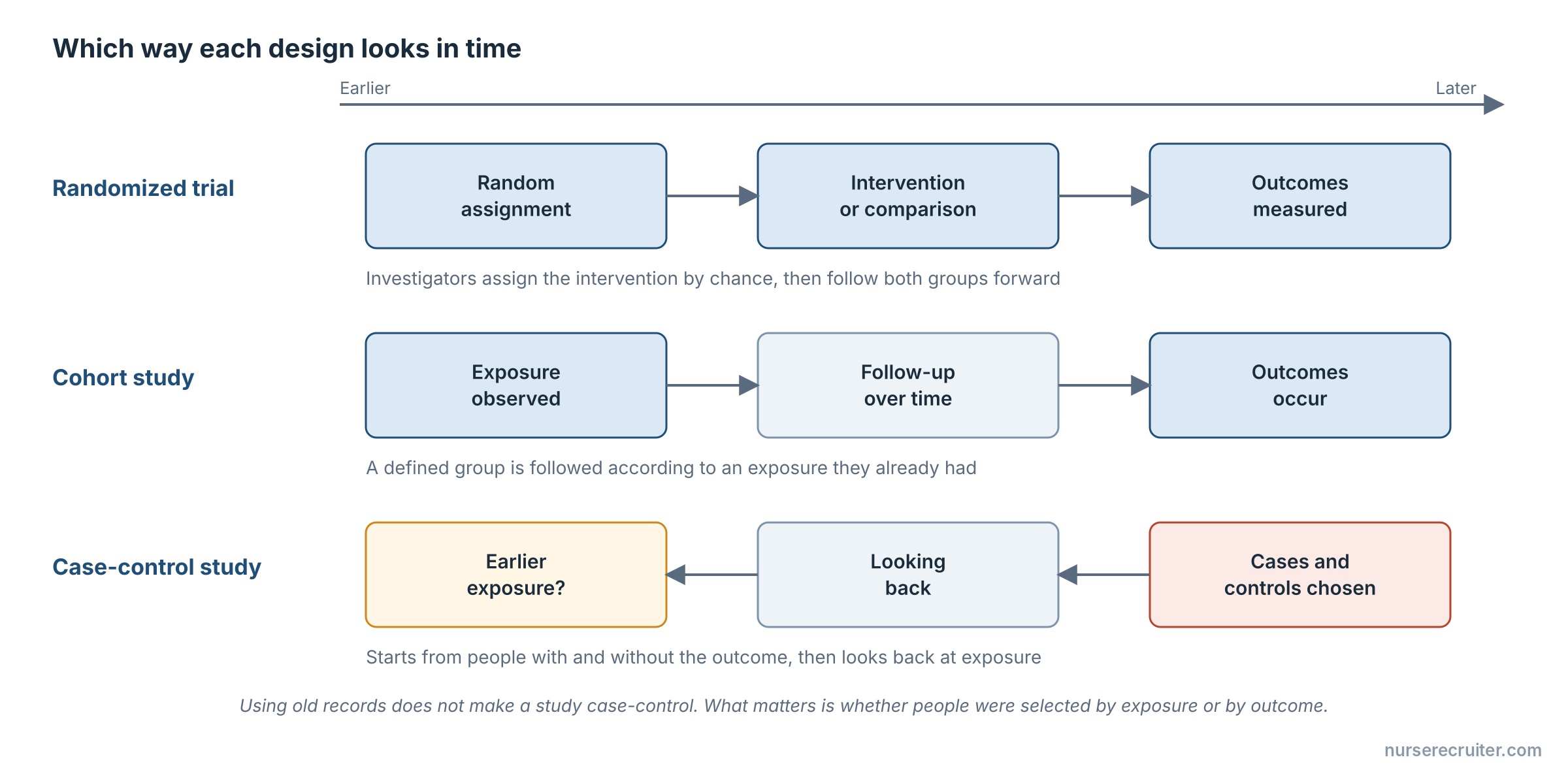
A case-control study starts with an outcome: investigators identify people who have the condition or event of interest and select a comparison group, then examine earlier exposures. It is an observational design. The central question is whether exposure histories differ between the groups.
This differs from a cohort study, which organizes follow-up around an exposure or defined starting population. A study using old records is not necessarily case-control; selection by outcome is the distinguishing feature.
Ask where the controls came from
Controls should represent the exposure distribution in the population that produced the cases. Choosing a convenient comparison group can distort the result even when the sample is large. Read the eligibility criteria, place, calendar period, and recruitment route for both groups.
Consider an illustrative study of a rare occupational injury. Investigators select nurses who experienced the injury and comparison nurses from the same employment setting and period, then examine earlier work arrangements. Comparing those cases with an unrelated group of retired nurses would introduce obvious differences unrelated to the exposure being studied.
The example demonstrates control selection, not an established relationship between work arrangements and injury.
Interpret the measure correctly
Case-control studies commonly report odds ratios. Odds and risks are different quantities. Because researchers choose the numbers of cases and controls, the fraction of cases in their study sample is generally not the risk of the outcome in the source population.
In an illustrative sample with 40 cases and 80 controls, the fact that one third of participants are cases does not mean one third of nurses experience the event. That fraction was created by the sampling design. A report should describe an odds ratio as an odds ratio rather than silently converting it into a risk ratio.
Check how exposure was reconstructed
Earlier exposure may come from records, interviews, measurements, or a combination. Ask whether the same process was used for cases and controls. People who experienced an event might recall earlier circumstances differently; records might also differ in completeness. Neither source is automatically perfect.
Look for consistent definitions and time windows. If “exposed” means the week before injury for cases but any time during employment for controls, the comparison is not aligned. Matching or statistical adjustment also needs explanation: what factors were addressed, and which important differences could remain?
Use the conclusion at the right scale
A strong case-control study can contribute useful evidence about an exposure-outcome relationship. It should still be considered alongside other studies and possible explanations for the association. One association alone is not a complete causal argument.
For a journal club, summarize the case definition, source population, control selection, exposure measurement, reported effect measure, and major limitations. Those details reveal more than the design label alone.
See association and causation for evaluating the next inferential step.
When the selection of cases or controls is uncertain, read about bias in nursing research.
Sources
- CDC Principles of Epidemiology: Analytic Epidemiology (archived teaching chapter) (accessed 2026-09-17).
- CDC Principles of Epidemiology: Measures of Association (archived teaching chapter) (accessed 2026-09-17).