
Cardiac catheterization laboratory nurses care for patients undergoing invasive cardiac tests and treatments, including urgent coronary intervention. The work combines patient monitoring, ordered medication, procedural support and transfer to recovery or critical care. It is a procedural branch of cardiac nursing.
Pay and call
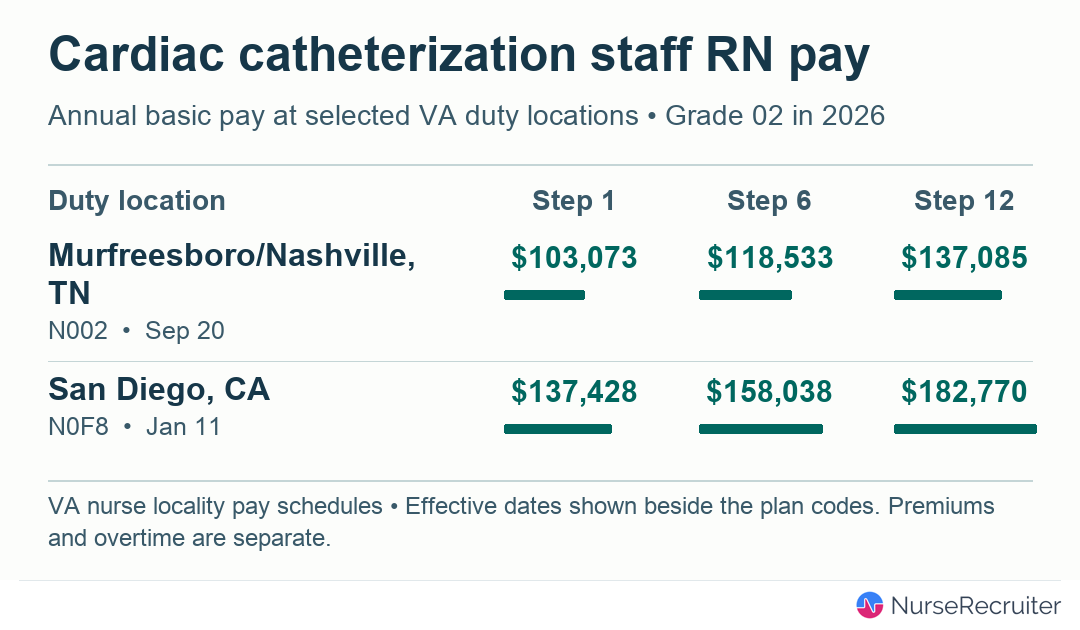
NurseRecruiter's comparison of the VA's 2026 locality schedules identifies these cardiac catheterization staff RN rates: series 0610, assignment C4, grade 02. The amounts are annual basic pay for the named locations and steps.
| VA duty location | Station / salary plan | Effective date | Step 1 | Step 6 | Step 12 |
|---|---|---|---|---|---|
| Nashville and Murfreesboro, TN | 626 / N002 | Sep 20, 2026 | $103,073 | $118,533 | $137,085 |
| San Diego, CA | 664 / N0F8 | Jan 11, 2026 | $137,428 | $158,038 | $182,770 |
For comparison, the May 2025 national median for all registered nurses was $46.90 an hour or $97,550 annually; NurseRecruiter's report on the May 2025 wage figures shows the full RN pay spread. It covers all specialties, rather than cath-lab assignments or VA grades.
Standby pay, callback rates and minimum paid callback hours are separate from base salary. The work commitment also depends on call frequency, required arrival time, the size of the call team, actual callback patterns and relief before the next scheduled shift. Those call terms belong in any comparison of offers alongside the base rate.
Finding cath lab nursing jobs
Cath lab nurse jobs are hospital positions in cardiac catheterization laboratories, sometimes combined with electrophysiology or interventional rooms. NurseRecruiter lists cath lab nursing jobs by location; the posting should say which rooms and procedures the position covers.
- Experience. Employers set their own requirements. ICU and emergency experience with unstable patients and rhythm recognition is relevant, but orientation still covers the devices, sterile workflow, sedation and radiation-safety competencies SCAI's staff guidance describes (see Preparation and working conditions).
- Call. A laboratory that treats emergencies after hours needs a team that can return, so positions there carry a call commitment. Call frequency, response time and post-call relief are often what separate otherwise similar cath lab jobs.
Travel and per diem work
For a travel cath lab contract, establish which procedures are performed, the roles assigned to the RN and how often the on-call team covers emergencies. For per diem coverage, distinguish a scheduled lab day from taking call and ask whether staying through post-procedure recovery is part of the booking.
Work within the laboratory
| Function | Work during a case |
|---|---|
| Patient monitoring and medication | Assess clinical changes, administer ordered medication and monitor response, including assigned sedation responsibilities |
| Circulating | Obtain supplies and coordinate activity outside the sterile field |
| Scrub | Assist with instruments and devices within the sterile field |
| Hemodynamic recording | Record pressures, clinical events and procedure timings; communicate significant changes |
These functions can be divided among nurses and technologists. SCAI's 2021 guidance bases staffing on the procedure's risks and sedation needs. It calls for an RN or equivalent to remain continuously present for sedation monitoring. Cross-training does not remove the need to cover simultaneous patient-monitoring and procedural tasks.
Before a case, the team verifies identity, the intended procedure, current orders, relevant results, access arrangements and the recovery plan. A patient transferred urgently from the emergency department may arrive with incomplete information, so someone needs to be named to communicate what remains outstanding. During the case, clinical changes and procedural events are time-linked; the hemodynamic record and nursing documentation should describe the same sequence.
The division of work also depends on which stations the Cardiac Catheterization Technologists cover, including imaging, physiological monitoring and assistance at the table.
Preparation and working conditions
SCAI's staff guidance identifies sedation assessment, medication knowledge, hemodynamic support, infection control and radiation safety as nursing competencies. Complex coronary, structural-heart and vascular procedures require additional training and skills assessment. ICU and emergency nurses bring experience with unstable patients and rhythm recognition, but cath lab orientation still adds unfamiliar devices, sterile workflow, radiation protection and procedure-specific competencies.
The case mix determines whether the position includes diagnostic studies, emergency intervention, structural procedures or work alongside electrophysiology. Cardiovascular operating room nursing is a separate operative assignment.
The clinical handoff identifies the procedure, vascular access and closure plan, medications, complications and required recovery observations; the receiving nurse needs the findings at transfer, not only that the procedure was "tolerated." Procedure records must be available to the receiving service. These responsibilities continue across a transfer to a recovery bay, inpatient unit or ICU.
Related articles
- Cardiac nursing · Electrophysiology nursing · Cardiovascular operating room nursing
- Critical care nursing · CCRN certification
- Radiation safety roles for nurses · Cardiac Catheterization Technologists
Sources
- VA: 2026 nurse locality schedules, series 0610 (accessed 2026-11-18).
- BLS: Registered nurses, national May 2025 wages (accessed 2026-11-18).
- NurseRecruiter, Average RN pay reached six figures, May 2026 (accessed 2026-11-19). NurseRecruiter's report on the May 2025 BLS RN wage estimates.
- SCAI: Operator and Staff Requirements (accessed 2026-11-18).
- SCAI: 2021 Cardiac Catheterization Laboratory Best Practices, combined slides (accessed 2026-11-18).