
A cardiovascular operating room (CVOR) nurse is a perioperative RN who circulates or scrubs during heart and major blood-vessel operations. Adult programs perform procedures such as coronary bypass and valve surgery; congenital programs may treat patients from infancy through adulthood. The assignment centers on circulating, scrub duties and coordination with the surgical, anesthesia and perfusion teams.
Pay and call
BLS reports wages for hospital RNs across specialties, rather than a separate CVOR occupation. Its May 2025 general medical and surgical hospital benchmark is:
| Employer industry | Middle half of RN hourly wages | Hourly median | Annual median |
|---|---|---|---|
| General medical and surgical hospitals | $39.23–$57.21 | $48.18 | $100,210 |
The range covers the 25th to 75th percentile. These wages exclude overtime premiums, shift differentials and employer benefit costs; NurseRecruiter's report on the May 2025 wage figures covers the national RN distribution. Standby pay, callback minimums and response-time requirements belong alongside base pay when comparing offers. A weekly call obligation commits personal time even in a week with no callbacks, and a short callback window can rule out a commute that would otherwise work for a day-shift job.
AORN's staffing position, reaffirmed in March 2026, recommends relief and rest after call and includes regular work and callback hours when assessing fatigue. Its recommendations guide staffing policy; they do not establish a universal CVOR call schedule.
Roles in the room
| Role | Main work |
|---|---|
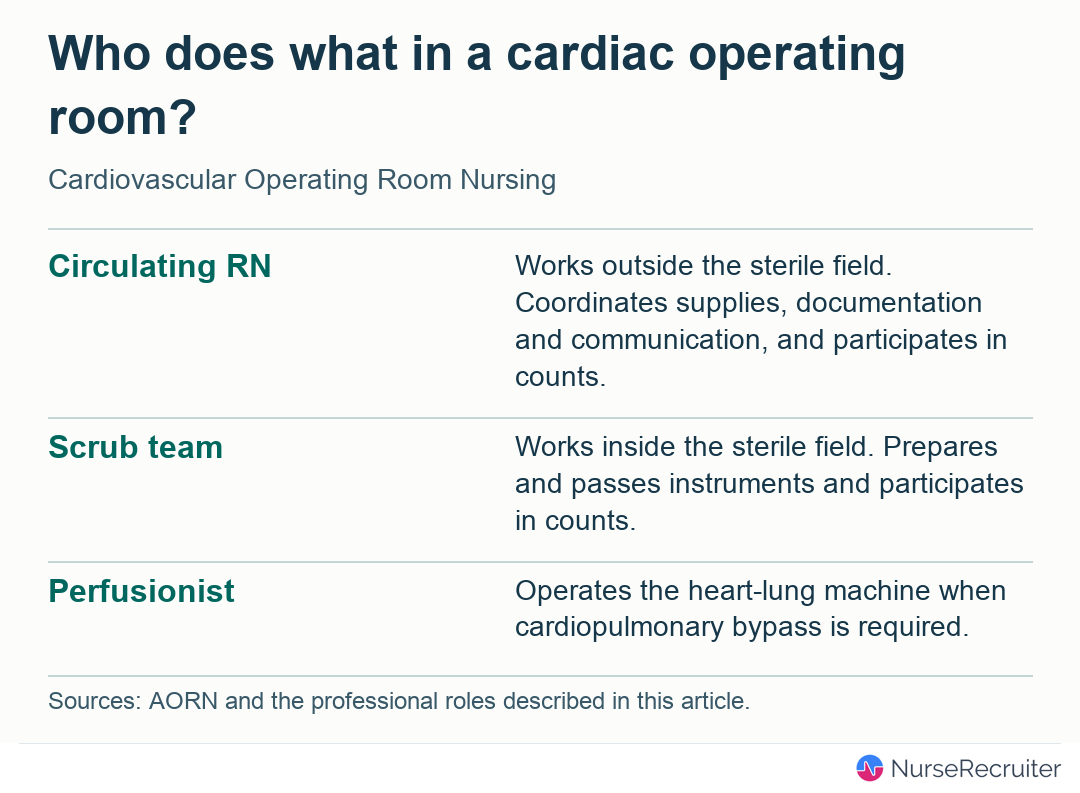
| Circulating RN | Coordinates nursing care outside the sterile field: confirms the patient, planned procedure and room readiness with the team before the operation, then obtains supplies, documents care, participates in counts and communicates changes inside and outside the room |
| Scrub nurse or surgical technologist | Prepares and passes sterile instruments and supplies, and participates in counts |
| Perfusionist | Operates the heart-lung machine when cardiopulmonary bypass is used |
AORN recommends a dedicated RN circulator for each patient throughout an operative or invasive procedure. A nurse may train for both circulating and scrub work; the department assesses the relevant competencies separately. CNOR is a perioperative nursing credential, rather than a CVOR-only certification.
During a bypass case, Cardiovascular Perfusionists operate the extracorporeal circuit. The perfusion assignment has its own equipment, handoff and call responsibilities.
Endoscopic vein harvesting
During a coronary artery bypass graft (CABG) operation, a clinician may use an endoscope to harvest a segment of the patient’s saphenous vein from the leg. The surgeon can use the vein as a graft to carry blood around a blocked coronary artery. Endoscopic vein harvesting (EVH) is a distinct operative skill. An RN who circulates for bypass cases can describe that experience separately from performing the harvest.
For example, Sharp Grossmont Hospital advertised a cardiac-program nurse practitioner position on NurseRecruiter that specifically required EVH experience. The job illustrates why a CVOR posting should identify who harvests the graft, who assists at the field and who circulates. The registered nurse first assistant article explains the preparation for first assisting.
Becoming a CVOR nurse
CVOR work requires an RN license and operating-room competence; there is no separate CVOR license. Hospitals reach that competence in different ways:
- Orientation within the program. Johns Hopkins All Children's Hospital describes orienting CVOR nurses to circulating and second-scrub duties. A nurse who arrives from a general OR still needs orientation to the service's instruments, equipment and emergency procedures, because perioperative competency is specific to the surgical service.
- Entry through perioperative services. Some hospitals hire new graduates into perioperative services through residencies. Johns Hopkins All Children's lists perioperative services among the units hiring residents with less than six months of RN experience; that is an OR entry route, not a guarantee of a cardiac assignment.
- Certification. CNOR ordinarily requires two years and 2,400 hours of perioperative experience, including 1,200 intraoperative hours. CNOR holders may add a cardiology specialty designation. First assisting is a separate role with its own preparation; see registered nurse first assistant.
ICU experience after heart surgery is relevant background but does not establish operative competence; see Programs and assignments.
Programs and assignments
Cleveland Clinic's published unit description lists 15 operating rooms in its Miller Pavilion (11 cardiac, two thoracic and two endovascular) plus two pediatric congenital heart rooms. It describes the main OR as staffed 24 hours a day, seven days a week, with a "minimal call schedule," a shift and specialty-unit differential, and a staffing mix of 60% RNs and 40% surgical technologists. Johns Hopkins All Children's Hospital describes orientation to circulating and second-scrub duties, with scrub technicians, perfusionists, cardiac anesthesiologists and surgeons on the team. Its unit profile covers weekday operating hours with call for after-hours, weekends and holidays. The two descriptions show how differently programs cover nights: one with staffed shifts, the other with call.
NurseRecruiter lists CVOR jobs by specialty and location, alongside general operating room nursing jobs. When comparing positions, the job description should identify patient ages, procedures, circulating or scrub responsibilities, required experience and call terms, including when a new nurse joins the call rotation.
CVOR and cardiovascular ICU are different jobs. The operating-room nurse transfers the patient and operative information to the critical-care team; postoperative ICU experience alone does not establish operative competency. The handoff covers the operation, lines and drains, current support and unresolved care needs. Cardiac nursing also includes telemetry, catheterization and rehabilitation.
Travel and per diem work
For a travel CVOR contract, ask which procedures are scheduled, whether the assignment is circulating, scrubbing or both, and how the team covers emergency returns to the operating room. For per diem coverage, distinguish an elective case-list shift from a call slot with a specified return time.
Related articles
- Perioperative nursing
- CNOR certification
- Registered nurse first assistant
- Cardiac nursing
- Cardiac catheterization laboratory nursing
- Critical care nursing
Sources
-
BLS: May 2025 industry-specific Occupational Employment and Wage Statistics (accessed 2026-11-18).
-
BLS: May 2025 OEWS wage definitions (accessed 2026-11-18).
-
NurseRecruiter, Average RN pay reached six figures, May 2026 (accessed 2026-11-19). NurseRecruiter's report on the May 2025 BLS RN wage estimates.
-
AORN: Perioperative RN Circulator position statement, reaffirmed 2024 (accessed 2026-11-18).
-
AORN: Safe Staffing and On-Call Practices, reaffirmed March 2026 (accessed 2026-11-18).
-
AORN: Operating room nursing roles (accessed 2026-11-18).
-
Cleveland Clinic: Cardiovascular and Thoracic Operating Room Nursing (accessed 2026-11-19). Room counts, 24/7 staffing, minimal call, differentials and RN/surgical technologist staffing mix.
-
Johns Hopkins All Children's Hospital: CVOR unit profile (accessed 2026-11-18).
-
Johns Hopkins All Children's Hospital, pediatric RN residency program (accessed 2026-11-19). Hiring units, including perioperative services, and experience limit.
-
CCI, CNOR certification (accessed 2026-11-18). Eligibility hours and specialty designations, including cardiology.
-
Texas Heart Institute: The perfusionist's role (accessed 2026-11-18).
-
NICE, endoscopic saphenous vein harvest for coronary artery bypass grafting (accessed 2026-11-19)
-
Sharp HealthCare on NurseRecruiter, cardiac-program nurse practitioner with endoscopic vein harvesting experience (accessed 2026-11-19)