
Electrophysiology (EP) nurses work with patients undergoing evaluation and treatment of heart rhythm disorders. An EP laboratory may perform diagnostic rhythm studies, catheter ablations, or implantation of rhythm-management devices. A device clinic may also follow patients in person or review transmissions from implanted devices. Laboratories and clinics can share a department while assigning these duties to different teams.
The case mix in one EP lab
At St. Joseph’s University Medical Center in Paterson, New Jersey, the electrophysiology team reported about 150 ablations and 400 device implants in 2021. The team also described a 12-week orientation with an assigned preceptor. For a nurse joining an EP lab, procedure mix helps explain what that orientation will cover. A service with a large implant list offers a different pattern of supervised cases from one dominated by ablations.
Pay and employer comparisons
NurseRecruiter compiled May 2025 BLS RN wages by employer industry. The hourly range below spans the 25th to 75th percentiles. These are all-RN industry figures, not specialty-specific rates. BLS excludes overtime premiums and employer-paid benefits.
| U.S. employer industry | Middle half of hourly wages | Hourly median | Annual median |
|---|---|---|---|
| General medical and surgical hospitals | $39.23–$57.21 | $48.18 | $100,210 |
| Outpatient care centers | $39.39–$61.54 | $47.77 | $99,350 |
A hospital EP lab can use a procedural RN scale shared with other cardiac services. An offer should specify call frequency, callback minimum, late-running cases, and whether staff rotate into the catheterization lab. See comparing RN pay offers.
How the work differs by service
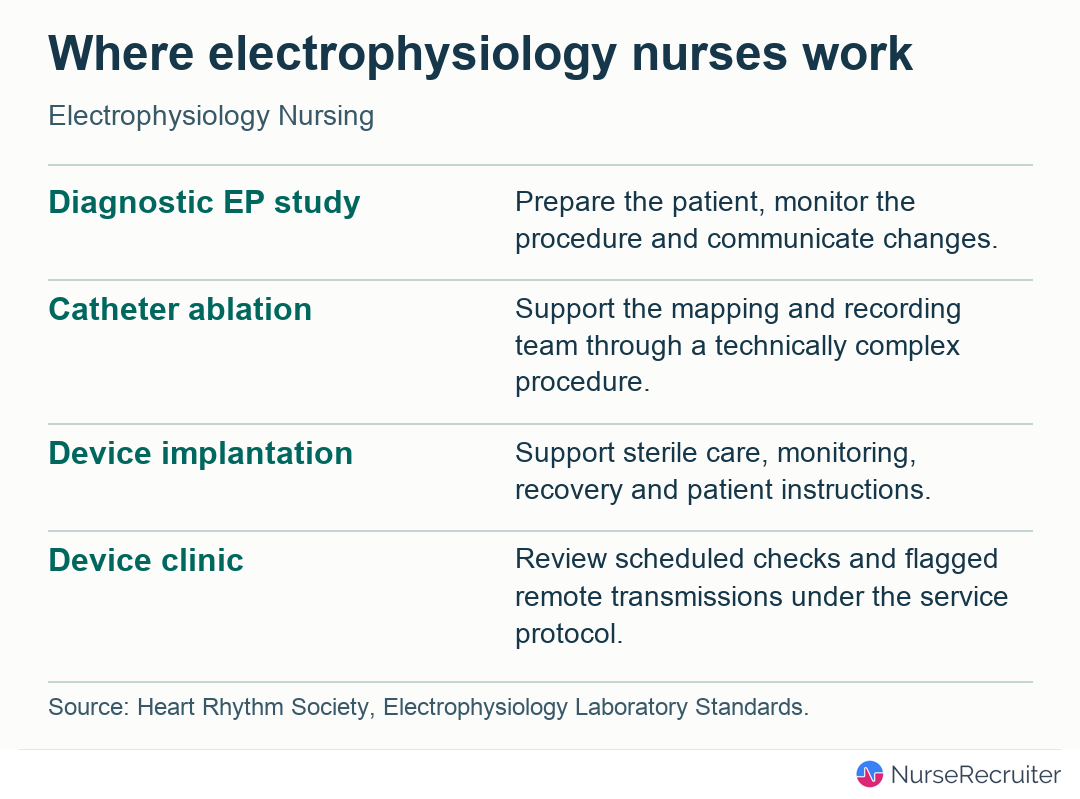
| Service | Focus of the nursing assignment |
|---|---|
| Diagnostic EP study | Prepare the patient, coordinate the monitoring plan, and document and communicate changes during the study. |
| Catheter ablation | Support a longer, technically complex procedure involving specialized recording and mapping systems, anesthesia or sedation, and coordinated recovery. |
| Pacemaker or defibrillator implantation | Support sterile procedural care, patient monitoring, recovery instructions, and the handoff to the team responsible for device follow-up. |
| Device clinic or remote monitoring | Work through scheduled checks and flagged transmissions under the service’s protocols, arrange clinician review, and document patient contact. |
In conventional coronary catheterization, the clinical question often concerns blood flow or pressure. An EP study asks how an electrical impulse travels through the heart and where an abnormal rhythm starts or is sustained. Some equipment and skills overlap, including vascular access care, rhythm recognition, and radiation protection. The team also needs expertise with intracardiac signals, pacing systems, and procedure-specific equipment.
The nurse’s role in the laboratory
The Heart Rhythm Society’s 2014 laboratory consensus statement distinguishes direct patient care from the technically demanding tasks of recording, mapping, and stimulation. Local teams allocate those stations according to training and case complexity. A nurse may circulate, monitor the patient, assist with an implant, or recover a patient. If sedation is part of the nursing role, its permitted depth, training requirements, monitoring responsibilities, and available rescue support require explicit definition. A person responsible for observing the patient must be able to do so throughout the case.
The handoff can extend well beyond a recovery bay. After a device procedure, the patient needs to know which service will address wound questions, who manages device follow-up, and what happens if equipment for remote monitoring has not arrived. A transmission waiting in a queue needs an assigned reviewer. Care coordination is as much a part of that work as reading a tracing.
Certification
EP credentials come from the International Board of Heart Rhythm Examiners (IBHRE), which tests allied professionals as well as physicians. They are not nursing-only credentials.
| Credential | What it covers | Eligibility |
|---|---|---|
| CEPS: Certified Electrophysiology Specialist | Cardiac electrophysiology | Involvement in heart rhythm management, a supervisor's or colleague's letter of recommendation, and one of: two years of cardiac EP experience; a formal pacing or EP training program with at least six months of didactic training plus six months in the field; or passing CCI's RCES examinations plus 12 months of clinical EP experience. |
| CCDS: Certified Cardiac Device Specialist | Follow-up and management of implanted pacemakers and defibrillators | Allied professionals involved in device management; IBHRE names nurses, technicians, engineers and others. New certifications are valid for four years, after which IBHRE's continuing competency program applies. |
Broader nursing credentials such as CV-BC, described under cardiac nursing, cover cardiac-vascular practice generally rather than EP procedures or device follow-up.
Comparing EP positions
An assignment should specify procedure-room, recovery and device-clinic coverage, competency validation and responsibility for urgent findings outside clinic hours. Nurses comparing cardiac procedural postings, for example in NurseRecruiter's cardiac cath lab job category, can check each one against these points. The IAC’s August 2025 standards distinguish procedural work from onsite and remote device monitoring. IAC has since announced that its cardiac electrophysiology accreditation program will end on December 31, 2026, with continued support for currently accredited facilities through sponsoring organizations.
Experience in cardiac nursing or critical care can provide a starting point. It does not by itself establish competence with a particular mapping platform, the device clinic’s workflow, or an individual laboratory’s sedation assignment.
Related articles
Sources
- May 2025 Occupational Employment and Wage Statistics (accessed 2026-11-18) — BLS; RN industry wage comparisons compiled by NurseRecruiter.
- May 2025 OEWS Technical Notes (accessed 2026-11-18) — Wage definitions and survey scope.
- Electrophysiology Laboratory Standards: Process, Protocols, Equipment, Personnel, and Safety (accessed 2026-11-18) — Heart Rhythm Society, 2014; full primary consensus statement, including nursing and technical roles.
- August 2025 Cardiac Electrophysiology Standards (accessed 2026-11-18) — IAC; procedural and device-clinic service distinctions.
- Discontinuation of Cardiac Electrophysiology and Cardiovascular Catheterization Accreditation (accessed 2026-11-18) — IAC announcement dated July 9, 2026; effective December 31, 2026.
- Allied Professional CEPS Exam Eligibility Policy (accessed 2026-11-19) — IBHRE; experience, training and RCES pathways and recommendation letter.
- Allied Professional CCDS Exam (accessed 2026-11-19) — IBHRE; device-follow-up scope, eligible professions and four-year validity.
- EP Lab Digest, interview with the St. Joseph’s University Medical Center EP team (accessed 2026-11-19)