
Evaluate a transition-to-practice program against the outcomes it was designed to achieve. Attendance is one part of that picture; it should not stand in for every outcome.
CCNE's 2021 entry-to-practice residency standards call for a written evaluation plan and examine completion, retention beyond the program, satisfaction and resident performance. As checked in September 2026, CCNE states that these standards remain in effect through December 31, 2026, although amended standards have been published. 2021 standards, current standards page
These are requirements for the relevant CCNE accreditation process, not a universal description of every employer's program.
Define the participants
State who enters the program and when. Separate newly licensed nurses from experienced nurses joining a new organization or specialty when their learning needs and program structures differ.
Identify the cohort before calculating results. Explain how transfers, leave, delayed completion and departures are handled.
A report should allow a reader to understand who is missing from the follow-up, not just who remained available to answer a survey.
Keep the outcomes distinct
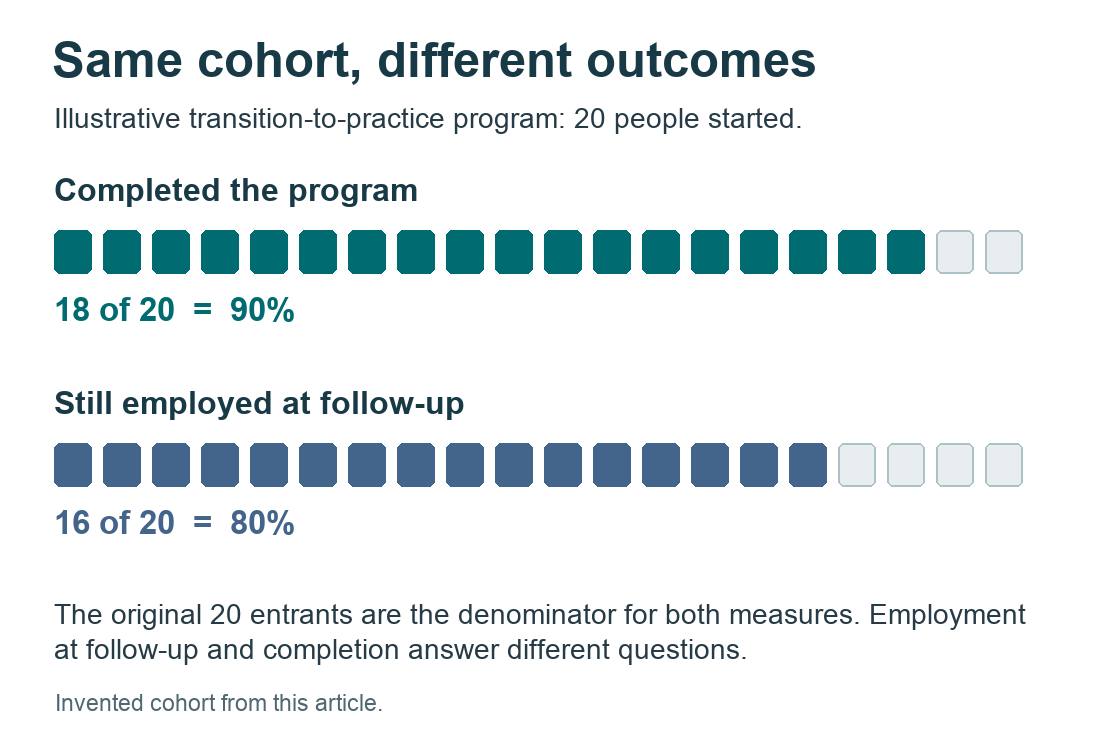
Both figures use the original 20 entrants. Neither outcome measures clinical competence.
Program completion describes finishing defined requirements. Retention describes remaining in a specified employment or practice setting at a specified time. Satisfaction reflects reported experience. Performance assessment examines demonstrated capabilities.
For a hypothetical cohort of 20 participants, 18 completing gives a completion proportion of 90 percent. If 16 remain with the employer at a later date, the corresponding proportion is 80 percent of the original cohort. Neither number by itself measures competence.
Avoid changing the denominator to program completers without saying so.
Match measures to the question
Use established assessment tools according to their instructions, and explain the source of each measure. Self-reported confidence, a preceptor assessment and an observed demonstration are different forms of evidence.
NCSBN's transition study reported several kinds of outcomes, including self-reports, linked preceptor ratings and hospital retention data. That variety is a reminder to name what was actually measured. NCSBN study results
Do not describe a confidence score as independently demonstrated clinical competence.
Examine whether support was delivered
Alongside outcomes, review the program's actual implementation. Were learning activities available, were preceptors prepared and could participants obtain feedback?
Ask learners and preceptors about specific barriers. A cancelled activity, repeated preceptor changes or insufficient protected time should be visible in the evaluation.
Distinguish a program design problem from a gap between the design and what staff actually received.
Use findings to improve
Record the change proposed, the responsible person and the next review date. Compare cohorts carefully when staffing, recruitment or working conditions changed at the same time.
Improved retention after a program change is not automatically proof of causation. Explain the limits of the comparison.
Compare what the program promised with the orientation and preceptorship each participant actually received.
Related
preceptor succession · orientation versus preceptorship.
Sources
- Entry-to-Practice Residency Standards, 2021 (accessed 2026-09-17) — CCNE, Standard IV.
- Standards, Procedures and Guidelines (accessed 2026-09-17) — CCNE.
- Transition to Practice Study Results (accessed 2026-09-17) — NCSBN.