
A telehealth nursing workflow organizes the work before, during, and after care delivered through communication technology. It includes more than the video conversation: scheduling, preparation, identity verification, clinical information, documentation, and follow-up all need an assigned place in the process.
HHS advises practices to adapt telehealth workflows to their setting, patient population, technology, and services. A process that works for a scheduled education visit may not fit a time-sensitive assessment or a patient who needs substantial communication support.
Prepare the patient and the team
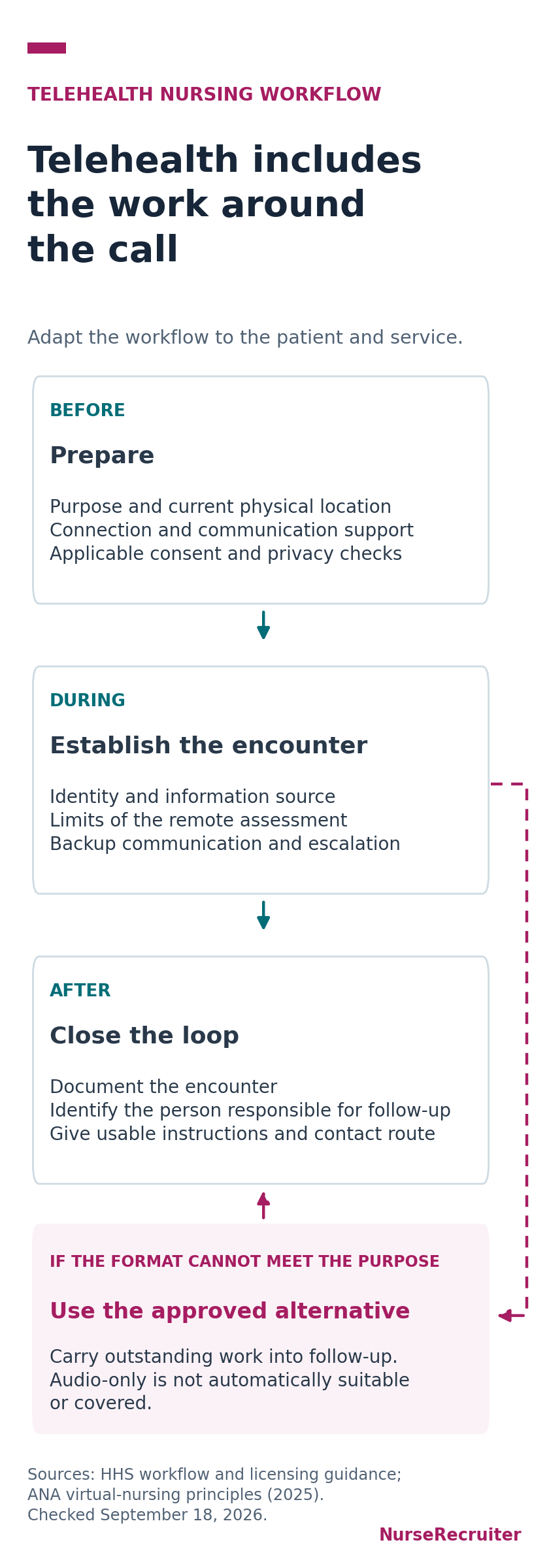
Illustrative nursing workflow to adapt to the service. Verify the patient’s current physical location and arrange needed support before the visit. A fallback must preserve the purpose of care; this diagram does not establish licensing authority, consent compliance or coverage for audio-only care.
Before the visit, identify the purpose and whether remote care is appropriate. Verify the patient's current physical location through the approved intake process, then confirm how the patient will connect, what information is needed, and who will help with technical problems. Arrange necessary communication support before the appointment rather than assuming it can be added after the call begins.
A preparation conversation can clarify whether the patient has a usable device, a private place, and a way to receive instructions. HHS recommends assistance for patients who are uncomfortable completing forms electronically, along with guidance on the camera, sound, lighting, and troubleshooting.
The organization must also determine applicable consent, privacy, and practice requirements. ANA's virtual-nursing principles emphasize professional scope and geographically applicable rules; a technology platform does not itself authorize practice.
Establish a reliable encounter
At the start, use the approved process to verify identity and clarify the reason for the visit. Identify other people participating and explain their roles. Confirm the backup communication and escalation plan appropriate to the service.
Document the source of information. A patient-reported measurement, a visible observation, and a finding obtained by an in-person clinician are not interchangeable. If the remote format cannot support a needed assessment, follow the care pathway for additional evaluation rather than treating the missing information as normal.
Illustrative connection problem
During an illustrative education visit, the video freezes repeatedly. The nurse can still hear the patient but cannot confirm the demonstration that was planned. The team uses its approved alternative process, which may include rescheduling that part of the encounter or arranging in-person support.
The example does not assume that audio-only care is always appropriate or covered. It shows why a backup plan should preserve the purpose of the encounter, not merely keep the conversation going.
Close the loop after the visit
HHS recommends documenting the telehealth encounter and evaluating the patient's experience. A nursing workflow should also identify outstanding questions, the responsible clinician, and how the patient will obtain further help. Instructions need to be accessible in the format the patient can use.
A local review might examine failed connections, incomplete visits, unresolved follow-up, and the need for additional support. Include the preparatory and follow-up work when estimating staffing. The visible appointment is only part of the service.
When a patient cannot use the normal platform, consider digital accessibility in planning the visit.
Related
Remote Patient Monitoring and Nursing
Digital Accessibility in Nursing
Sources
-
HHS: Licensing Across State Lines (accessed 2026-09-17).
-
HHS: Planning Your Telehealth Workflow (accessed 2026-09-17).
-
ANA: Principles of Virtual Nursing (accessed 2026-09-17).
-
HHS and DOJ: Guidance on Nondiscrimination in Telehealth (accessed 2026-09-17).