
Match the sheet to the product
A safety data sheet, or SDS, communicates a hazardous chemical's identity, hazards, and protective information. In healthcare, it can help staff understand products used in disinfection, specimen processing, maintenance, and other tasks.
Start with the product identifier on the container. The federal Hazard Communication Standard uses that identifier to connect the label, chemical inventory, and SDS. A sheet for a similarly named product or a different formulation may not answer the question in front of you.
NIOSH warns that concentration and other ingredients can change precautions. A general chemical reference is useful background, but it does not replace the actual product's label and SDS.
Use the section headings
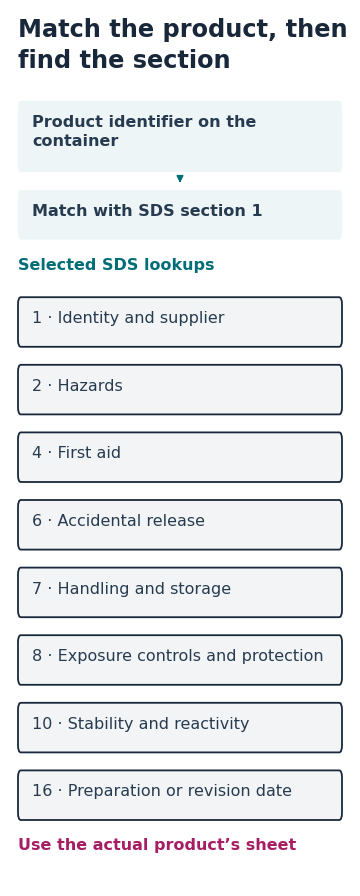
Selected lookups in the federal SDS format. This reference does not decide who is trained or authorized to handle an incident.
The standard organizes information into numbered sections. These are useful starting points:
| Question | SDS section |
|---|---|
| Is this the correct product, and who supplies it? | 1: Identification |
| What hazards are identified? | 2: Hazard identification |
| What first-aid information is provided? | 4: First-aid measures |
| What does the sheet say about an accidental release? | 6: Accidental release measures |
| How should the product be handled and stored? | 7: Handling and storage |
| What exposure controls and protection are described? | 8: Exposure controls/personal protection |
| What reactivity or incompatibility information is available? | 10: Stability and reactivity |
| When was the sheet prepared or revised? | 16: Other information |
Reading one section may lead to another. For example, protective equipment information needs to be understood alongside the task, exposure conditions, and employer's procedures.
OSHA's rule includes headings for sections 12 through 15, but states that it does not enforce their information requirements because those areas are outside its jurisdiction. Do not interpret that limitation as permission to ignore applicable disposal or transport rules.
Check access before an incident
Required SDSs must be readily accessible during each work shift in the employee's work area. Electronic access is allowed if it creates no barrier to immediate access.
A practical orientation exercise is to choose a stocked product and locate its sheet using the unit's normal process. Confirm the product identity and ask how access works when the usual computer, network, or staff contact is unavailable. Record an access problem with enough detail for the responsible team to correct it.
Know what the sheet does not decide
An SDS does not by itself authorize an untrained worker to clean up a spill, select a respirator, or perform a task outside the employer's procedure. Use the designated response process and obtain trained assistance when the situation exceeds your role.
Likewise, first-aid information should support prompt care rather than delay it while someone searches through a document. Report an exposure through the workplace's clinical evaluation and incident-reporting channels.
For the surrounding training and labeling system, see hazard communication for nurses.
Sources
- eCFR: 29 CFR 1910.1200, Hazard Communication (accessed 2026-09-17) — Text current through September 15, 2026.
- NIOSH: Hazard Communication for Disinfectants Used Against Viruses (accessed 2026-09-17) — Archived 2020 guidance.