
Quality improvement seeks to improve a process or service. Research is designed to develop or contribute to generalizable knowledge. In practice, one activity can have both purposes. The distinction cannot be settled simply by calling a project “QI,” using familiar improvement methods, or deciding whether to publish it.
In the United States, HHS human-subject protections apply according to regulatory definitions and coverage. Organizational review processes may also apply even when an activity does not require IRB review under those regulations.
Start with purpose and design
Describe what the project is trying to learn, what care or work will change, how participants are selected, and what information will be collected. Ask whether the aim is limited to implementing and measuring a local practice or also includes a research purpose.
OHRP's quality-improvement FAQ explains that some projects designed to improve care also serve research purposes. It also explains that an intention to publish is insufficient to classify a project as research. A project can involve research even when publication is not planned.
The FAQ predates the revised Common Rule and explicitly identifies that limitation. Use it for its general distinctions alongside current applicable regulatory text and institutional review.
Two illustrative proposals
In one hypothetical proposal, a ward audits whether staff use an already adopted documentation process and uses the results for local administrative improvement. In another, investigators design a comparison of different approaches to answer a broader scientific question and collect additional participant information for that purpose.
These sketches illustrate different purposes; they are not regulatory determinations. Details about interventions, data identifiability, interaction with participants, institutional coverage, and exemptions could change the review route. A project containing both activities may need more than one determination or oversight arrangement.
Ask the questions in order
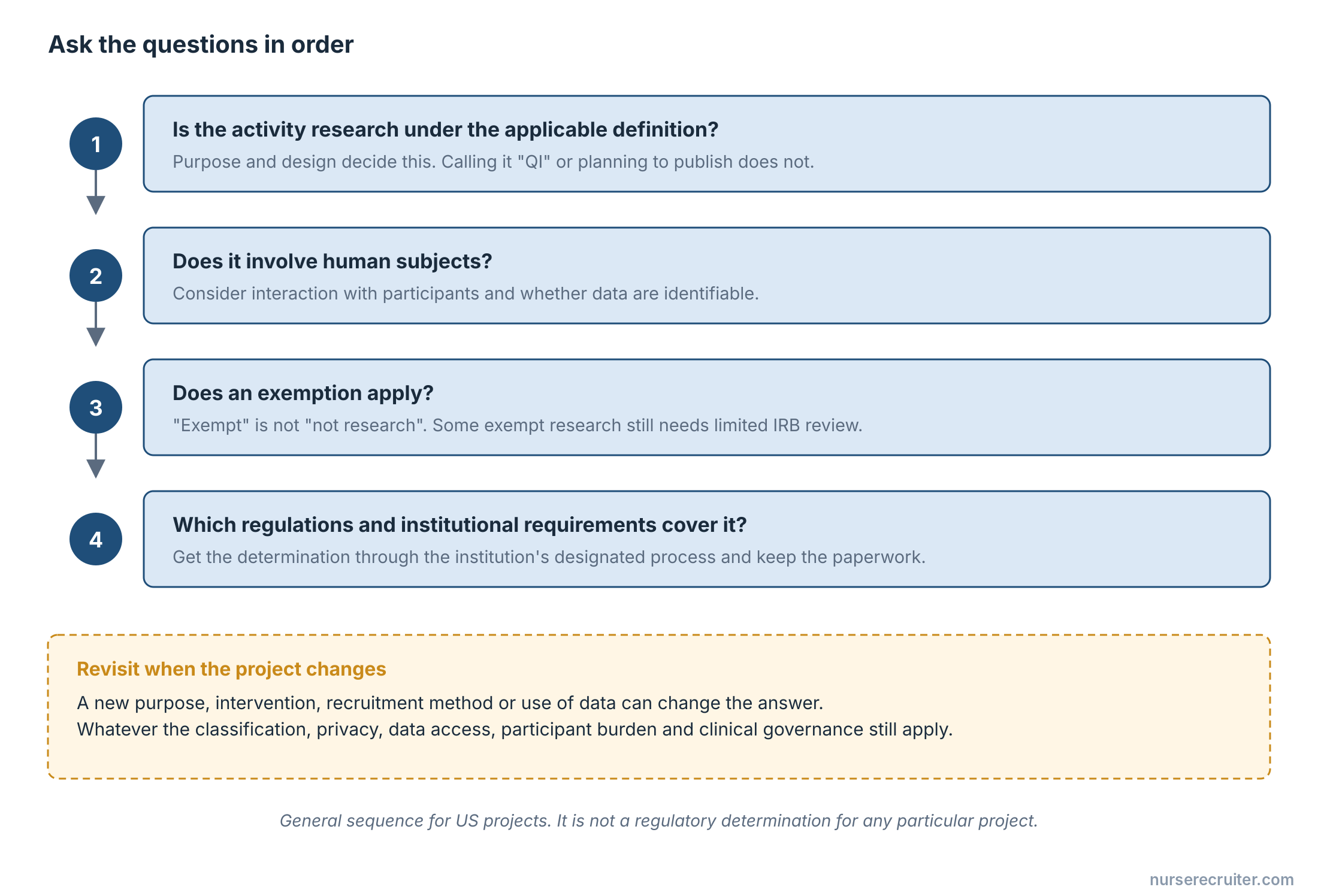
First clarify whether the activity is research under the applicable definition. If it is, determine whether it involves human subjects, whether an exemption applies, and which regulations and institutional requirements cover it. Some exempt research requires limited IRB review. “Exempt” is not a synonym for “not research.”
Obtain the determination through the institution's designated process. Keep a concise written description and the resulting documentation with the project materials. Do not treat a colleague's experience with a similar project as approval for a new one.
Revisit changes
A local improvement project can acquire a new research component if its purpose, intervention, recruitment, or data use changes. Review the change before assuming the original determination still applies. Likewise, a later plan to publish does not, by itself, retroactively turn every improvement activity into research.
Regardless of classification, address privacy, appropriate data access, participant burdens, and clinical governance. The absence of one regulatory requirement does not remove every responsibility.
See research ethics and institutional review boards for the broader review framework.
If the work is an improvement project, consider how patients can take part in choosing what to change.
Sources
- HHS OHRP: Quality Improvement Activities FAQs (accessed 2026-11-11).
- eCFR: 45 CFR 46.102, Definitions (accessed 2026-11-11).
- eCFR: 45 CFR 46.104, Exempt research (accessed 2026-11-11).