
Nurse peer-assistance and alternative-to-discipline programs address substance use disorders and, in some jurisdictions, other health conditions affecting practice. They combine assessment, monitoring and support with requirements for safe work. Eligibility, confidentiality and reporting rules come from the individual program and state board of nursing.
NCSBN describes alternative programs as a route to early identification, treatment and possible retention of a license without public discipline. Its state locator identifies substance-use programs. Participation does not carry one nationwide promise of confidentiality or unrestricted practice.
Assistance and regulatory authority
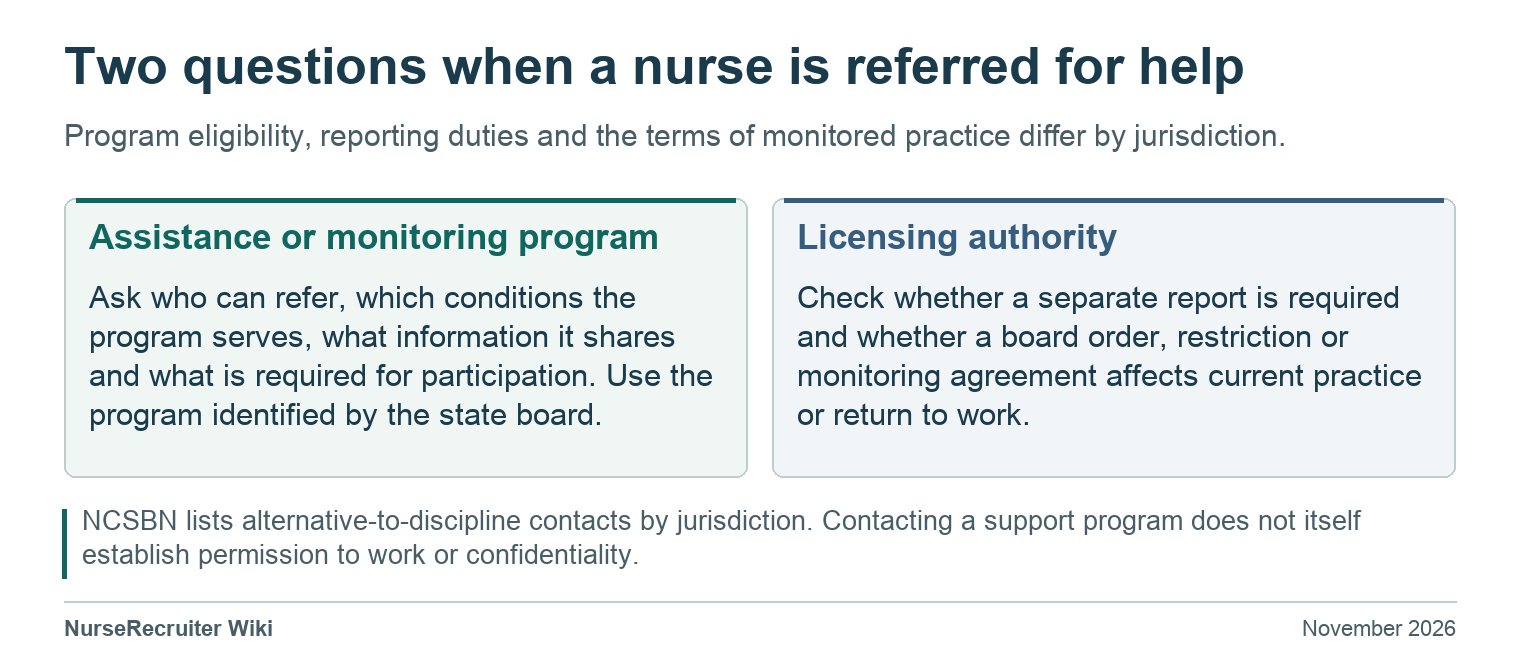
The program explains its participation requirements; the board determines license status and regulatory restrictions. A monitoring agreement, employer permission and current authority to practice address different parts of returning to work.
The American Association of Nurse Attorneys offers an attorney directory for nurses seeking legal representation. Treatment providers and peer supporters have different roles from counsel in a licensing matter.
Texas: a documented program example
The Texas Peer Assistance Program for Nurses (TPAPN) serves nurses with substance use disorders, mental health conditions or both. Evaluation informs an individualized monitoring plan. Case managers coordinate with the nurse, providers, employer and peer supporter.
Its April 2026 handbook sets these terms:
| Issue | Texas program terms |
|---|---|
| Duration | Individualized; participation may range from a minimum of one to five years. |
| Program fee | No monitoring fee. Some board orders require a separate $350 LVN or $500 RN/APRN payment. |
| Return to nursing | Required provider releases, TPAPN authorization, an approved position and a signed work agreement precede practice. |
| Employer involvement | Returning participants notify the employer; work agreements can impose supervision and practice restrictions. |
| Confidentiality | Self-referral may remain confidential from the board. Third-party referrals are reviewed with the board; nonparticipation or nonadherence can trigger reporting. |
The handbook describes restrictions affecting shifts, work settings and access to controlled substances; the individual's agreement determines applicable conditions. These can materially affect eligibility for travel or per diem work.
Costs and evaluation assistance
Participants pay expenses such as evaluations, treatment, recovery support and drug testing. The Texas Nurses Foundation offers eligible nurses 50% of the initial evaluation cost, up to $750, paid to the evaluator after completion.
Eligibility requires a current RN or LVN license, starting TPAPN intake, an initial evaluation, no previous grant under this policy and demonstrated financial need. This is evaluation assistance, not coverage of all participation expenses.
Referral and board reporting
TPAPN's explanation in the Texas Board's October 2025 bulletin distinguishes early referral for a condition that has not affected practice from a report about a suspected practice violation. It states that mandated reporters—including employers, nurses and peer-review committees—must report suspected practice violations to the board. This Texas example should not be substituted for another state's nurse practice act.
When the board investigates
A board complaint is an administrative regulatory matter, separate from an employer's internal review. NCSBN's overview of the discipline process says an investigation can include asking the licensee to respond to the allegations in writing, and that investigations often take many months. A nurse's written response becomes part of what the board reviews, which is one reason nurses commonly seek counsel before answering.
A case may close, resolve through a settlement conference in which the board and nurse agree to the terms and type of action, or proceed to a hearing. At a hearing, prosecuting attorneys present the case to the board, a panel or an administrative law judge, and the nurse or the nurse's attorney presents a defense. Alternative-to-discipline programs are the voluntary, non-public and non-disciplinary route for eligible cases.
Mental health questions on applications
As of November 18, 2026, the Dr. Lorna Breen Foundation reports that 82 licensure boards, 1,087 hospitals and 3,306 other care facilities have removed stigmatizing mental health questions from licensing or credentialing applications through its Wellbeing First Champion Challenge. These are the foundation's reported counts across health professions, not a count of nursing boards.
The change concerns application questions. Current impairment, practice restrictions and program-reporting duties remain separate issues. Nurse burnout covers the broader workforce-wellbeing context.
Immediate help
- 988 Suicide and Crisis Lifeline: call, text or chat 988; free, confidential and available 24 hours a day.
- SAMHSA National Helpline: 1-800-662-HELP (4357); a free, confidential, 24/7 treatment-referral and information service, in English and Spanish, for mental and substance use disorders.
Related articles
- State boards of nursing
- Nurse practice acts and boards of nursing
- Nursing license status terms
- Addictions nursing
- Nurse burnout
- Nursing ethics
Sources
- NCSBN: Alternative-to-discipline programs and state locator (accessed 2026-11-18).
- NCSBN: Discipline investigation process (accessed 2026-11-18) — Written responses and investigation length.
- NCSBN: Board proceedings (accessed 2026-11-18) — Settlement conferences and hearings.
- TPAPN: Participant handbook (accessed 2026-11-18) — April 9, 2026; confidentiality, fees, work approval and individual restrictions.
- TPAPN: Participants (accessed 2026-11-18) — Current program description and evaluation-grant eligibility; official indexed text checked because the direct page returned 403.
- Texas Board of Nursing: October 2025 bulletin (accessed 2026-11-18) — TPAPN's referral-versus-reporting explanation, printed page 22.
- The American Association of Nurse Attorneys (accessed 2026-11-18) — Attorney directory and professional role.
- Dr. Lorna Breen Foundation (accessed 2026-11-18) — Foundation-reported application reform counts.
- 988 Suicide and Crisis Lifeline (accessed 2026-11-18).
- SAMHSA National Helpline (accessed 2026-11-18).