
Addictions nurses assess and care for people affected by substance use and addictive disorders. Jobs include withdrawal management, opioid treatment programs, hospital consultation and outpatient recovery services. The assignment combines nursing assessment, ordered medication, patient education and coordination with mental health and community services.
Earnings and employer pay benchmarks
NurseRecruiter's analysis of HRSA's 2022 National Sample Survey of Registered Nurses estimates $84,800 in mean primary-job earnings for 2021 among full-time RNs without an APRN license whose main clinical specialty was substance use disorder care. The estimate uses 53 respondents; its approximate 95% confidence interval is $76,300–$93,200.
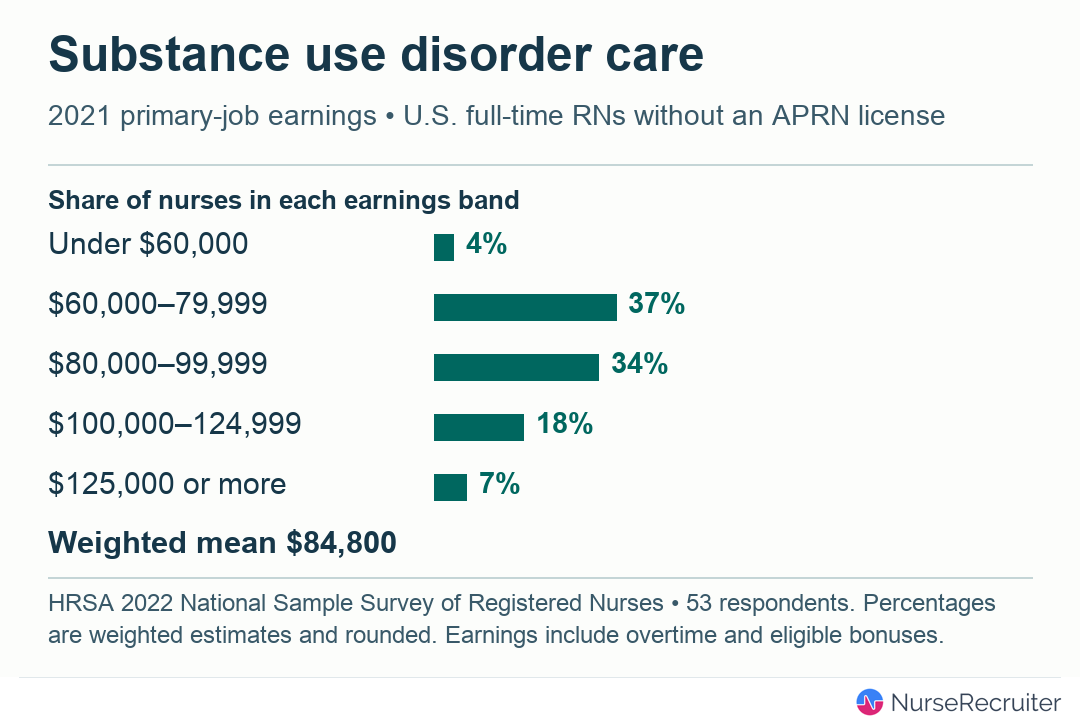
The survey includes overtime and bonuses other than sign-on bonuses, and caps public-use individual earnings at $250,000. This small historical subgroup is distinct from the broader employer-industry wage estimates below.
| U.S. employer industry, May 2025 | Middle half of RN hourly wages | Hourly median | Annual median |
|---|---|---|---|
| Psychiatric and substance-use hospitals | $39.66–$51.95 | $46.67 | $97,060 |
| Outpatient care centers | $39.39–$61.54 | $47.77 | $99,350 |
These BLS figures cover RNs across specialties within each industry. The range runs from the 25th to 75th percentile. OEWS wages exclude overtime premiums, shift differentials and employer benefit costs. An RN covering overnight withdrawal management and an outpatient nurse working early dosing hours can have different shift commitments and differential eligibility. Comparing RN pay offers also requires the actual shift and additional-pay terms.
Scheduled and actual hours
In HRSA’s 2022 U.S. nursing workforce survey, among full-time RNs without an APRN credential who spent the largest share of their patient-care time in substance use disorder care, 30.4% reported actually working more than 40 hours in a typical week in their primary nursing job in 2021. The estimated share working more than 40 hours had a 95% confidence interval of 13.4% to 47.5%. A program that combines clinic visits with on-call withdrawal coverage can spell out which hours belong to each duty. The specialty survey notes explain which hours count.
Settings and nursing work
| Setting | Main responsibilities |
|---|---|
| Withdrawal management | Assess changes, monitor response to ordered treatment and escalate deterioration |
| Opioid treatment program | Provide nursing assessment and medication services; communicate treatment concerns and coordinate interruptions or transfers |
| Hospital consultation | Establish treatment history and patient goals, support the inpatient team and arrange follow-up |
| Outpatient or community service | Provide education and harm-reduction support, monitor engagement and coordinate treatment, primary care and community services |
Program staffing, observation capacity and emergency transfer arrangements determine the work behind a label such as “detox.” When a specialty search on a nursing job board such as NurseRecruiter returns addictions roles, the posting's setting and these arrangements distinguish one job from another. Jobs also vary in required addiction-specific education, availability of peer support and the degree of independent practice. Nurses coming from psychiatric nursing, emergency care or community clinics may have relevant skills while still needing orientation to a program's medication, privacy and transfer policies.
Registered and advanced practice nursing duties differ; the Addictions Nursing Certification Board offers the CARN and CARN-AP credentials. Specialty certification does not grant prescriptive authority. Nurses whose own substance use affects practice face a separate regulatory process; see peer assistance and license trouble.
Continuity between programs and hospitals
A patient already receiving opioid treatment may enter a hospital for an unrelated condition. Medication reconciliation establishes the current treatment; a direct handoff identifies the receiving program, next treatment arrangements and contact for unresolved information. Communication must follow applicable consent and confidentiality requirements. Adding a referral to discharge paperwork does not establish that a clinic can accept the patient or that the patient has a way to get there; the handoff should record which next step has actually been confirmed.
The nursing record identifies actual observations, response to treatment and barriers to attending care. It preserves the patient's stated goals rather than substituting a label such as “noncompliant.” A missed visit can reflect an interrupted work schedule, lost transportation, medication concerns or a change in the person's goals, and each explanation calls for a different nursing response.
Travel and per diem work
A travel assignment should specify whether the receiving service provides withdrawal management, residential treatment or outpatient follow-up. For per diem coverage, ask who handles intake and ongoing medication coordination and how the next team receives information about patients awaiting follow-up.
Related articles
Sources
- ANA and IntNSA: Addictions Nursing Scope and Standards, third-edition introduction (accessed 2026-11-18).
- SAMHSA: Federal Guidelines for Opioid Treatment Programs, 2024, patient records and continuity (accessed 2026-11-18).
- SAMHSA: Current 42 CFR Part 8 questions and answers (accessed 2026-11-18).
- ANCB: CARN and CARN-AP certification (accessed 2026-11-18).
- BLS: May 2025 industry-specific Occupational Employment and Wage Statistics (accessed 2026-11-18).
- BLS: May 2025 OEWS wage definitions (accessed 2026-11-18).
- HRSA: 2022 National Sample Survey of Registered Nurses public-use data (accessed 2026-11-18).
- HRSA: 2022 NSSRN questionnaire, clinical specialty and primary earnings (accessed 2026-11-18).
- HRSA: Public-use codebook, methodology and replicate weights (accessed 2026-11-18).