
Pediatric intensive care unit (PICU) nurses care for critically ill or injured infants, children and adolescents, sometimes including young adults. The service's admission criteria determine its age range and whether cardiac surgery, trauma, transplantation and other complex care occur in the general PICU or a separate unit.
Pay
NurseRecruiter compiled the following rates from Seattle Children's 2026–2029 RN agreement. The ratification schedule is in effect in November 2026; the next increase begins with the first full pay period after March 1, 2027.
| Experience label in the agreement | Wage step | Current base hourly rate | Rate after the March 2027 increase |
|---|---|---|---|
| Less than one year | 1 | $51.60 | $54.85 |
| Year one | 2 | $53.24 | $56.49 |
| Year five | 6 | $59.87 | $63.12 |
| Year nine | 10 | $66.52 | $69.77 |
These are rates for covered hospital RNs. They are not a separate national wage estimate for this specialty.
The same agreement provides $1.35 an hour for one approved, relevant national nursing certification maintained in good standing. Its $4 an hour ECMO premium applies during assignment to a pump as an ECMO specialist or while carrying the ECPR pager. Those assignment conditions matter: a PICU appointment does not automatically earn every premium in the agreement.
For national context, the May 2025 RN median was $46.90 an hour across employers and specialties; NurseRecruiter's report on the May 2025 wage figures shows the full spread. Registered nurse pay includes geographic comparisons; the employer's credited experience and paid shift premiums determine a specific offer.
Finding PICU jobs
PICU nurse jobs are at children's hospitals and at other hospitals with pediatric critical care services; the SCCM levels of care described below mean two PICUs can offer quite different services. NurseRecruiter lists pediatric ICU openings by location. A nurse comparing them should look for the details in Assignment and coverage in each description rather than relying on the unit name.
- New graduates. Some children's hospitals train new graduates for the PICU through a residency. Johns Hopkins All Children's Hospital hires residents with less than six months of RN experience into critical care, in an ANCC-accredited program whose practice settings include the PICU.
- Experienced nurses. Adult ICU or pediatric ward experience is relevant but does not by itself document PICU competence. CCRN (Pediatric) eligibility counts hours caring for acutely or critically ill pediatric patients, so pediatric step-down work can count toward it.
- Schedules. PICUs are staffed around the clock; staff positions include nights and weekends unless the posting says otherwise. Assignment premiums such as Seattle Children's ECMO rate apply only to the defined duty.
- How long hiring takes. In Texas's 2024 hospital nurse staffing study, 21.3% of the 47 hospitals reporting on pediatric ICU positions usually took 91 days or more to fill them, and 63.8% filled them within 60 days. These are staff-hiring measures from one state, not vacancy counts; NurseRecruiter's 2026 staffing numbers report sets out the wider hiring picture.
- Travel assignments. Temporary PICU coverage appears among NurseRecruiter's travel nursing jobs. A travel contract still needs recent experience with the receiving unit's population and therapies; see getting started in travel nursing.
Travel and per diem work
For a travel contract, identify the PICU’s case mix and whether a separate cardiac ICU falls within the float agreement. On a per diem shift, confirm the age range, available respiratory support staff and which competencies must already have been verified for that unit.
General, cardiac and neonatal intensive care
| Service | Distinction for nursing assignments |
|---|---|
| General PICU | Critical illness, injury and postoperative care within the unit's accepted age range and available services |
| Pediatric cardiac ICU | Congenital or acquired heart disease and cardiac surgical recovery; the service may be separate from the general PICU |
| NICU | Newborn care, including premature and critically ill infants; some older infants instead enter a PICU under local admission criteria |
For example, Johns Hopkins All Children's has a 28-bed PICU whose listed services include invasive and non-invasive ventilation, trauma, serious infections or sepsis, and care after major surgery. Its separate cardiovascular ICU cares for children with congenital and acquired heart disease, after cardiac surgery and complex catheter interventions, and after heart transplant. Seattle Children's describes a 40-bed PICU serving patients through age 21. These are named hospital examples, not a standard size or universal age cutoff. Their admission mix illustrates why pediatric ICU experience needs a more specific description than the unit name.
The Society of Critical Care Medicine's 2019 PICU admission, discharge and triage guidance specifies levels of pediatric intensive care that differ in team structure, resources, technology and equipment. Two hospitals using the same unit name can therefore offer different services.
PICU work draws on critical care nursing and pediatric nursing. Neonatal nursing and pediatric cardiac care have overlapping skills but different patient populations and competencies.
Bedside work and team communication
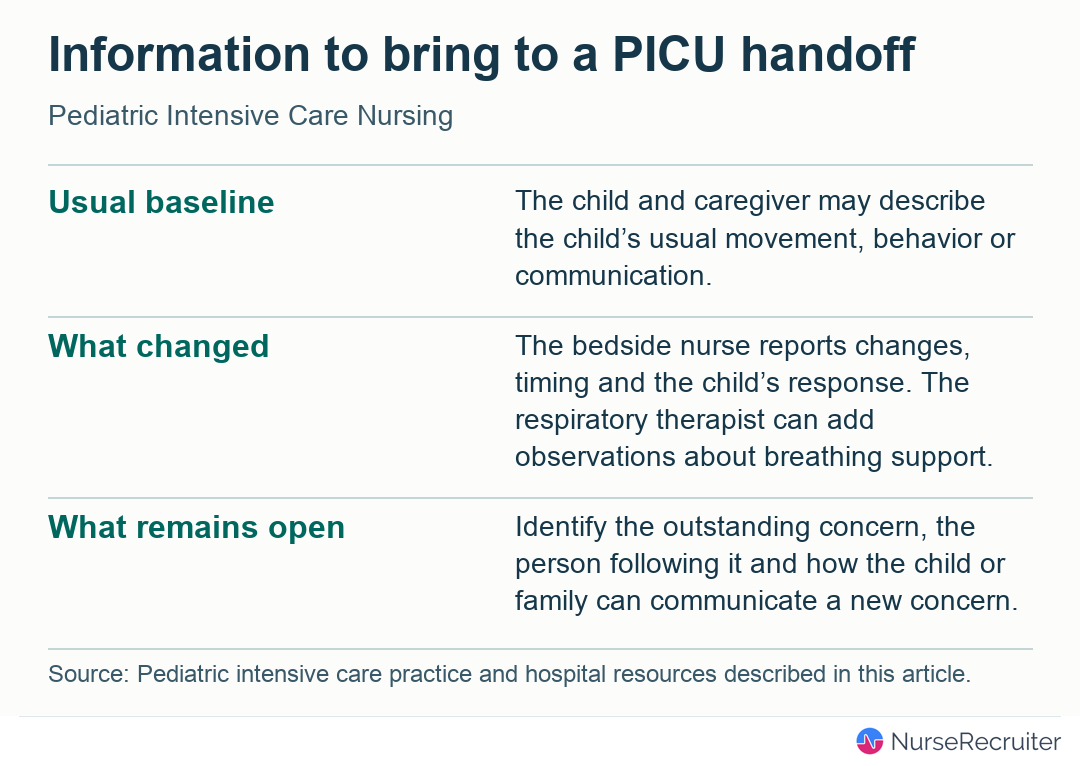
The nurse follows changes in breathing, circulation, neurologic status, comfort and response to treatment; manages the assigned monitoring and therapies; and coordinates with the critical-care team. Pediatric assessment also depends on developmental stage, baseline function and the child's usual communication.
During rounds or handoff, the useful information is the trend, its timing, actions taken and the concern that remains unresolved. A respiratory therapist contributes observations about breathing support. A parent or caregiver may clarify baseline movement or behavior. Staff should distinguish that account from their own observations and communicate directly with the child using a suitable method. See communication with children and family-centered communication.
Assignment and coverage
A PICU position may cover mechanically ventilated patients, postoperative monitoring or specialized support that requires additional preparation. Orientation and validated competencies must match the assigned therapies, equipment and patient groups. Experience in an adult ICU or pediatric ward does not by itself document competence for every PICU assignment.
The unit's admission criteria, nighttime clinical support, float destinations (for example a pediatric step-down unit, general pediatric ward or cardiac ICU) and coverage during procedures determine the workload. A dedicated cardiac ICU rotation or ECMO assignment can add responsibilities that are absent from another hospital's PICU position. Those distinctions belong in the role and orientation plan, not only in a general job title.
Certification
A unit may ask for a current Pediatric Advanced Life Support (PALS) provider card as evidence of pediatric emergency response training. The employer can assess prior intensive care experience separately.
AACN's CCRN (Pediatric) is the critical care certification for nurses caring for acutely or critically ill pediatric patients. Its direct-care pathway requires either 1,750 hours of such care in the previous two years (875 in the most recent year) or 2,000 hours over five years (144 in the most recent year). See CCRN certification and, for general pediatric credentials, CPN and the pediatric credentials.
Related articles
- Critical care nursing
- Pediatric nursing
- Neonatal nursing
- CCRN certification
- Pediatric acute care nurse practitioners
Sources
- Seattle Children’s and WSNA, 2026–2029 RN Agreement (accessed 2026-11-18) — Articles 9 and 10; base wages and assignment-specific premiums.
- Registered Nurses (accessed 2026-11-18) — BLS; May 2025 national wage median.
- NurseRecruiter, Average RN pay reached six figures, May 2026 (accessed 2026-11-19) — NurseRecruiter's report on the May 2025 BLS RN wage estimates.
- Texas DSHS, 2024 Hospital Nurse Staffing Study, Table 6 (accessed 2026-11-19) — share of responding hospitals by usual time to fill RN positions, by specialty area; staff positions, not travel vacancies.
- NurseRecruiter, Fewer openings, slower hiring: the 2026 staffing numbers (accessed 2026-11-19) — NurseRecruiter's September 2026 report, updated November 2026, on hiring time and turnover.
- Johns Hopkins All Children's Hospital, pediatric RN residency program (accessed 2026-11-19) — hiring units, experience limit and ANCC-accredited practice settings.
- Pediatric Intensive Care Unit (accessed 2026-11-18) — Johns Hopkins All Children’s; 28-bed service and listed conditions.
- Cardiovascular Intensive Care Unit (accessed 2026-11-18) — Johns Hopkins All Children’s; separate cardiac service including post-transplant care.
- Pediatric Intensive Care Unit (accessed 2026-11-18) — Seattle Children’s; 40 beds and age range through 21.
- PICU Admission, Discharge, Triage and Levels of Care (accessed 2026-11-18) — SCCM, 2019; levels of care by team structure, resources and technology.
- PICU Nursing Profile (accessed 2026-11-12) — Johns Hopkins All Children’s; nursing work description.
- AACN Certification Corporation: CCRN (Pediatric) (accessed 2026-11-18) — direct-care eligibility hours.