
Patient-generated health data (PGHD) are health-related information created, recorded, or gathered by patients, family members, or other caregivers. Examples include a symptom diary, home measurements, answers to a questionnaire, or information collected through a device.
ONC distinguishes these data from information produced during healthcare encounters because patients are primarily responsible for capturing them and deciding how to share them. PGHD can add context about life between visits, but the source and method remain important to interpretation.
Start with the question the information should answer
A nursing team should decide which data are useful for the patient's care and how they will be reviewed. Collecting a large stream of measurements without assigning responsibility can create expectations that the team cannot meet.
Clarify the requested measure, frequency, transmission method, and review arrangements. Patients need to know whether information is reviewed during office hours, at scheduled visits, or through another defined process. A portal upload should not be described as continuous monitoring unless that service actually exists.
Keep provenance and context
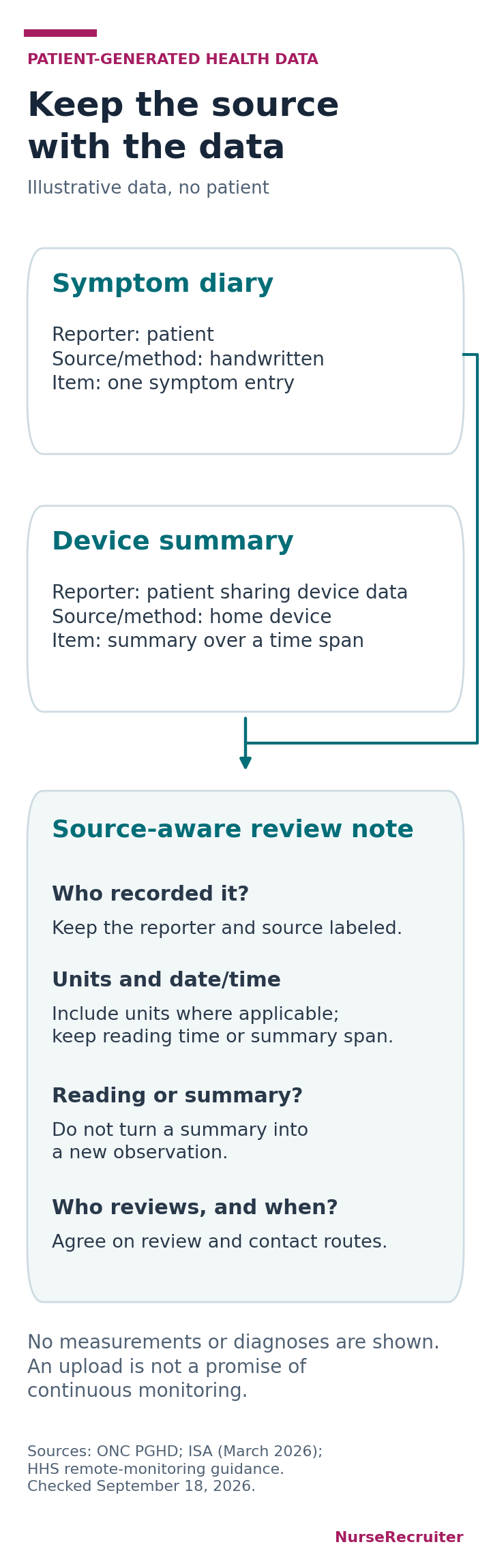
Illustrative data sources, no patient. Keep reported symptoms distinguishable from device measurements, and agree who reviews uploads and when. This diagram shows information to clarify, not a diagnosis or a promise of continuous monitoring.
Useful details include who recorded the information, the device or method, units, date and time, and relevant circumstances. A patient-reported medication history should remain identifiable as reported information until it is reconciled through the appropriate clinical process.
HL7’s FHIR Release 4 standard separates what was observed from the result, which can be a quantity with units. This principle applies when a home observation is incorporated into the record: a bare number is less useful than a value with its meaning preserved.
Illustrative review
In an illustrative visit, a patient brings a handwritten symptom diary and a screenshot from a home device. The nurse asks when the measurements were taken and whether the screenshot shows individual readings or a summary. The record preserves that distinction and documents the patient's reported symptoms separately from device measurements.
The example does not determine which source is clinically correct. It shows how clarifying the source prevents a summary from being mistaken for a new observation and allows the responsible clinician to interpret the information appropriately.
Plan feedback and exceptions
HHS guidance on remote monitoring advises patients to understand device use, transmission, notifications, and whom to contact for problems. Those questions are also helpful when a team accepts PGHD outside a formal monitoring program.
Agree on what happens when data are missing, implausible, or difficult to transmit. Do not automatically label a missed upload as a failure to follow the care plan; first investigate whether the patient could use the equipment and communication method.
When home measurements are collected for regular clinical review, compare remote patient monitoring workflows.
Related
Remote Patient Monitoring and Nursing
Sources
- ONC: Patient-Generated Health Data Fact Sheet (accessed 2026-09-17).
- HHS: How Can I Use Remote Patient Monitoring? (accessed 2026-09-17).
- HL7: FHIR Release 4 Observation (accessed 2026-11-11).