
Observation status and inpatient admission describe different hospital classifications. For Medicare, the distinction can affect the patient's costs and coverage after discharge. Nurses can help patients identify the question and reach the team responsible for answering it.
Medicare explains that inpatient status begins with formal admission under a doctor's order. Emergency department care, observation and other hospital services can remain outpatient care even when a patient stays overnight. The room or length of time in a bed does not, by itself, establish inpatient status.
Clarify what the patient is asking
A patient who asks, “Have I been admitted?” may mean that they were moved upstairs, assigned a bed or told they would stay. Ask whether the concern is the treatment plan, the formal status, the expected bill or coverage for care after discharge.
Check the available record and use the hospital's process for confirming current status. Bring unresolved questions to utilization management, case management, the treating team or the designated coverage specialist. Avoid promising a coverage outcome based on clinical appearance or an expected discharge destination.
For example, in a fictional conversation, a patient says, “I slept here, so my rehabilitation stay will be covered.” A useful response identifies the assumption: “Let's ask the coverage team to explain your hospital status and the requirements for the next service before you make arrangements.”
Understand the MOON
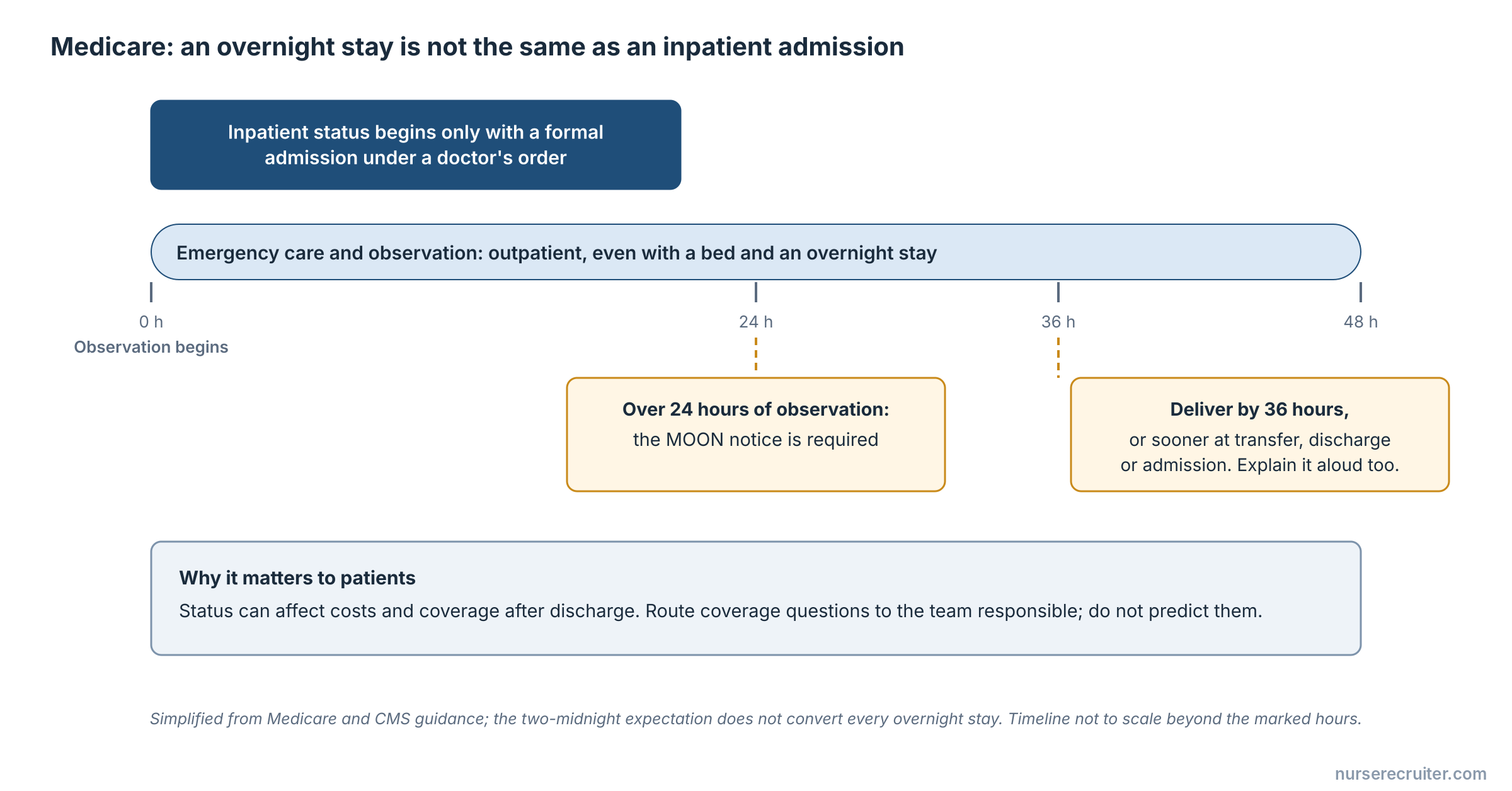
The Medicare Outpatient Observation Notice, or MOON, explains observation status and its implications. Federal requirements apply when a Medicare beneficiary receives outpatient observation services for more than twenty-four hours. The notice is due by thirty-six hours after observation begins, or sooner on transfer, discharge or admission. An oral explanation accompanies the written notice.
CMS provides the current form and instructions for both Original Medicare and Medicare Advantage beneficiaries. Use the current materials and the organization's delivery process.
A signature acknowledges receipt; it is not a substitute for an understandable explanation. Document questions and route unresolved concerns to the appropriate person.
Keep coverage explanations precise
Medicare's public guidance describes a general expectation involving a hospital stay crossing two midnights, but this is not an automatic conversion of every overnight stay into an inpatient admission. Admission still requires the appropriate order and decision.
Do not turn a general explanation into an individual eligibility determination. Ask the coverage team to address the patient's plan, service, timing and any applicable exceptions. If the patient disputes a decision, connect them with the relevant notice and current review or appeal process rather than saying that all observation decisions are unappealable.
Make the next step visible
Record whom the patient spoke with and what remains unanswered. Before discharge, check that the patient knows whom to contact about the bill or the proposed next setting.
When status questions affect the transition home, plan who will follow up after discharge.
Related pages address discharge readiness and transitions to skilled nursing facilities.
Sources
- Inpatient or outpatient hospital status (accessed 2026-09-17) — Medicare.gov.
- 42 CFR 489.20: Basic commitments (accessed 2026-09-17) — eCFR, subsection (y).
- FFS & MA MOON (accessed 2026-09-17) — CMS, updated July 17, 2026.