
Debriefing after simulation examines what participants noticed, why they acted and what they would do differently. It gives the experience an explicit learning purpose beyond completing the scenario. A useful discussion examines reasoning as well as visible performance.
INACSL's simulation endorsement criteria describe debriefing as planned, purposeful, and directed toward learning outcomes. They include psychological safety, confidentiality, and analysis of individuals, teams, and systems. These criteria are an educational reference; they do not make every informal conversation a formal assessment.
Preparing for the discussion
Before the scenario starts, clarify whether the exercise is practice or an assessment, who will see recordings or scores, and what confidentiality means within the program. Learners should know how to raise a concern about the scenario or evaluation. Promising that “nothing leaves this room” is unhelpful if the program actually records performance for progression decisions.
A facilitator can begin by allowing a brief reaction, then agree on the main events and explore a small number of decisions linked to the objectives. This is one practical structure, not the only acceptable debriefing method. The balance should match the learner's level and the purpose of the exercise.
Discussing reasoning without guessing it
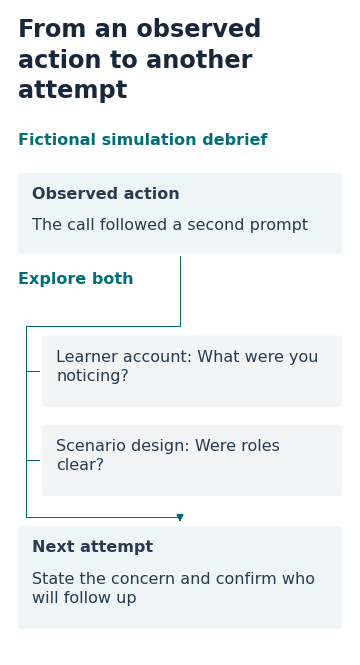
One possible debriefing conversation, using a fictional exercise. The branches invite questions rather than assign motives.
Separate observation from interpretation. “The call for assistance occurred after the second prompt” is an observation. “You did not care about the patient” assigns a motive that the recording cannot establish. Ask what the learner was noticing, expecting, or trying to accomplish.
In an illustrative fictional exercise, two team members each assume the other has contacted the supervising clinician. The discussion could examine how that assumption arose and how the team might explicitly confirm responsibility next time. It should also examine whether the scenario assigned roles clearly. An individual explanation alone may miss a design problem.
Feedback can be specific without being humiliating. Name the action, explain why it mattered to the objective, and invite the learner to propose a better approach. Correct a factual misunderstanding before asking the student to practice the alternative.
Turning discussion into another attempt
End with a manageable next step: repeat a handoff, rehearse a request for help, or review a relevant policy before a new scenario. Where appropriate, give learners another opportunity to demonstrate the revised approach. “Be more confident” is difficult to assess; “state the concern and confirm who will follow up” is more observable.
Debriefing should not become a competition to discover the largest number of mistakes. It can also examine successful decisions and the conditions that supported them. Equally, reassurance alone does not resolve a missed learning objective.
A simulation debrief is an educational process. It should not be presented as psychotherapy, a guarantee against distress, or a substitute for the organization's response to an actual patient-safety event. Those situations have different purposes and support needs.
Related
Nursing Simulation · Reflective Practice in Nursing.
Sources
- INACSL: Healthcare Simulation Standards Endorsement Criteria (accessed 2026-09-17).