
Remote nursing jobs let RNs, LPNs and nurse practitioners work from home in telephone triage, case management, prior authorization, chart review and telehealth. Employers include insurers, health systems and telehealth companies, and most still ask for recent clinical experience and a license that covers the patients' states.
These jobs are a small slice of nursing: the U.S. Bureau of Labor Statistics estimated that only 1.1% of U.S. RN positions routinely allowed telework in its 2025 Occupational Requirements Survey. Pay, licensure rules and schedules vary widely by role, so compare an offer's paid hours and the states it needs you licensed in before applying.
Find a work-from-home nursing role
NurseRecruiter lists current remote nursing jobs.
For a bedside nurse, the appeal of a work-from-home job might be getting evenings back, using clinical judgment without another 12 hours on the floor, or trading a commute for time at home. Those are three different job searches. A weekday chart reviewer, an evening advice-line RN and a care navigator who visits members can all have “remote” in their job titles.
When NurseRecruiter published its 2020 guide to work-from-home nursing, one of the questions nurses asked most often in comments was whether there were jobs they could do from home. Those jobs are still a small slice of nursing. The U.S. Bureau of Labor Statistics estimated that only 1.1% of U.S. RN positions routinely allowed telework in its 2025 Occupational Requirements Survey. That figure describes existing jobs across settings.
Looking for a remote job? Start with the constraint that would make you turn an offer down: weekly pay, where you can live or evenings and weekends. When you search nursing jobs, try the title of the work you want, such as prior authorization RN, clinical documentation specialist or LPN care navigator.
Hiring a remote nurse? A busy inpatient team may already have the reviewer you need: an RN who can reconstruct a hospital stay but has never held an insurance title. Another opening may genuinely require an experienced abstractor who can start reviewing independently after calibration. Compare what to require, what to teach and what will win the nurse over.
| What you want to do | Where to start |
|---|---|
| A first remote RN role | Entry-level openings and résumé and interview examples |
| Following patients after discharge | Telephonic RN case management |
| Reviewing an insurer’s requests or claims | Insurance nursing, prior authorization and nurse auditing |
| Working with records and quality measures | Chart review and HEDIS project work |
| Teaching nursing students from home | Online nurse educator and adjunct faculty jobs |
| Working with an LPN or LVN license | Care navigation and other remote LPN jobs |
| Part-time, evening or weekend shifts | Part-time remote nursing |
| Practicing as an NP | Telehealth NP visits, assessments and review |
How to hear about remote openings early
NurseRecruiter can email you when matching remote nursing jobs are posted. It can pay to read the alert that day. In a November 2026 posting for a remote transplant case manager, Optum warned that it could close the posting early if it received a high volume of applications.
When an alert arrives, the title can help you decide what to open first. A telephonic RN case manager follows members over time. A clinical review nurse may work through requests for coverage. A DRG validation auditor checks the documentation behind inpatient claims.
Start with three lines in the posting: where you can live, which licenses you need and how much experience the team requires. If you meet those requirements and the hours work for you, apply while the posting is open. Keep your résumé ready with the experience a reviewer will look for first. For a transplant case manager, that might be the transplant patients you followed after discharge. For telephone triage, it might be the calls you assessed independently and when you escalated them.
Pay by employer industry
BLS reported these May 2025 U.S. RN wages. The range covers the 25th through 75th percentiles.
| Employer industry | Middle half, hourly | Hourly median | Annual median |
|---|---|---|---|
| Insurance carriers | $40.00–$48.06 | $44.55 | $92,670 |
| Physicians’ offices | $36.25–$49.17 | $40.87 | $85,000 |
These industry estimates include on-site and remote RNs. They are not remote-job pay estimates. They exclude overtime premiums, shift differentials and employer benefit costs; annual estimates use 2,080 hours. An insurer’s utilization-review position and a physician group’s triage position belong to different employer benchmarks. Comparing RN offers accounts for the actual schedule and premiums.
Roles and workload
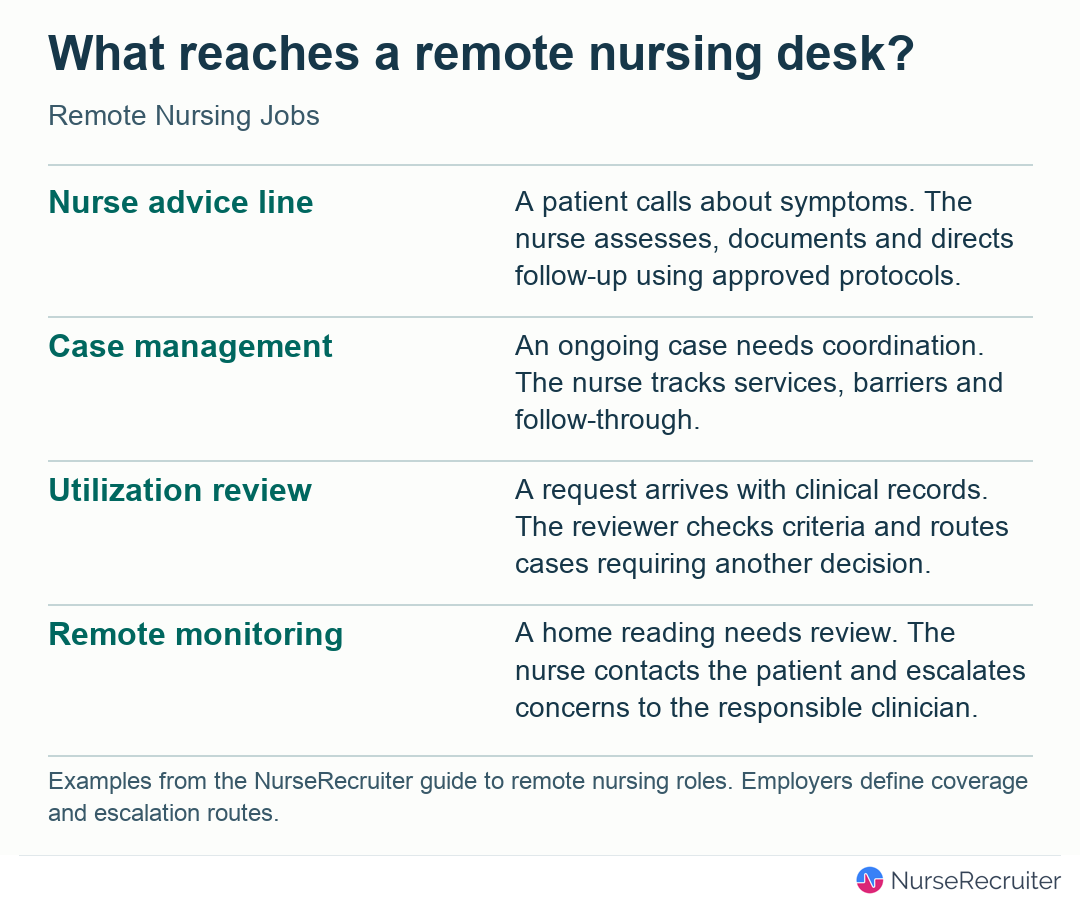
| Role | Nursing work | Workload and coverage |
|---|---|---|
| Telephone triage | Assess calls using approved protocols, document advice and arrange escalation. | Incoming-call volume, time to document, clinical backup and coverage for urgent calls. |
| Case management | Follow patients over time, coordinate services and identify barriers to care. | Active caseload, contact frequency, unfinished referrals and coverage during leave. |
| Utilization review | Review records against applicable criteria and route cases needing another decision-maker. | Case volume, missing records, review deadlines and the reviewer’s authority. |
| Remote patient monitoring | Review transmitted readings, contact patients and escalate findings. | Alert volume, failed transmissions, after-hours coverage and unresolved alerts. |
| Virtual inpatient nursing | Complete assigned admission, education or discharge work by video with hospitalized patients. | Assigned units, video access and coordination with staff providing hands-on care. |
Searching a nursing job board such as NurseRecruiter by a specialty like telephone triage or case management and utilization review narrows the field, but each posting still has to state whether the work can be done from home. Telehealth nursing workflows describes how these services route calls and escalations.
UAB’s account of virtual nursing describes nurses completing admission interviews for patients boarding in the emergency department while bedside nurses continued direct care. That model illustrates a division of nursing work; it does not establish that the virtual nurse works from home.
Practice location and licensure
For clinical nursing at a distance, the patient’s physical location during the encounter matters. A patient whose chart lists a nearby home address may take the call from another state. The service needs to confirm that location and the nurse’s authority to practice there. A qualifying multistate license can confer privileges in participating jurisdictions; a single-state license issued by a compact state does not provide those privileges. A multistate service also has to decide which states it assigns to each nurse’s queue, who monitors changes in authorization and who pays any additional licensing fees.
Chart-only duties require their own assessment of applicable requirements. The actual work, employer and relevant board determine which licensing questions arise. Telehealth practice authorization explains the distinction.
An employer’s permitted work locations, on-site orientation and hybrid attendance rules are separate from professional licensure. They affect whether a position can be performed from the nurse’s home.
Showing transferable experience
Bedside and clinic work supplies evidence for remote roles when it matches the task. For triage, that is assessing a concern by phone, documenting the reasoning and confirming the caller understood the next step. For case management, it is a referral that stalled and how the nurse found out whether the patient received the service. For utilization review, it is reconstructing a clinical timeline from several notes and identifying the information still needed. A work sample should use a fictional case; patient records do not belong in application materials.
Work organization
A remote role needs defined hours and time zone, weekend or call coverage, clinical escalation contacts and a handoff for unfinished work. Live advice calls and scheduled patient outreach use different workloads even when both occur from a home workstation.
Orientation can include supervised calls, paired record reviews or monitoring simulations appropriate to the role. The employer also needs arrangements for equipment, technical support and interrupted connections. Privacy safeguards apply to the workstation and communications used to deliver care.
Remote nurse practitioner jobs
A virtual primary care practice may pay an NP for a scheduled block, while an assessment service pays for each completed visit. In the remote NP job guide, a four-hour example shows how one cancellation or an extra half hour of charting changes which offer pays more per hour.
Compare the patient population, which states the NP will cover, who handles results and messages, and whether the practice pays for licenses and required collaboration. These questions apply differently to psychiatric NPs, urgent care clinicians and NPs hired for record review. Browse nurse practitioner jobs.
Related articles
- Telephone Triage Nursing
- Utilization Review Nursing
- Virtual Nursing Models
- Verifying Authorization for Telehealth Nursing
Sources
- Optum, Telephonic Case Manager RN – Transplant Medicine, requisition 2401781 (posted 2026-11-13, accessed 2026-11-19). The employer described when application volume could trigger early closure.
- U.S. Bureau of Labor Statistics, Occupational Requirements Survey, registered nurses, 2025 (accessed 2026-11-18).
- American Academy of Ambulatory Care Nursing, telehealth nursing practice (accessed 2026-11-13).
- Case Management Society of America, case management responsibilities (accessed 2026-11-13).
- CMS, State Operations Manual, hospital utilization review requirements in Appendix A (accessed 2026-11-13).
- HHS, planning a remote patient monitoring service (accessed 2026-11-18).
- American Association of Critical-Care Nurses, UAB’s account of virtual inpatient nursing (accessed 2026-11-18).
- HHS, licensing across state lines (accessed 2026-11-18).
- Nurse Licensure Compact, what nurse leaders need to know about multistate practice (accessed 2026-11-13).
- HHS Office for Civil Rights, privacy safeguards for audio-only telehealth (accessed 2026-11-18).
- BLS, May 2025 industry-specific Occupational Employment and Wage Statistics (accessed 2026-11-13)
- BLS, May 2025 OEWS technical notes and wage definitions (accessed 2026-11-13)
- BLS occupational profiles (accessed 2026-11-18). May 2025 RN industry percentiles and annual medians, checked against the public service.
- Can nurses work from home? Yes! These are your options (accessed 2026-11-18). NurseRecruiter blog, December 2020; pandemic-era overview of remote nursing roles and their preparation.