
Telephone triage nursing is the assessment of a caller’s concern by a nurse to determine the appropriate level and timing of care. The work can take place in a primary care practice, specialty clinic, after-hours service, or centralized call center. A triage call requires clinical judgment. Booking a requested appointment or passing on a message does not complete an assessment.
Pay and employer comparisons
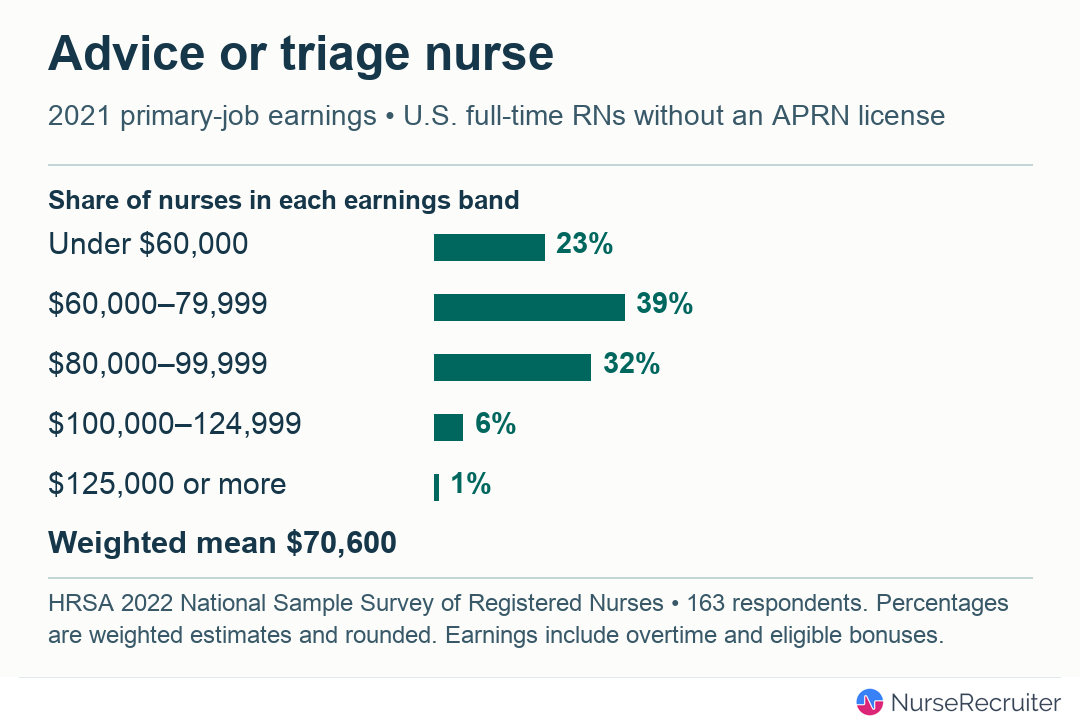
NurseRecruiter’s weighted analysis of HRSA’s 2022 National Sample Survey of Registered Nurses found that 163 respondents working full time in their primary nursing job, licensed as RNs without an APRN license, reported advice or triage nurse as the primary job title. Their weighted mean primary-job earnings for 2021 were $70,600 (approximate 95% confidence interval $66,700–$74,600). Earnings include overtime and bonuses other than sign-on bonuses. The public data cap individual earnings at $250,000. Full-time status describes the primary job; annual earnings can cover less than a full year. The estimate covers the full named group; its components cannot be priced separately from these data.
NurseRecruiter also compiled May 2025 BLS RN wages by employer industry. The hourly range below spans the 25th to 75th percentiles. These are all-RN industry figures, not specialty-specific rates. BLS excludes overtime premiums and employer-paid benefits.
| U.S. employer industry | Middle half of hourly wages | Hourly median | Annual median |
|---|---|---|---|
| Physician offices | $36.25–$49.17 | $40.87 | $85,000 |
| Insurance carriers | $40.00–$48.06 | $44.55 | $92,670 |
A telephone triage nurse may work for a medical practice or a payer. When searching telephonic nursing jobs on NurseRecruiter or elsewhere, check which kind of organization posted the opening, since the employer type shapes the call population and the comparison data above. Establish when required documentation and callbacks are paid and whether overnight or weekend coverage is scheduled work or standby. See comparing RN pay offers.
Scheduled and actual hours
In HRSA’s 2022 U.S. nursing workforce survey, among full-time RNs without an APRN credential in the survey’s “advice or triage nurse” job-title group, 2% reported being scheduled for more than 40 hours a week, while 21.4% reported actually working more than 40 hours in their primary nursing job in 2021. The estimated share working more than 40 hours had a 95% confidence interval of 12.1% to 30.7%. For a telephone service, the queue at closing time matters. A staffing plan can identify who finishes calls and who owns callbacks after a shift. The specialty survey notes explain which hours count.
What the nurse has to establish
Identity, the patient’s current physical location, a reliable callback number, and the identity of the caller matter early. A parent, home caregiver, or interpreter may be describing what they observe. The nurse records who supplied the information and what the patient could communicate directly. A caller’s telephone area code does not establish a location for emergency help or authorization to practice across state lines.
A structured assessment establishes the reason for the call, how the concern has changed, associated features the protocol requires, relevant history, and what the caller has already tried. The nurse selects a disposition under the service’s decision support and escalation arrangements. Protocols support consistency. The nurse still has to recognize an incomplete history, an unreliable connection, multiple symptoms, or a presentation that does not fit the tool.
NurseRecruiter’s 2008 feature on telephone triage describes a challenge familiar from urgent care: how a caller describes the urgency of a concern can differ from the information the nurse elicits in conversation.
From advice to a usable plan
The record should distinguish the caller’s description, the nurse’s assessment, the protocol or clinical consultation used, the agreed action and its timing, and the circumstances for seeking further help. Read-back or teach-back can reveal that the caller heard “soon” when the nurse meant a particular timeframe. Telephone documentation and handoff to an on-call clinician each need a clear recipient.
HHS recommends a plan for lost connections and emergencies: confirm the patient’s location, identify local help, agree who calls back and assign follow-up for an unresolved escalation.
What shapes the job
Same-day access to records, interpreters, on-call clinicians, and local appointments changes what the nurse can offer. A central line covering several practices also needs to identify which practice owns the follow-up. Speed of answer measures access. Calls per hour alone cannot show whether the right disposition was reached or whether the patient could carry it out.
When considering a triage position, ask which populations and hours the service covers, who can assist when a call falls outside a protocol, how interrupted calls are handled and which credentials the employer recognizes.
An employer can audit a sample of charts for assessment completeness, agreement between the assessment and disposition, appropriate escalation, and follow-up closure. Shift coverage must account for queued calls, unresolved cases and access to language assistance. Telephone triage is one part of ambulatory care nursing and can be done on site as well as remotely.
Working from home on a part-time triage schedule
For a nurse keeping a second job, two calendars matter. The advice line may need evening coverage once the nurse is independent, while its educator teaches the first cohort during business hours. A rotating weekend can also fall on the same dates as the nurse’s other job. Part-time remote nursing jobs compares actual shift windows and orientation commitments.
Travel and per diem work
Working remotely or answering calls from another state does not by itself make the position a travel assignment. A temporary contract should identify the service covered and the handoff of pending calls. For per diem triage, ask which queues open on the shift, how callbacks are assigned and who handles them after sign-off.
Related articles
- Emergency department triage covers in-person assessment and prioritization on arrival at the ED.
- AMB-BC certification · Ambulatory Care Nursing
- Telehealth nursing workflows · Verifying Authorization for Telehealth Nursing
- Telephone Communication and Nursing Documentation
Sources
- NurseRecruiter, Trying Telephone Triage (published 2008-07-22, accessed 2026-11-19).
- American Academy of Ambulatory Care Nursing, Telehealth Manager’s Toolkit, 2011–2012 (accessed 2026-11-18)
- HHS, creating an emergency plan (accessed 2026-11-18)
- HHS, licensing across state lines (accessed 2026-11-18)
- BLS, May 2025 industry-specific Occupational Employment and Wage Statistics (accessed 2026-11-18)
- BLS, May 2025 OEWS technical notes and wage definitions (accessed 2026-11-18)
- HRSA, 2022 National Sample Survey of Registered Nurses public use files (accessed 2026-11-18)
- HRSA, 2022 NSSRN questionnaire; primary job title and primary earnings (accessed 2026-11-18)
- HRSA, 2022 public use codebook, methodology and replicate-weight instructions (accessed 2026-11-18)