
A nurse-to-patient ratio states how many patients are assigned to a nurse during a defined period. A ratio of 1:4 can describe a legal maximum assignment, a unit’s budget target, or an average calculated after a shift. Those figures answer different questions. A nurse evaluating a job needs to know which staff count, which patients count, when the ratio applies, and who takes responsibility when another nurse goes on break.
The unit of measurement
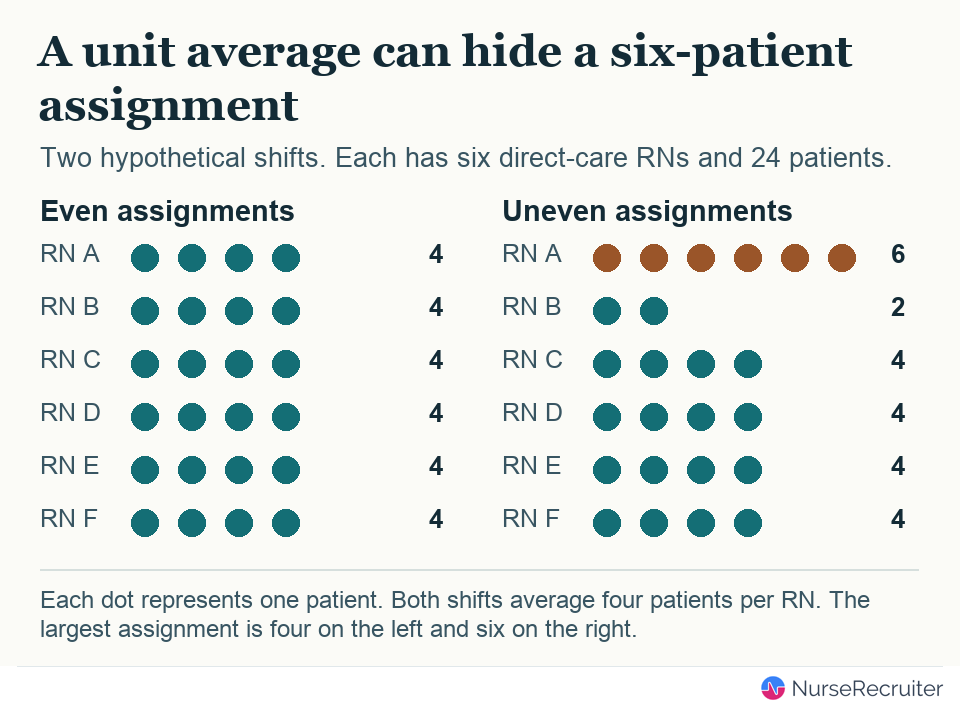
Six direct-care RNs covering 24 patients gives a unit average of four patients per RN. If one nurse has six and one has two, that average still equals four. It does not demonstrate that every nurse had four or fewer patients. A nurse coordinating beds, teaching an orientee, or assisting with procedures should be counted according to the rule being evaluated and the actual assignments.
A schedule can also show six nurses while only five are carrying patients during a meal break. The relevant question is which qualified nurse takes the absent nurse’s assignment and how many patients that relief nurse then carries. In another unit, the charge nurse or a dedicated relief nurse may cover the break. Head count on a posted schedule cannot settle that question.
California and Oregon use different definitions
| Setting | What the cited rule measures |
|---|---|
| California medical/surgical care unit | California’s rule specifies at least one licensed nurse per five patients at all times. The state also requires staffing to reflect assessed patient needs. The category named in this provision is licensed nurse. |
| Oregon medical-surgical unit | ORS 441.765 specifies no more than four patients per direct-care RN under the text operative July 1, 2026. The preceding version used five. The date and statutory qualifications matter when comparing historical schedules. |
| Oregon intensive care unit | The same statute specifies no more than two patients per direct-care RN. Under ORS 441.765(3), the applicable ratio follows the patient classification documented by a licensed independent practitioner, including when the patient receives care on a different unit. |
These are jurisdiction- and unit-specific examples. Oregon also sets out circumstances and reporting requirements for deviations and provisions affecting particular hospitals. A numeric entry from another state, specialty, or year is a poor substitute for the applicable section and the unit’s staffing plan.
Enforcement has its own legislative history. NurseRecruiter reported on the 2012 veto of a California staffing-penalty bill; the dispute concerned what happened after a violation of an existing ratio.
Why the same ratio can feel different
Four patients present at handoff and four patients at the end of a shift can conceal several discharges and admissions in between. Orientation responsibilities, a patient requiring continuous observation, availability of a respiratory therapist, and the distance between rooms can change the work. Patient acuity and staffing systems and nursing workload beyond patient counts explain what a ratio leaves out.
A ratio quoted in a job listing, whether on an employer's site or a nursing job board such as NurseRecruiter, is a starting point for those questions. For hiring or shift review, record the usual assignment, the largest actual assignment, break relief, whether the charge nurse carries patients, and how the unit responds when demand rises. Compare like shifts. A reporting period’s staffing hours and a patient’s bedside assignment use different denominators. How to read a hospital staffing plan explains where to look for the unit-level assumptions.
Related articles
- Nurse staffing and patient outcomes
- Nursing hours per patient day
- Hospital staffing committees
- Nurse staffing budgets
Sources
- NurseRecruiter, Nurse-to-Patient Ratios and Penalties (published 2012-10-03, accessed 2026-11-19).
- California Department of Public Health, medical/surgical staffing and patient classification (accessed 2026-11-13)
- California Code of Regulations, title 22, § 70217, Nursing Service Staff (accessed 2026-11-13)
- Oregon Revised Statutes, chapter 441, including §§ 441.760–441.765 (accessed 2026-11-13)