
Nursing hours per patient day (NHPPD or HPPD) is a measure of staff time relative to the size of a patient population. Divide the included nursing hours for a unit and period by patient days counted for the same unit and period. The result may describe RN hours alone or combined hours for several nursing roles. A figure without the staff categories, dates, and census method is hard to interpret.
One month, two different figures
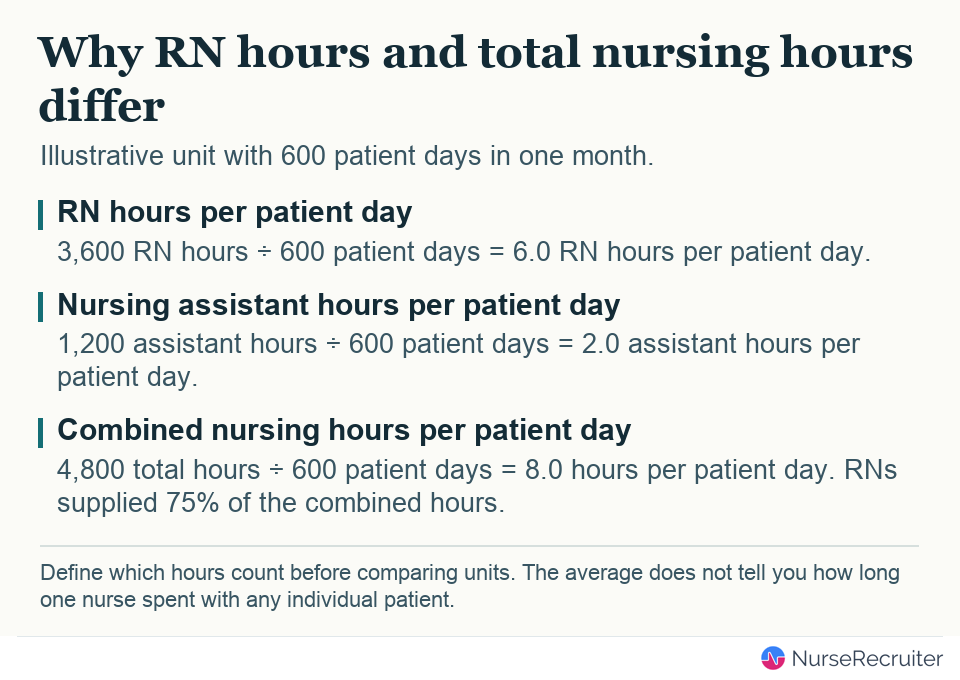
Consider a hypothetical unit with 600 patient days during a month. Staff provided 3,600 qualifying RN hours and 1,200 nursing assistant hours. RN hours per patient day are 6.0. Combined hours per patient day are 8.0. RNs supplied 75% of the combined hours. The three figures answer different questions.
An average of six RN hours does not mean each patient saw a nurse for six uninterrupted hours. Some patients need considerably more time than others. Nurses also review results, document care, coordinate transfers, and hand off assignments. The monthly figure cannot reconstruct which nurse had which patients at 3 a.m.
What goes into the count
The CDC’s National Healthcare Safety Network protocol for eligible critical-care locations counts direct-care hours for RNs, LPNs/LVNs, and unlicensed assistive personnel. Its instructions specify which staff count, including how to handle nurses in orientation and charge nurses. A charge nurse counts only when included in the unit’s staffing plan, replaced if absent, charged to the unit’s cost center, and responsible for direct care for more than 50% of the shift. Orientation time normally does not count; direct-care work during orientation qualifies when the nurse is included in the staffing plan, charged to the unit, and replaced if absent.
Scheduled hours that were never worked, leave, and education time generally fall outside the direct-care count. Actual qualifying overtime hours are worked hours. Patient days are counted using a consistent daily census, typically at midnight, and summed over the month. A patient admitted and discharged between counts can generate considerable nursing work without entering the midnight census.
Comparing units or employers
Start with the same setting, measure definition, staff categories, and period. A change in RN hours while total hours stay flat signals a change in the mix of nursing staff. Compare budgeted with worked hours separately. Payroll records can show what the unit purchased while patient acuity, turnover within a shift, and admissions explain work the census misses.
Long-term care uses hours per resident day. CMS’s Payroll Based Journal collects nursing home staff hours by job category and employment type and publishes daily facility data. A nursing home’s reported RN hours per resident day and a hospital ICU’s direct-care RN hours per patient day come from different systems. Nursing home staffing data and the hospital staffing plan each provide context for the setting they describe.
Related articles
- Skill Mix in Nursing Teams
- Patient Acuity and Staffing Systems
- Nurse Staffing and Patient Outcomes
- Nursing Home Staffing by the Numbers
- Nursing Home Staffing Requirements
Sources
- CDC, NHSN Nurse Staffing Hours Indicator protocol (accessed 2026-11-18)
- CMS, Payroll Based Journal methodology (accessed 2026-11-13)