
A hospital staffing committee brings direct-care staff and management together to develop or oversee staffing plans. Its authority depends on state law and the hospital’s governance. The membership list matters, but so do three details in the governing documents: who votes, who can change a proposed plan, and what happens when a unit departs from it.
Two state models
Washington. Under RCW 70.41.420, at least half of voting members must be nonsupervisory, nonmanagerial nursing staff currently providing direct patient care. Employee participation occurs on scheduled work time at the appropriate pay rate, with relief from other duties during meetings. The committee develops and oversees an annual staffing plan by unit and shift. A majority vote sends a proposed plan to the chief executive or designee. The statute provides a process for changes and feedback, annual submission to the Department of Health, and review of staffing complaints. It also calls for the unit’s plan and current staffing information to be posted. The committee’s draft and the adopted plan are different documents.
Oregon. ORS 441.762 provides for a nurse staffing committee with two elected cochairs, a direct-care registered nurse and a nurse manager. It develops a written hospital-wide nurse staffing plan. The statute provides paid release time for covered committee representatives to attend meetings. Other provisions govern unit plans, review, variances, and applicable ratios. Oregon also distinguishes nurse staffing from its professional and technical and service staffing committees. The nurse committee’s decisions should be read alongside the rules for the particular unit.
From a complaint to a plan change
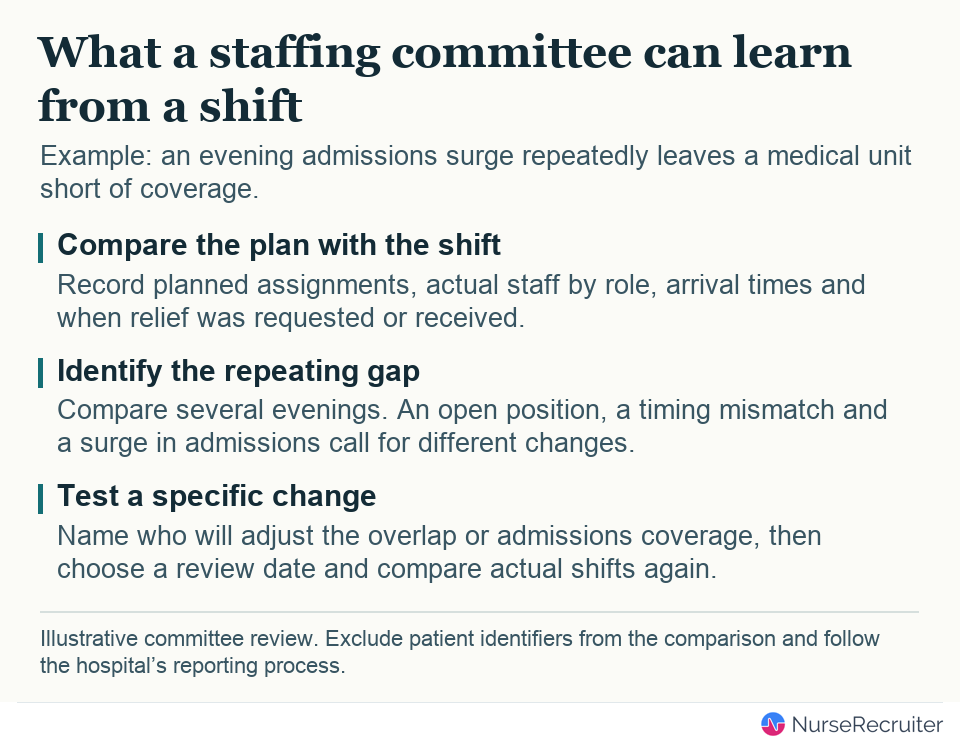
Consider a medical unit whose plan covers ordinary census but repeatedly falls short during the evening admission period. A useful submission identifies the unit, shift, planned assignments, actual staff by role, timing of arrivals, and whether requested relief arrived. It can describe interrupted breaks or work left uncovered without circulating patient identifiers. Comparing several such shifts can distinguish an unfilled position from a recurring gap in the plan.
The response might be a change in shift overlap, different admissions coverage, or recruitment for a hard-to-fill shift, such as posting the evening position on NurseRecruiter or searching its nurse database for candidates. Each has a different owner and cost. A recorded decision, a person responsible, and a date to review actual coverage make it possible to see whether the change helped.
What nurses can verify
The adopted staffing plan identifies the staffing commitment; the direct-care representative and complaint process provide routes for reporting a variance. A committee’s existence alone says little about how the last night shift was staffed, so a job candidate can ask to see the adopted plan for the unit, the name of its direct-care representative and how staff receive a response to a reported variance. A unit practice council may address workflow and professional practice. A union may bargain over staffing language. Their roles can intersect with a statutory committee while retaining separate authority.
Related articles
- How to Read a Hospital Staffing Plan
- Unit Practice Councils
- Nurse Staffing and Patient Outcomes
- Nurse-to-Patient Ratios
Sources
- Washington Legislature, RCW 70.41.420 (accessed 2026-11-18)
- Oregon Health Authority, hospital nurse staffing (accessed 2026-11-18)
- Oregon Legislature, ORS chapter 441 (accessed 2026-11-18)