
A nurse staffing budget puts a cost and a number of paid positions against the nursing coverage a service expects to provide. A budgeted full-time equivalent (FTE) describes paid time. A position on the roster describes a job. A nurse present on the unit describes coverage. A unit can be within budget and short a nurse on nights if the funded hours land on the wrong shifts.
From one staffed position to paid positions
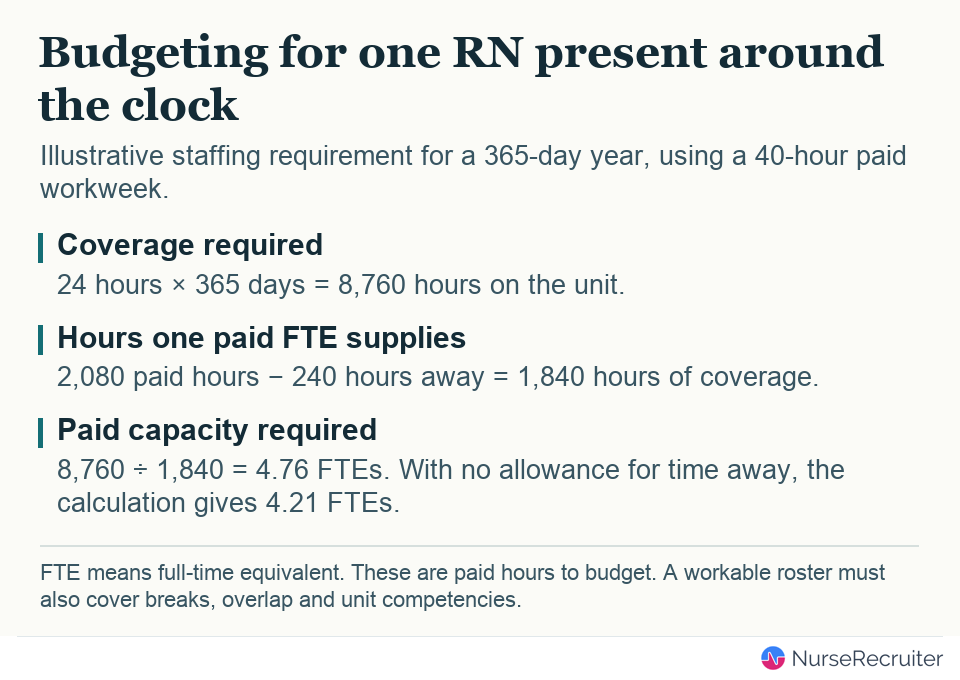
Suppose a unit needs one additional RN present at all times for a 365-day year. That is 8,760 hours of coverage. Assume this employer defines one paid FTE as 40 hours a week for 52 weeks, or 2,080 hours. If an average FTE spends 240 of those hours on leave, education, or other duties away from this assignment, it supplies 1,840 hours of coverage.
| Calculation | Result |
|---|---|
| Coverage required | 24 × 365 = 8,760 hours |
| Paid FTEs before allowance for time away | 8,760 ÷ 2,080 = 4.21 |
| Paid FTEs including the stated allowance | 8,760 ÷ 1,840 = 4.76 |
| Additional paid capacity attributable to that allowance | About 0.55 FTE |
These are illustrative inputs. The employer’s full-time workweek, leave policy, education time, and budget year determine the actual divisor. The 4.76 figure can be distributed among full- and part-time people. It does not produce a workable roster by itself. Break relief, shift overlap, weekend coverage, and who can cover the assignment still have to be specified. If another budget funds relief, count those hours once.
What changes with workload
Start with the coverage required on each shift. A procedural service may need two nurses throughout opening hours even when its first case is late. A ward may need additional staff when admissions cluster or several patients require close observation. A hospital staffing plan describes the coverage commitments. Patient acuity helps explain why two shifts with the same census can need different skills.
Where the money went
Compare budgeted hours, worked hours, and expenditure separately. Replacing a vacant position with overtime can preserve hours while raising cost. Leaving it open can reduce spending while increasing uncovered shifts. NurseRecruiter's review of a 2012 staffing-cost example, reported at the time by HealthLeaders, shows the pattern: a unit with 12.5 FTEs on its roster routinely needed 16.4 to cover its target worked hours, a gap of 3.9 FTEs met through other coverage. For orientation, distinguish a newly hired nurse’s paid hours from the date they can carry an independent assignment. A preceptor and orientee appearing together on payroll may still cover one assignment. A useful variance report pairs dollars with vacancies, overtime, agency hours, and shifts that missed planned coverage. That gives nursing leadership a specific decision about hiring, relief, or scheduling. If the decision is to hire, the opening can be posted on a nursing job board such as NurseRecruiter, or candidates found through its nurse database, while the variance report tracks the overtime that continues until the new nurse can take an independent assignment.
In California’s annual hospital financial disclosures, statewide operating expenses rose 8.7% between fiscal 2022 and 2023 while operating revenue rose 7.5%. Nursing labor accounts for only part of the operating budget.
How can a unit spend its full budget and still miss a shift?
Suppose a unit budgets for 20 twelve-hour RN shifts over two weeks. At $60 per hour of regular staff coverage, the 240 planned hours cost $14,400. The table follows those same assignments through the end of the pay period. All rates are hypothetical employer costs. Staff rates include wages, payroll taxes and benefits allocated to the hours worked. The agency rate is the invoice per hour worked. Only hours providing independent coverage on the planned shifts count here.
| Coverage in the pay period | Planned hours | Actual hours | Actual cost to the unit |
|---|---|---|---|
| Regular staff at $60/hour | 240 | 192 | $11,520 |
| Staff working overtime at $75/hour | 0 | 24 | $1,800 |
| Agency RN at $90/hour | 0 | 12 | $1,080 |
| Total coverage | 240 | 228 | $14,400 |
Spending landed exactly on budget, with one 12-hour shift uncovered. Overtime added $360 above the budgeted cost for those 24 hours. The agency added another $360 above budget for its 12 hours. The unfilled shift reduced spending by $720, which offset both premiums. If a qualified agency RN had covered that final shift at the same rate, all 240 hours would have been covered and the unit would have spent $15,480, or $1,080 over budget.
For the next roster, identify the unit, shift and qualifications attached to those 12 hours. An available float nurse or per diem nurse can cover the gap only if the nurse can take that assignment. If the same shift stays open during a permanent search, nurse recruitment metrics can track how many shifts needed interim coverage before the new hire could work independently.
Related articles
- Nursing Hours per Patient Day
- Nursing Workload Beyond Patient Counts
- How to Read a Hospital Staffing Plan
- Nurse Overtime
- Float Pools and Internal Resource Pools
Sources
- American Nurses Association, financial management for nurse managers (accessed 2026-11-13)
- Queensland Health, Business Planning Framework for nursing and midwifery services (accessed 2026-11-13)
- Keeping Nurse Labor Costs Down (accessed 2026-11-18). NurseRecruiter, published 2012-01-14.
- California Office of Health Care Affordability, fiscal 2022 and 2023 comparison (PDF) (accessed 2026-11-18)