
A mentor offers guidance and feedback on professional development. Sponsorship involves actively supporting someone's access to an opportunity or advancement. One person may provide both, but the activities are different.
ANA describes nursing mentorship as a formal or informal relationship supporting career development, with goals and expectations established at the beginning. ANA mentorship guidance
Johns Hopkins' Department of Medicine describes sponsors as leaders who actively support another person's advancement, including through nominations. Its explanation notes that not every mentor is positioned to be a sponsor. This is an academic medicine example that clarifies the distinction. Hopkins sponsorship description
Start with the professional question
Identify what you need help doing. A nurse considering a specialty change may want to understand the work. A nurse preparing a project presentation may want feedback on the argument. Someone ready for a leadership opportunity may need a person who can advocate for their consideration.
These needs can involve different people. Avoid expecting one relationship to answer every clinical, educational and career question.
An original request might be: “I am considering an educator role and would value a conversation about the experience I should develop first.”
Agree on the relationship
Discuss the goal, meeting arrangements and how both people will prepare. Clarify whether the arrangement is formal, time limited or informal.
Decide what information may be shared outside the conversation. Do not assume a mentor is separate from all supervisory or assessment responsibilities; ask about those roles.
Keep a brief record of agreed actions and revisit the goal as circumstances change. An effective next step should be something the nurse can actually do, such as arranging an approved observation opportunity or revising an application.
Make sponsorship specific
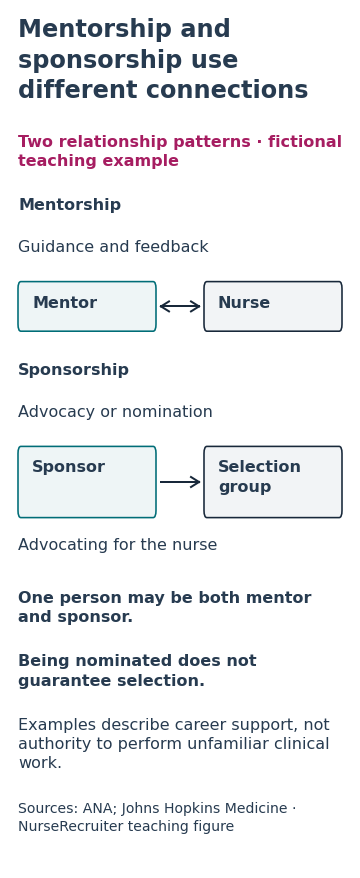
Mentorship centers on a development relationship; sponsorship includes advocating for someone’s consideration for an opportunity. These fictional relationship maps show different activities, not a promotion pathway.
For a fictional example, a nurse has led a useful improvement project. A sponsor might put the nurse forward for an appropriate presentation opportunity and explain the contribution to the selection group.
The sponsor should describe real work accurately and use the normal selection process. Sponsorship is not permission to bypass eligibility criteria or promise a role.
Ask the nurse whether the opportunity fits their goals and whether they have time and support to accept it.
Preserve boundaries
Mentorship does not replace orientation, supervised clinical learning or formal competency assessment. A career conversation should not be used as authorization to perform unfamiliar work.
Similarly, a mentor should recognize when an issue needs another resource, such as an educator, human resources contact or professional support service.
If a relationship is not useful, discuss a revised arrangement or an appropriate ending without treating the mismatch as a personal failure.
Look at access to opportunities
Organizations can review who receives development invitations, feedback and nominations. Make eligibility and application routes visible across shifts and locations.
Judge a program through its stated goals and actual participation. A list of matched pairs alone does not establish that meaningful development occurred.
In succession planning, clarify whether a senior colleague will coach a nurse or put the nurse forward for a particular opportunity.
Related
succession planning · orientation versus preceptorship.
Sources
- Benefits of Mentorship in Nursing (accessed 2026-09-17) — ANA.
- Task Force on Women's Academic Careers: Initiatives (accessed 2026-09-17) — Johns Hopkins Medicine.