
Alberta Hunter was one of the most influential blues and jazz singers of the twentieth century. She was also, for more than twenty years, a licensed practical nurse on a New York hospital ward where hardly any of her colleagues knew what she had done before.
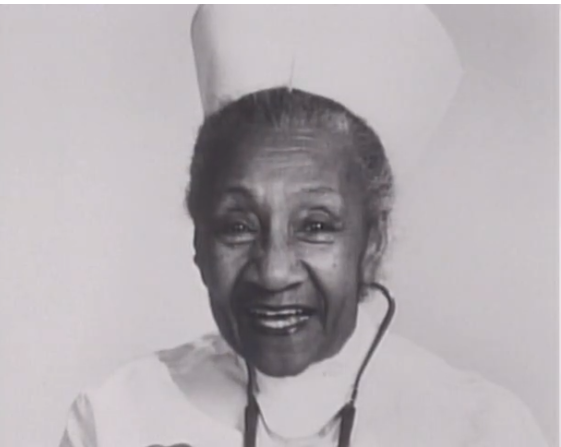 Alberta Hunter in her nurse's uniform at Goldwater Memorial Hospital, shortly before her forced retirement in 1977
Memphis
Alberta Hunter was born on April 1, 1895 in Memphis, Tennessee. Her father, Charles Hunter, a Pullman porter, had died of pneumonia six weeks earlier. Her mother, Laura Peterson, worked as a chambermaid at a Memphis brothel on Gayoso Street. An older brother, John, died in infancy; her sister La Tosca was born in 1893.
She spent her early childhood in her maternal grandparents' house on High Street. She was delivered at home by Dr. Albert Burchette, the family physician who had attended her father, and was reportedly named after him. Her grandfather Henry Peterson died in 1899, when she was four. She and her sister attended Grant Elementary School.
By all accounts her childhood was a hard one. She was sexually abused by several adult men, among them a landlord's boyfriend and a school principal, and her mother's second husband, Theodore Beatty, was reported to be violent toward both his wife and his stepchildren.
In 1909, when Hunter was fourteen, her mother and sister left Memphis for Denver, Colorado. Hunter, then working as a laundress for a dollar a week, was left behind.
The singer
In 1911, having heard that singers in Chicago earned as much as ten dollars a week, the sixteen-year-old Hunter left Memphis. She took a job in a Chicago boarding house at six dollars a week and began singing at a South Side club owned by Francisco Cirofici, known as Dago Frank. From there she moved through the city's better rooms — the Elite Cafe, the Panama Club, the Dreamland Cafe — accompanied at various points by Louis Armstrong and Jelly Roll Morton.
New York made her bigger. Black Swan signed her in 1921 and Paramount took an exclusive contract in 1922, which did not stop her recording for rival labels under assumed names so the contract would not catch her: Josephine Beatty on Gennett, May Alix on Harmograph, Alberta Prime on Biltmore. She appeared in Broadway productions, performed in Paris and London, and entertained American troops as a USO volunteer during the Second World War and again in Korea.
By the mid-1950s she was in her late fifties, rock and roll was arriving, and the work for an aging blues singer was thinning out.
I went as far as you could go. I played Broadway. I played the Royal Theatre in London. I played in Paris… and I figured I had gone to the top.
So she stopped, and did something else.
Nursing school at sixty-one
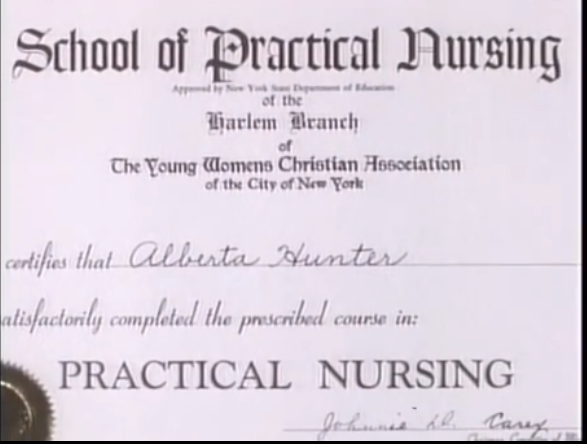 Alberta Hunter's nursing school diploma
Hunter had no high school diploma and was far past the age any nursing program would have accepted. She produced a diploma she had not earned, knocked more than a decade off her stated age, and enrolled in the practical nursing program at the Harlem YWCA, graduating in 1956 at the age of 61.
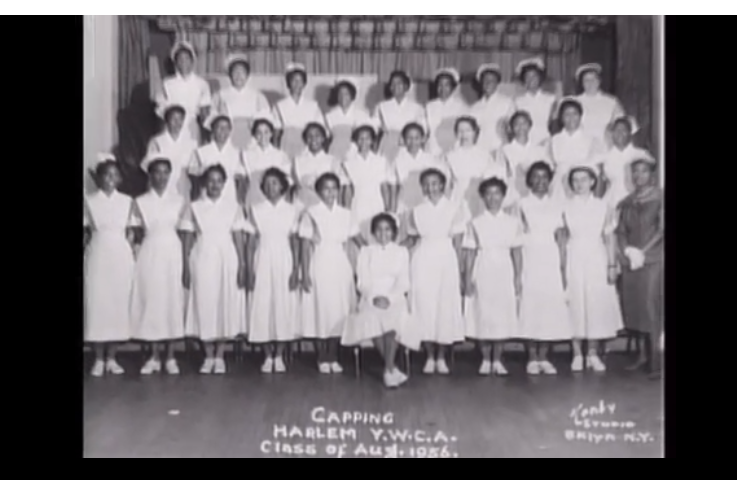 Alberta Hunter with her nursing school class, Harlem YWCA, August 1956
She started as a volunteer at Joint Diseases Hospital in Harlem, then took a post at Goldwater Memorial Hospital on Roosevelt Island, a chronic-care hospital for long-stay patients. She stayed for more than twenty years.
Apart from one 1961 session — "Songs We Taught Your Mother", with Victoria Spivey and Lucille Hegamin, produced by Chris Albertson — she did not perform or record during those years, and she kept her past to herself.
When you saw Alberta walking around the halls of Goldwater starched and crisp in her uniform, you would never think that she could get up there and be so risqué and flirting.
— Mildred Crisp Littles, a fellow nurse, to Hunter's biographer Frank C. Taylor
She was, by every account, a very good nurse. "Twenty years and I was never late one day," she said in the 1988 documentary Alberta Hunter: My Castle's Rockin'. "That's a record, isn't it?"
Retired against her will
In 1977 the hospital retired her. Goldwater's mandatory retirement age was 65; the administration believed she was 70 and had already stretched a point for her. She was 82.
I was the most hurt person in the world when they retired me from the hospital. You know, they give you… 65 is mandatory to retire. Well, they gave me 5 more years, they thought I was 70. When they retired me, they thought I was 70. I was 82. They all recognized me because I tried to be so good to them and if the time was up and my patients were restless, I stayed right there and tried to soothe them to sleep before I could go home and that learned me how to try to be kind to my fellow man.
The second career
Out of a job at 82, Hunter went back to singing. In October 1977, at Barney Josephson's insistence, she opened at the Cookery in Greenwich Village, and the run lasted the rest of her life.
On October 6, 1978, the governor of Tennessee declared an Alberta Hunter Day and the mayor of Memphis gave her a key to the city. That December she performed at the White House for President Carter. Columbia signed her in 1978 and she recorded four more albums.
She died on October 17, 1984, at 89, on Roosevelt Island, where she had spent her twenty years on the wards. She was inducted into the Blues Hall of Fame in 2011 and the Memphis Music Hall of Fame in 2015.
Related
Sources
- Alberta Hunter: A Celebration in Blues, Frank C. Taylor with Gerald Cook. McGraw-Hill, 1987. Accessed September 9, 2026.
- Alberta Hunter, 89, Cabaret Star, Dies. The New York Times, October 19, 1984. Accessed September 9, 2026.
- Alberta Hunter, on her recording pseudonyms, her entry into nursing and her years at Goldwater Memorial Hospital. Accessed September 9, 2026.
- Cookin' at the Cookery: The Music and Times of Alberta Hunter, Rob Pratt. Metro Silicon Valley, July 3, 2003. Accessed September 9, 2026.
- Tennessee Women: Their Lives and Times. University of Georgia Press. Accessed September 9, 2026.
- Notable American Women: A Biographical Dictionary, Volume 5. Harvard University Press. Accessed September 9, 2026.
- Alberta Hunter: My Castle's Rockin', documentary, 1988. Accessed September 9, 2026.