
After an unsuccessful NCLEX attempt, a candidate receives a Candidate Performance Report (CPR). NCSBN describes it as an individualized report showing performance by test-plan content area and clinical judgment categories. It is intended to guide further preparation, rather than provide a transcript of the questions answered.
The key limitation is that NCLEX is not graded as separately passed sections. Overall performance determines the result. A category marked above the passing standard does not cancel out another category or establish that a candidate needs only to “retake” the weaker section.
Understanding the indicators
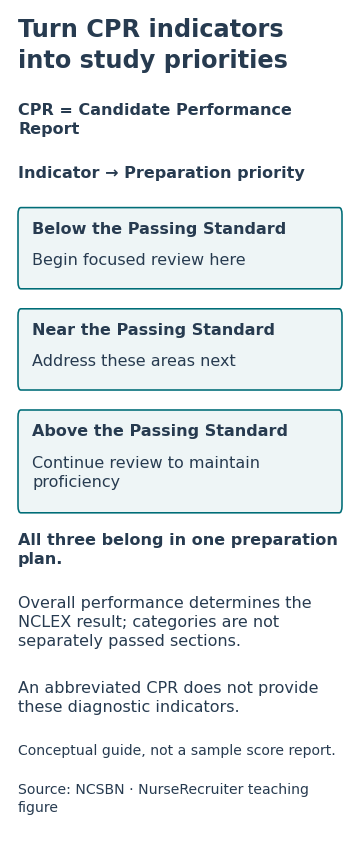
NCSBN’s categories guide preparation after an unsuccessful NCLEX attempt. This diagram shows study priorities, not numerical scores or a timetable for passing.
The report uses below, near, and above the passing standard to describe performance. These labels are not percentages correct. Read them as indications of relative strengths and weaknesses within the report's purpose.
NCSBN advises beginning with areas below the passing standard, then addressing areas near it, while continuing to maintain stronger areas. If the candidate did not answer the minimum number of items, the report is abbreviated and does not provide the usual diagnostic detail. That distinction matters when deciding how much can be inferred from the document.
Build a preparation plan
Use the CPR alongside the applicable RN or PN test plan. For each weaker area, identify the relevant activities and content, then examine practice work for the type of difficulty involved. A missed question may reflect missing knowledge, misreading, or a reasoning error; the category label alone does not identify which explanation applies.
For illustration, a fictional candidate receives a below-standard indicator in one content area. The candidate reviews several practice cases and discovers a recurring tendency to select an action before identifying the information the question asks for. A tutor can help examine that pattern while also checking the underlying content knowledge.
The example does not establish what caused the actual NCLEX result. It shows how a broad indicator can lead to a more focused learning conversation.
Use progress evidence carefully
Track what was reviewed, what explanation the candidate can now give, and which errors recur in new practice work. Avoid interpreting one improved commercial practice score as proof of readiness or a guarantee of passing. Different question sets and scoring systems may not measure the same thing.
A balanced plan should also retain review of stronger areas. Ignoring them entirely assumes the report is a permanent inventory of knowledge, which is more than the feedback establishes.
Separate feedback from retake administration
The CPR does not itself authorize a new examination appointment or replace the regulator's retake requirements. Consult the nursing regulatory body and current NCLEX instructions for the next attempt. If the report is missing or unclear, use the official contact route rather than relying on social-media interpretations of examination length or perceived difficulty.
The report is most useful when treated as a starting point for deliberate preparation: identify a priority, examine the underlying work, obtain feedback, and reassess the plan.
Related
Test Anxiety and Nursing Exams · NCLEX Test Plans.
Sources
- NCSBN: Candidate Performance Report (accessed 2026-09-17).