
A learning plan during nursing orientation names the tasks an orientee will practice and how progress will be assessed. It should answer four questions: what needs to be learned, how practice will occur, what evidence will show progress, and when the plan will be reviewed.
A plan can support any orientee. It does not have to begin as a response to difficulty. The American Association of Critical-Care Nurses' preceptor curriculum includes adapting learning opportunities to changing needs, supporting increasing independence, and defining completion criteria. A written plan makes those conversations easier to revisit.
Begin with the actual gap
Compare the role's expectations with what has already been observed. Avoid using a checklist of unfamiliar tasks as if every item were a demonstrated weakness. Separate “not yet attempted,” “performed with assistance,” and “performed under the expected conditions.”
An experienced nurse changing specialties may need focused practice with unfamiliar workflows. A new graduate may need support integrating several familiar tasks into a whole patient assignment. These are different starting points, even when both nurses attend the same orientation classes.
Write a usable objective
An objective should identify a behavior and the conditions under which it will be demonstrated. “Improve communication” is too broad to guide tomorrow's practice. A more useful objective might be to organize a handoff using the unit's format and confirm that the receiving nurse understands the immediate follow-up needs.
Add the learning activity, the observer, the feedback method, and a review date. Specify which resources the orientee may use and which supervision is required. The plan should not silently expect independent work before the organization has authorized it.
An illustrative plan
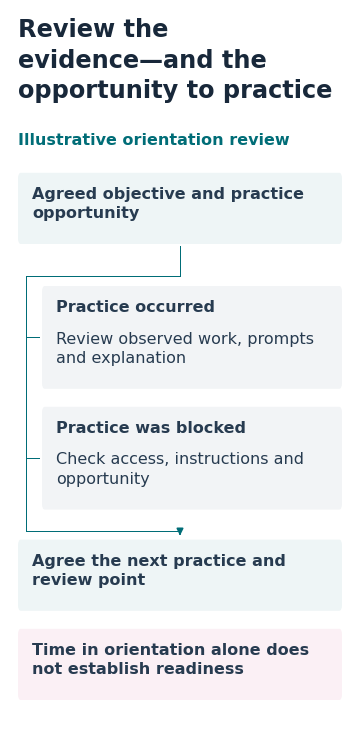
Use observed work and the conditions for practice to decide what the next learning opportunity should address.
For a fictional orientee learning a documentation system, a plan could include reviewing the local guide, watching an educator demonstrate a practice record, completing a supervised practice entry, and discussing omissions. A subsequent observed attempt would show whether the learner can find the required sections and explain their choices.
A filled-in version of that fictional plan could look like this:
| Plan element | Example entry |
|---|---|
| Objective | Find the required sections of a practice record and explain where each supplied item belongs. |
| Preparation and practice | Review the local guide, observe the educator, then complete a supervised entry in the training environment. |
| Evidence | The educator records omitted fields, prompting needed and the learner's explanation. |
| Review point | At the next agreed practice session, compare a new entry with the recorded feedback. |
| If the task cannot proceed | Record missing system access or conflicting instructions and assign someone to resolve them. |
This example is about organizing learning, not establishing a nationally required number of attempts. The employer's assessment process determines how proficiency is validated. An educator should also check whether access problems or inconsistent instructions are contributing to the difficulty.
Review and revise
At each review, record evidence, remaining questions, and the next step. If the expected clinical opportunity did not occur, identify another appropriate opportunity instead of recording lack of exposure as failure. If an objective was met, choose a new objective or test the skill under another relevant condition.
When a plan is associated with a formal performance process, clarify that status, the decision maker, and the applicable policy. Do not disguise a consequential evaluation as informal coaching. Equally, do not treat every request for additional learning as a disciplinary event.
The plan is complete when its agreed objectives have been evaluated and the responsible educator or supervisor has documented the outcome. Time spent in orientation and evidence of readiness should remain separate entries.
Related
Nursing Preceptorship · Competency Validation in Nursing.
Sources
- American Association of Critical-Care Nurses: Preceptor Course Syllabus (accessed 2026-09-17).