
Credential evaluation helps a U.S. nursing regulator assess education earned outside the United States. The first decision is which regulator will receive the report and exactly what that regulator requires.
A report ordered for university admission, a nursing-license application or immigration screening may answer different questions. Before paying, match the service name, recipient and purpose to the instructions for your application.
Start with the receiving board
Identify the state, license type and application route. Read the nursing board's instructions for internationally educated applicants and record its accepted evaluation or verification process.
NCSBN's licensure-guidance tool provides state-specific starting points, including credential evaluation and English-proficiency requirements. Use the board's current instructions to resolve a difference between a general guide and the application you are completing.
Do not choose a state solely because someone else found its application easier. Consider where you intend to practice and what a later endorsement application may require.
Distinguish evaluation from verification
TruMerit's CES Professional Report authenticates nursing credentials and provides a statement comparing the education with U.S. nursing standards. Its document process includes records sent directly by the relevant schools and issuing authorities.
New York illustrates why the precise service matters. NYSED describes two routes for foreign nursing-education verification: TruMerit's Credential Verification Service for New York State, or direct verification by the nursing school using the state's forms. NYSED reviews the submitted material and decides whether the education meets its licensing criteria.
That example should not be generalized to other states. It also does not mean an applicant should substitute a CES report for New York's named process.
Map every document to its sender
Create a checklist with the document, issuing organization, required recipient, submission method and date requested. Separate documents you may upload from those that must come directly from an institution.
Resolve name differences before sending records. Keep a record of former names and any requested supporting evidence so that a school transcript and license validation can be matched to the same applicant.
Check translation instructions carefully. TruMerit's CES process distinguishes between secondary-school documents and professional-education records; do not assume every document may use the same translation method.
Track acceptance, not just delivery
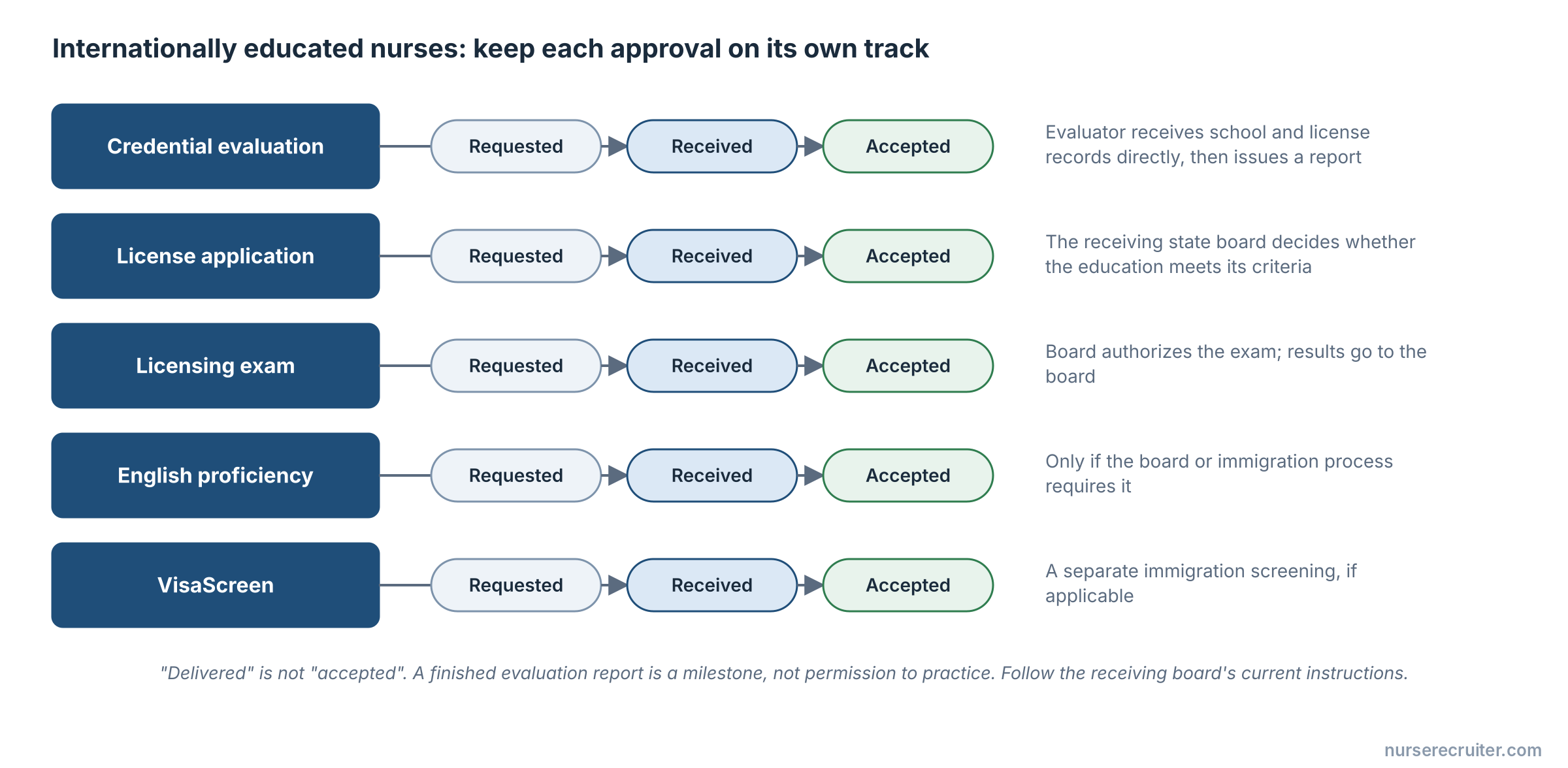
A courier receipt or portal upload confirms a submission step. It does not establish that the evaluator accepted the document or that the board found the education sufficient.
When additional information is requested, identify the exact issue: missing source verification, an incomplete transcript, translation, or a question about educational content. Send the request to the organization able to answer it.
If a deficiency is identified, obtain the receiving board's instructions before purchasing a course advertised as a solution.
Keep the remaining approvals visible
Maintain separate status lines for the evaluation report, license application, examination requirements and any VisaScreen process. Completion of the report is a milestone, not the final authorization to practice.
Sources
- TruMerit: CES Professional Report (accessed 2026-09-17).
- NYSED: RN Pathway 5 (accessed 2026-09-17).
- NCSBN: Nurse Licensure Guidance (accessed 2026-09-17).