
Contact hours and continuing education units (CEUs) measure different amounts of learning time. Read the unit on the completion certificate before transferring a number into a renewal application.
IACET defines one CEU as ten contact hours. Under that definition, 0.5 CEU represents five contact hours, and 1.2 CEUs represents twelve. A certificate awarding “1.2 contact hours” therefore describes a very different amount from one awarding “1.2 CEUs.”
Use the awarded credit
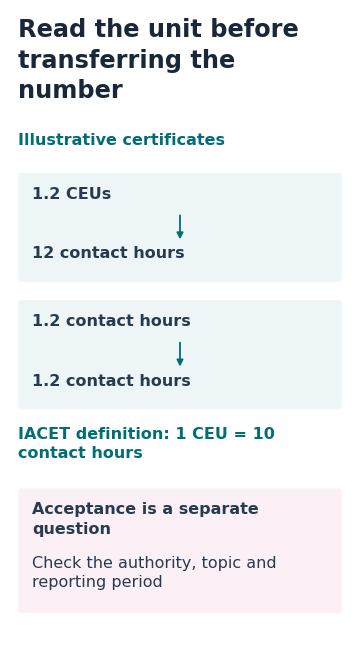
The conversion uses IACET’s CEU definition. It does not decide whether a course meets a particular license or certification requirement.
Start with the provider's completion record, including the type and amount of credit. Do not substitute the time you spent logged into a course for the amount formally awarded.
If the course advertisement says “CEUs” but the certificate says “contact hours,” ask the provider to clarify the award. Keep the reply with the certificate rather than silently applying a conversion that may not match the provider's terminology.
A useful learning record has separate fields for the original award and the amount claimed under a particular authority's rules. That preserves the evidence behind the calculation.
A conversion does not establish acceptance
Converting a number answers a measurement question. It does not establish whether the course is accepted for your license or certification, whether the topic fits a required category or whether it was completed in the correct period.
Review those questions before counting the credit. Accredited continuing nursing education explains how provider approval and renewal acceptance fit together.
Even academic credit is not converted identically by every recipient. California's RN continuing-education guidance converts one quarter unit to ten contact hours. ANCC's certification-renewal handbook converts one academic quarter credit to 12.5 contact hours. Use the rule of the authority receiving the renewal application, not a single conversion saved from a previous purpose.
Keep pharmacology inside the total
A pharmacology allocation may be a subset of an activity's total credit. It should not automatically be added on top.
ANCC's renewal handbook gives a specific example: an activity with ten total contact hours, five designated as pharmacotherapeutic hours, is entered in its application as five CE contact hours and five pharmacotherapeutic hours. The sum remains ten.
For your own tracking, a row can show “total: 10; pharmacology included: 5.” That makes the relationship visible and prevents a later reader from mistaking the entry for fifteen hours. Follow the receiving application's actual field instructions when submitting.
Check the final ledger
Before renewal, compare the total claimed with the original certificates. Look for misplaced decimals, repeated activities and subsets counted twice. Keep separate calculations when the same education is being evaluated under different licensing and certification rules.
ANCC's handbook equates a contact hour with sixty minutes for its renewal calculations. That does not authorize a learner to assign credit to any hour spent reading. The provider's award and the receiving authority's acceptance remain the basis for the claim.
Sources
- IACET: About the CEU (accessed 2026-09-17).
- ANCC: Certification Renewal Handbook (accessed 2026-09-17) — pages 7–8.
- California BRN: Continuing Education for License Renewal (accessed 2026-09-17).