
A concept map shows how ideas relate by naming the connection between them. In nursing education, it can help a student make the connections in a case or topic visible for discussion. A useful map does more than place terms in boxes: the connections explain a relationship that the student can defend.
In their report on concept mapping, Joseph Novak and Alberto Cañas describe concepts joined by linking words into meaningful statements. Their guidance emphasizes a focus question and connections across parts of the map. That structure distinguishes a concept map from a decorative list of facts.
Choose a question first
Start with a question narrow enough to answer. “What factors need consideration in this fictional discharge plan?” is more workable than “Everything about nursing.” List the main concepts, arrange them, and label the connections with phrases that explain what they mean.
For each connection, read the two concepts and the linking phrase as a sentence. If the sentence is vague or unsupported, revise it. “Is related to” may hide an uncertainty that “requires clarification of” makes visible. Not every association is a causal relationship.
An illustrative nursing map
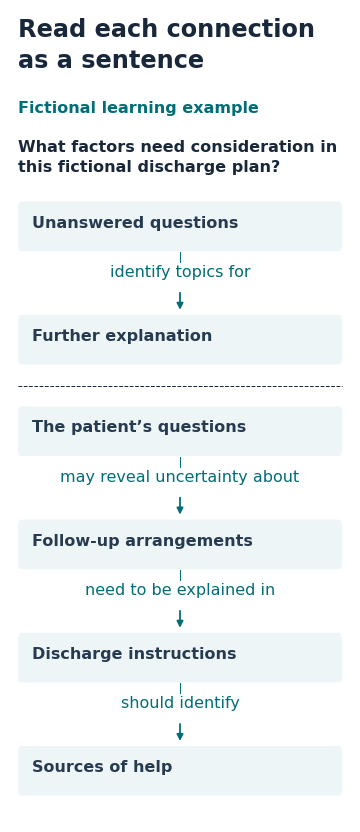
The connecting phrases state the relationships. A clear map still needs its claims checked against the case.
A fictional learning case might place “understanding the discharge plan” near the center. Branches could include the patient's questions, written instructions, follow-up arrangements, and sources of help. A connection might state that unanswered questions “identify topics for” further explanation.
A small part of the map could use these connections. Read each row from left to right as a sentence, then draw the concepts as boxes joined by the linking phrase.
| Concept | Linking phrase | Connected concept |
|---|---|---|
| Unanswered questions | identify topics for | Further explanation |
| Follow-up arrangements | need to be explained in | Discharge instructions |
| Discharge instructions | should identify | Sources of help |
| The patient's questions | may reveal uncertainty about | Follow-up arrangements |
The last row connects two branches instead of adding another isolated list item. Ask whether each relationship is supported by the fictional case or still needs clarification.
This example illustrates how to organize a discussion. It is not a clinical care plan for a real patient. If the map includes a claim about a disease, medication, or intervention, the student should check that claim against the course's appropriate clinical references. The map's visual clarity does not make its content correct.
Use the map to reveal gaps
An instructor can ask why a connection was made, what evidence supports it, and what information is missing. A student may discover that two facts were memorized separately without understanding the relationship. Another may find that a confident connection rests on an assumption that the case never supplied.
Revision is part of the exercise. Keep an earlier version if the goal is to show how understanding changed. A brief explanation of a revised connection can be more informative than adding many more boxes.
Avoid common problems
An overcrowded map may become difficult to read. Remove concepts that do not help answer the focus question, or divide the work into smaller maps. Color and layout can aid navigation, but they should not carry meaning that a reader cannot interpret.
For a graded assignment, ask whether the instructor is assessing factual accuracy, relationships, prioritization, explanation, or some combination. Do not assume that the most elaborate diagram earns the strongest assessment.
A concept map is a learning aid. It does not replace required documentation, a clinical reference, or discussion with a supervisor. Its strongest use is often as a starting point for explaining and testing the learner's reasoning.
Related
Clinical Judgment in Nursing · Teaching Evidence Appraisal to Nursing Students.
Sources
- Novak and Cañas, IHMC: Theory of Concept Maps (2008) (accessed 2026-09-17).